Category: show on event page

[blog] Techno-Galactic Software Observatory

Author: Lonneke van der Velden


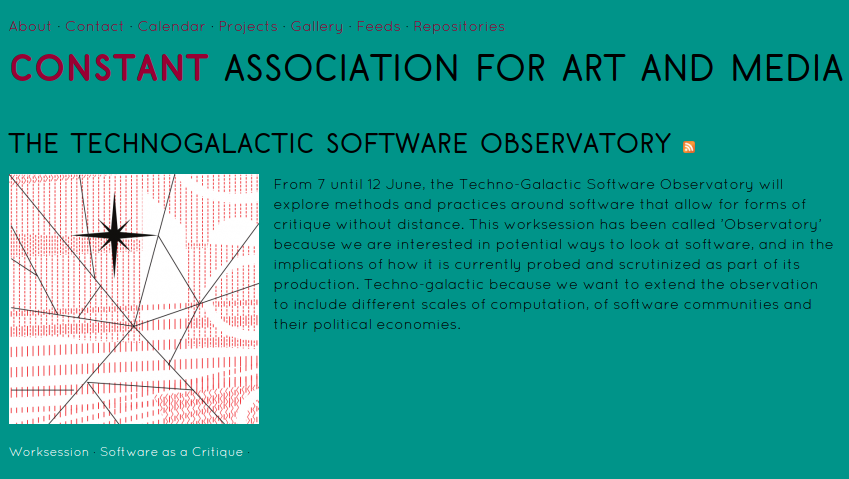
Early June Becky and I participated in the Techno-Galactic Software Observatory, an event organised by Constant, a feminist art and technology collective in Brussels. It was a great event, in which theoretical insights from the philosophy of technology and software studies were combined with practical interventions which ended in an exhibition.

The event aimed to critically interrogate all kinds of assumptions about software and software knowledge. We discussed how software relates to time, spatializations, perspectives, and the hierarchies implied in ways of looking. The last day of the event was a ‘walk-in clinic’ in which visitors could get ‘software-critique as service’ at several ‘stations’.

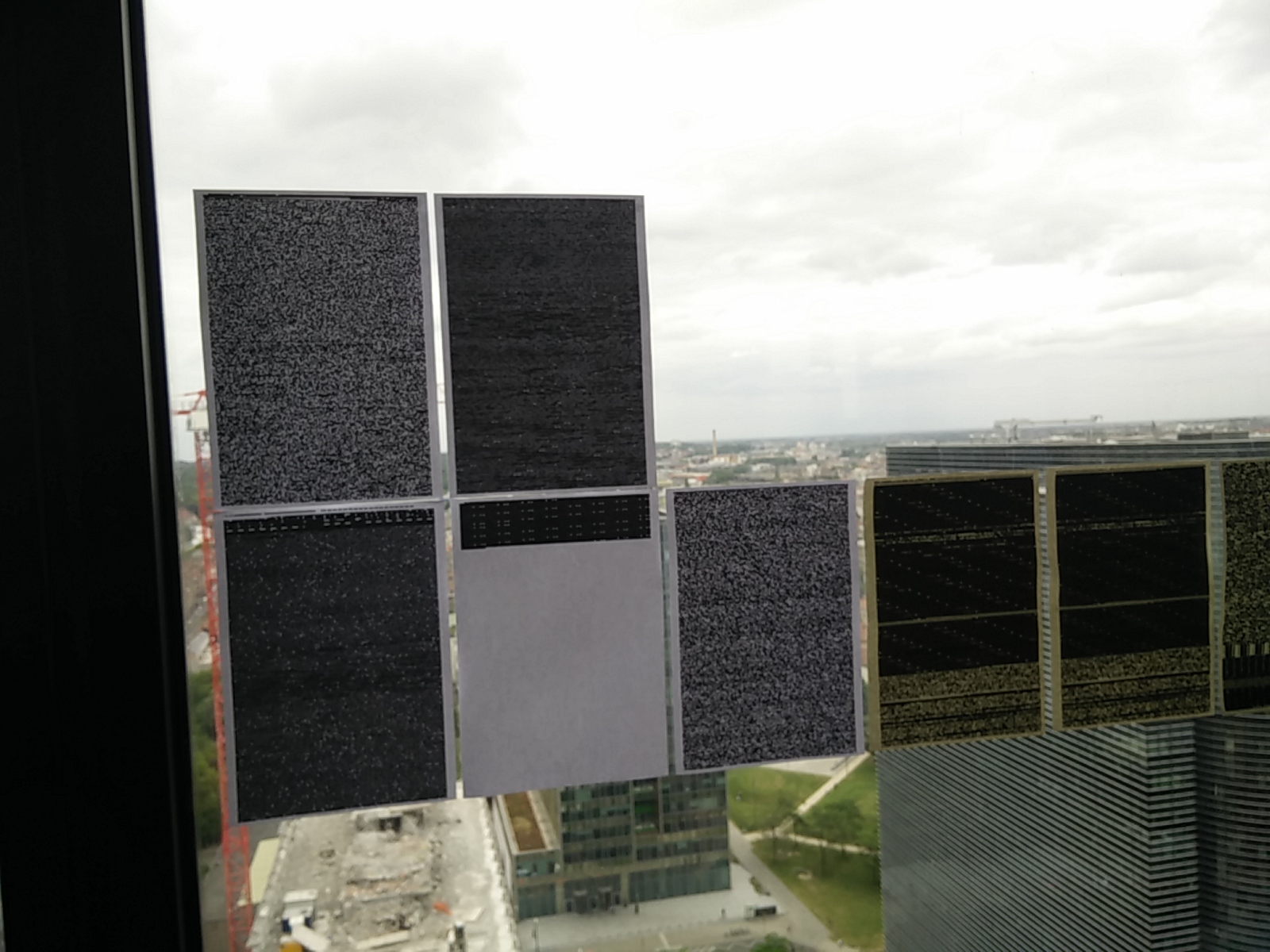
The project I participated in was file-therapy. Departing from the Unix-philosophy that everything consists of a file (a program is a file, an instruction is a file, etc.), our desk would take people’s problems, understand them in their property of a file. Next, we would transform these files into other file types: visual data or music files.

We would not offer solutions. The idea was that our visitors, by being confronted with their new visualised or sonified file, could start developing a new relationship to this file. For example, one person would have a problem with her PhD-file: it was a big Word-file full of references and therefore difficult to handle. Working in it becomes a hassle. But listening to the transformed file is rather meditative. The other station in the room would criticise the reductionist ´file-formatted’ vision of the world, and in that way, we set up a dialogue about how computers format our lives.


hoij

A comparison of the various problematic files

The observatory was a great event and a learning experience at the same time. Please read other people’s experiences too 🙂


About constant

Constant is a non-profit, artist-run organisation based in Brussels since 1997 and active in the fields of art, media and technology.
Constant develops, investigates and experiments. Constant departs from, feminisms, copyleft, Free/Libre + Open Source Software. Constant loves collective digital artistic practices. Constant organises transdisciplinary worksessions. Constant creates installations, publications and exchanges. Constant collaborates with artists, activists, programmers, academics, designers. Constant is active archives, poetic algorithms, body and software, books with an attitude, cqrrelations, counter cartographies, situated publishing, e-traces, extitutional networks, interstitial work, libre graphics, performative protocols, relearning, discursive infrastructures, hackable devices.

DATACTIVE lecture series: Bernardo Sorj

What? Bernando Sorj on digital activism in South America

When? 23 May at 11:00 hours

Where?  in Elab, BG1 room 0.16 (Turfdraagsterpad 9)

We will discuss the main conclusions of the book “Political Activism in the Era of Internet”, in which we analyse experiences from six South American countries, presenting a broad range of innovative experiences and their impacts on the ways in which civil society, political parties and governments are organized and act. The cases of cyberactivism analyzed indicate that none of them represents a “silver bullet” — an experience capable of resolving the multiple challenges faced in constructing higher quality, more robust democratic institutions. But they all indicate new possibilities and new challenges for the development of virtuous relations between the traditional forms of participation (both in civil society organizations and in political parties) and activism in the virtual space.

Bio

Bernardo Sorj was born in Montevideo, Uruguay. He is a naturalized Brazilian, living in Brazil since 1976. He studied anthropology, philosophy and history and received his Ph.D. in Sociology from the University of Manchester in England. Sorj is the director of the Edelstein Center for Social Research in Rio de Janeiro, and Plataforma Democrática project. He was professor of Sociology (ret.) at the University of Rio de Janeiro, visiting professor and chair at many European, d North American and Latin American universities. The author of 28 books and more than 100 articles on international relations, the social impact of new technologies and Latin America political development, he is member of the board of several academic journals, and consultant to NGOs, governments and international organizations.

DATACTIVE featured as success story at ERC 10th anniversary

We are very proud to share that DATACTIVE is featured in the ERC 10th anniversary celebrations as one of the success stories!

The European Research Council turns ten this year. The anniversary program ‘Beyond the first ten years‘, scheduled for March 21st in Brussels, highlights the key achievements and some among the successful ERC funded projects, while setting the stage for the coming years. During this event, Stefania Milan (DATACTIVE PI) will talk about ‘data politics at the grassroots’ in the section ‘ERC development’ stories. She will also participate in the evening talk show ‘Beyond the first 10 years’, discussing ideas for ameliorating ERC funding schemes. On March 20th she will participate in a dinner hosted by the ERC President to discuss with stakeholders how to ‘stimulate excellence’ and get more bottom-up research across the EU. You can find more about the celebration on the dedicated website. The program for March 21st will be live streamed.

The European Research Council (ERC) was set up by the EU in 2007 to fund excellent scientists and their most creative ideas. It supports cutting-edge research in all fields, and helps Europe keep and attract the best researchers of any nationality. Today, the ERC is a key component of Horizon 2020, the EU’s programme for Research and Innovation. Check out the ERC achievements!

DATACTIVE Annual PhD Colloquium

DATACTIVE will host its annual PhD Colloquium on March 22-23 at Oudemanhuispoort (OMHP) at the University of Amsterdam. Marlies Glasius (AISSR), Thomas Poell (ASCA) and Linnet Taylor (TILT) will serve as respondents, jointly with Promotors Richard Rogers (ASCA), Marieke de Goede (AISSR) and Cees Hamelink (ASCOR). Here goes the program for the days:

Wednesday 22 March, room OMHP E1.07

Chair: Davide Beraldo

09:00 – 09:15 Niels ten Oever “Contestation in the Global(ized) Village – Internet Governance, Civil Society and Institutional Innovation”

09:15 – 10:00 Feedback session with Prof. R. Rogers, Prof. M. Glasius, Dr. T. Poell

10:00 – 10:15 Coffee break

10:15 – 10:30 Kersti R. Wissenbach “Accounting for Power in a Datafied World: A Social Movement Approach to Civic Tech Activism”

10:30 – 11:15 Feedback session with Prof. R. Rogers, Prof. C. Hamelink, Dr. T. Poell


Thursday 23 March, room OMHP E0.13

Chair: Lonneke van der Velden

14:00 – 14:15 Becky Kazansky “Calculating & Countering Surveillance Risks: Translations in Practice”

14:15 – 15:00 Feedback session with Prof. M. de Goede, Dr. L. Taylor, Prof. R. Rogers

15:00 – 15:15 Coffee break

15:15 – 15:30 Guillen Torres “Everyday Forms of Institutional Resistance to Civic Engagement through Data”

15:30 – 16:15 Feedback session with Dr. L. Taylor, Prof. R. Rogers

DATACTIVE lecture series: Elizabeth Losh


We are happy to announce that Elizabeth Losh will present on gender and technology in the discourse surrounding Hillary Clinton’s email scandal as part of DATACTIVE Speaker’s Series and in collaboration with the DMI’s data sprint. Please find the outline and bio below.

Date: 8 March, 15.30 – 17.00 in OMHP C0.17


I Did Not Have Text with that Server: 
Gender, Technology, and Digital Literacy in the 2016 U.S. Presidential Campaign

This presentation argues that the rhetoric surrounding failed U.S. presidential candidate Hillary Clinton’s 2016 email scandals can be understood as a consequence of a particular confluence of gender and technology in which excessive digital privacy is represented as a feminized user choice and calls for digital transparency are presented in terms of masculinist norms. Using techniques from discourse analysis and the theoretical framework of feminist technology studies, Losh analyzes materials in the @realDonaldTrump Twitter archive, the Fox News website, the WikiLeaks database that indexes hacked emails from Hillary Clinton and John Pedestal, and FBI documents from the agency’s website. Additionally, it references visual culture depicting Clinton as a user of personal mobile devices in public places, where she is shown as a secretive technology user claiming privacy in the public sphere, and popular Internet memes that associated her email conduct with sexual impropriety and dishonesty about a lack of digital purity. This talk explores how a political official’s relationships to non-human servers, peripherals, and portable devices could be perceived of as potentially threatening to the sexual order and by extension threatening to political sovereignty.

Bio:
Elizabeth Losh is an Associate Professor of English and American Studies at William and Mary with a specialization in New Media Ecologies. Before coming to William and Mary, she directed the Culture, Art, and Technology Program at the University of California, San Diego. She is a core member and former co-facilitator of the feminist technology collective FemTechNet, which offers a Distributed Open Collaborative Course and part of the international organizing team of The Selfie Course.

She is the is the author of Virtualpolitik: An Electronic History of Government Media-Making in a Time of War, Scandal, Disaster, Miscommunication, and Mistakes (MIT Press, 2009) and The War on Learning: Gaining Ground in the Digital University (MIT Press, 2014). She is the co-author of the comic book textbook Understanding Rhetoric: A Graphic Guide to Writing (Bedford/St. Martin’s, 2013) with Jonathan Alexander.

Report: Contentious Data and the Politics of Big Data for Activism

We are very happy to announce that the report from our September ‘Contentious Data’ workshop is ready for publication and circulation. The report is included below or can be downloaded here. Text continues below the report.

With special thanks all speakers, including Sandra Braman (Texas A&M University), Alison Powell (London School of Economics), Hisham al-Miraat (Digital Rights Morocco), Linnet Taylor (Tilburg Institute for Law, Technology and Society), Dorien Zandbergen (University of Amsterdam), Jaromil/Denis Rojo (dyne.org), Geert Lovink (Institute for Network Cultures), and Stefania Milan (DATACTIVE Principle Investigator).


DATACTIVE_report_Contentious_Data


Contentious Data brings together scholars and practitioners to explore the politics of big data from the perspective of activism and civil society.

Contentious Data is sponsored by the European Research Council (ERC), the Amsterdam Centre for Globalisation Studies (ACGS), the Amsterdam School of Cultural Analysis (ASCA), and the Amsterdam Institute for Social Science Research (AISSR).


Contentious Data: A One-day event on the Politics of Big Data for Activism

Coming up on September 15, 2016!

CScreen Shot 2016-08-04 at 19.02.46ontentious Data is the kick-off  event of the DATACTIVE project.

How do people resist corporate privacy intrusion and government surveillance by means of technical fixes? How does civil society take advantage of the possibilities for civic engagement, advocacy, and campaigning provided by the availability of the so-called ‘big data’?

We are an interdisciplinary research project hosted at  the Department of Media Studies at the University of Amsterdam. DATACTIVE  investigates citizens’ engagement with massive data collection. It originates  from the observation that, with the diffusion of big data, citizens become increasingly aware of the critical role of information in modern societies. This awareness nurtures new social practices rooted on data and technology, which we term ‘data activism’. By increasingly involving ordinary users, data activism is a signal of a change in perspective and attitude towards massive data collection emerging within the civil society realm.

Contentious Data will bring together scholars and practitioners to explore the politics of big data from the perspective of activism and civil society.

Speakers include Sandra Braman (Texas A&M University), Alison Powell (London School of Economics), Hisham al-Miraat (Digital Rights Morocco), Linnet Taylor (Tilburg Institute for Law, Technology and Society), Dorien Zandbergen (University of Amsterdam), Jaromil/Denis Rojo (dyne.org), Geert Lovink (Institute for Network Cultures), and Stefania Milan (DATACTIVE Principle Investigator).

Contentious Data is sponsored by the European Research Council (ERC), the Amsterdam Centre for Globalisation Studies (ACGS), the Amsterdam School of Cultural Analysis (ASCA), and the Amsterdam Institute for Social Science Research (AISSR).

ERCacgs-logo Drukwerk     asca-logo-hippo-m


Learn more about our speakers and the final programme here:

Brochure-DATACTIVE-EVENT-for-speakers-final

Registration

The workshop is public and free of charge, but seating is limited so please register in advance by filling this form:

[rsvp]

DATACTIVE at the Digital Methods Summer School

The DATACTIVE team will organise the second week of annual Digital Methods Summer School at the University of Amsterdam from July 4 – 8, 2016. We will lead three projects on digital methods for mailing lists, mapping the civil tech landscape and the evolution of digital security tools. The results of our work will be shared on this blog in the following week.

Data Activism

The theme of this year’s Digital Methods Summer School is “Only Connect? A Critical Appraisal of Connecting Practices in the Age of Social Media”. The second week will be entirely dedicated to data activism.

With the diffusion of big data, citizens become increasingly aware of the critical role of information in modern societies. Today’s world is awash with data. Never before have we created such a quantity of data by and about people, things, and their interactions. While this data has captured the imagination of governments and corporations alike, people are also increasingly responding to this new technological landscape.

From open data initiatives to privacy enhancing technologies, a growing number of people are developing new tools and practices in response to massive data collection and availability. People take advantage of the possibilities of data for civic engagement, advocacy, and campaigning (pro-active data activism). At the same time, people resist its harms through the development and use of encryption and free and open source alternatives to centralised software and online services (re-active data activism). Data activism is a signal of a more general change in perspectives and attitudes towards massive data collection. For more see data-activism.net.

Experiments with methods

Data activism emerges at the intersection of the social and technological dimensions of human action. This raises the question: how are we to understand and study this phenomenon? We think that it is important to experiment with methods. We want to investigate how people make use of data and interact with the socio-technical infrastructures that enable their circulation. This is especially relevant, since these are often complex, proprietary and opaque. For this purpose, we want to test and refine research approaches that enable the study of technological practices and infrastructures. This can involve configurations of digital methods and ethnographically informed traditions bridging media studies, science and technology studies (STS), informatics, and anthropology.

  • Can we develop an approach to ‘software ethnography’, which traces and explores assemblages of data, infrastructures, technology designers and technology users?
  • How can we learn how (big) data infrastructures actually function and are used in practice?
  • Technology is always changing. How can we trace changes to the socio-technical infrastructures of tools over time?
  • How can new software tools help us understand the workings of different kinds of data infrastructures? Can we develop tools to reverse-engineer algorithms, analytic techniques, or surveillance infrastructures?

Our projects

Mapping the Civic Tech landscape using digital methods

Civic Technology has become a popular term over the past years. Whilst there is no clear definition of the term, the wider civic tech scene spans from business-oriented tech start-ups towards (digital) social and political activist groups. However, attention is often disproportionately directed towards creation of tools and technologies at the expense of the development of other capacities needed to pull them to work in the service of social and democratic goals.

In this project we will apply various digital methods in order to explore the fabrics of civic tech in the digital.

Evolution of digital security tools – sociotechnical infrastructures of security tools

For this project we will trace changes in the chat application ecosystem try to understand the evolution of their design. Encrypted chat applications such as whatsapp, signal, telegram, and others have garnered a lot of attention in the last couple of years, with increasing public awareness and confusion over their relative merits.

Signal, a tool developed within the free libre open source software community, has recently begun contributing to the infrastructure of closed, commercial tools such as whatsapp and now Google Ello, leading to pushback in the community. As Signal has become a product, its lead developer has written that he sees less importance in federating its infrastructure with other free and libre open source tools, breaking both a formal and informal code among free libre open source developers. As researchers interested in tracing the evolution of sociotechnical infrastructures,  we argue that the evolving ecosystem of chat tools offers a great opportunity to develop DATACTIVE’s ‘infrastructure ethnography’ both in method and object of study. 
Discussions about encrypted chat apps generally focus on issues of usability and design. Instead, the extent to which encrypted chat apps are sustainable is just as, and maybe even more, important. This research project focuses on how infrastuctures are shared and maintained and thereby aims to trigger discussion about the sustainability of applications for encryption.

Digital methods for mailing lists

The Big Bang tool can be used to study collaborations in mailing lists and on github. We want to use this tool to study the composition and development of the ICANN community. Are there different socio-technical imaginaries, across different ‘generations’ of users? Which words or phrases are used at what time? To what extent have conversations about rights spread from civil society discourse to the more general ICANN (industry-related) discourse?

DATACTIVE lecture series: Hossein Derakhshan

 We are pleased to announce that Hossein Derakhshan is going to join us for a guest lecture on March 4.

The Web We Have To Save

The Web, as envisaged by its inventors, is founded on the idea of Hyperlink. Derived from the notion of hypertext in literary theory, hyperlink is a relation rather than an object. It is a system of connections that connects distant pieces of text, resulting in a non-linear, open, active, and diverse space we call the world wide web.

But in the past few years, and with the rise of closed social networks, the hyperlink and thereby the web are in serious decline. Most social networks have created a closed, linear, sequential, passive, and homogenous space where users are encouraged to stay in all the time — a space that is more like television.

The web was imagined as an intellectual project that promoted knowledge, debate, and tolerance; as something I call books-internet. Now it has become more about entertainment and commerce; I call this tv-internet. (This is extensively articulated in ‘The Web We Have to Save‘ published in July 2015 by Matter magazine.)

Hossein Derakhshan

Hossein Derakhshan is a Canadian-Iranian author, journalist, and analyst. A pioneer of blogging in Iran, he spent six years in prison in Iran from 2008. He is the author of The Web We Have to Save (Matter, July 2015) and the creator of Link-age, an art project to promote an open and diverse internet. He shares his thoughts on Iran, media, and technology on Twitter (@h0d3r) and at hoder.ir.

March 4 @ 11:00 am – 12:00 pm |Elab, room 0.16 | Turfdraagsterpad 9, 1012 XT Amsterdam

DATACTIVE lecture series: Dr. Elena Pavan

We were very happy to host Dr. Elena Pavan (University of Trento/Scuola Normale Superiore) for a special lecture on social network analysis in January. The lecture inaugurated the DATACTIVE Methods Workshop, which will run from February to May 2016. Elena gave an introduction to network analysis.Find more about Elena following this link.

Below you will find the slides to her talk.

SNA_DMI3