Category: show on event page

DATACTIVE brunch with Noortje Marres

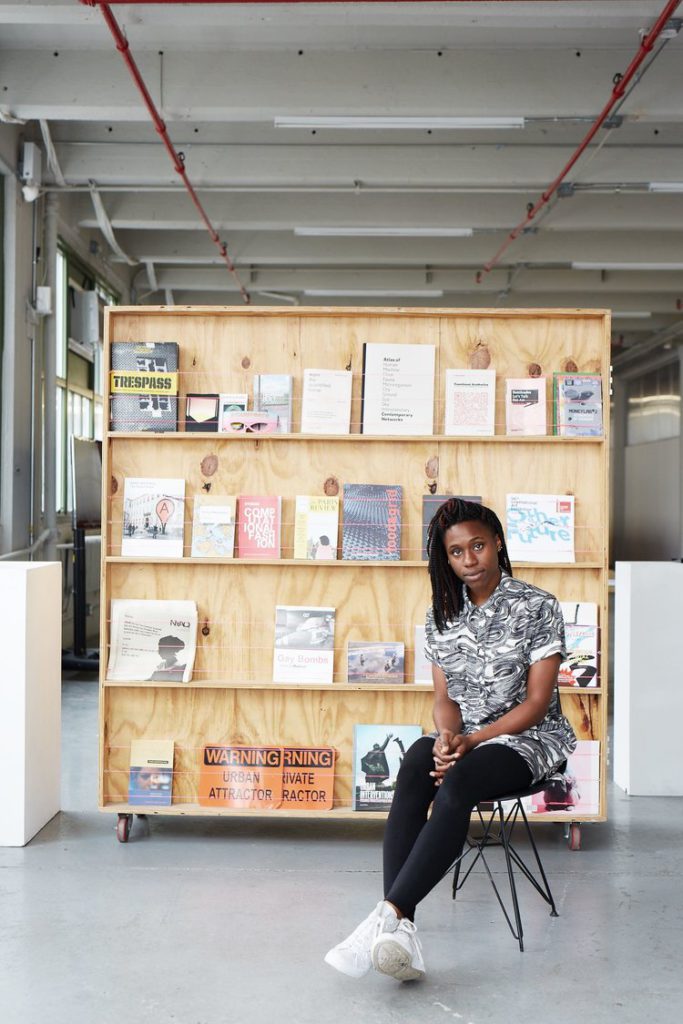
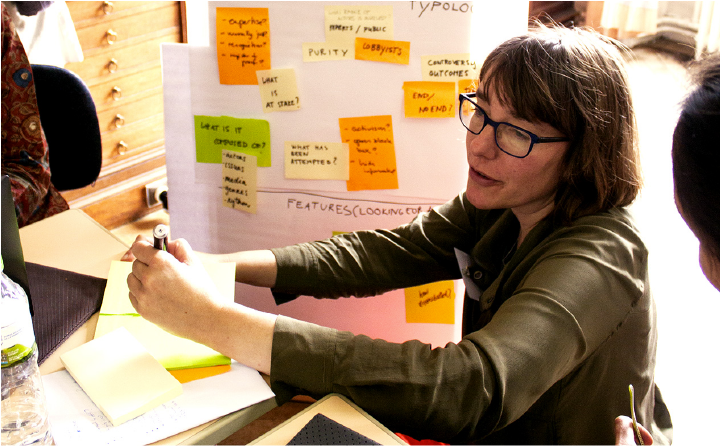
We had the luxury of Noortje Marres (Associate Professor at the Centre for Interdisciplinary Methodologies, Warwick University) joining us for a late breakfast on Friday, February 9th. Over croissants, we touched upon various topics including data politics, and interdisciplinary research: breaking barriers and other intersectionalities. 


Noortje Marres is part of the DATACTIVE advisory board, find her bio below:

My work contributes to the interdisciplinary field of Science, Technology and Society (STS) and investigates issues at the intersection of innovation, everyday environments and public politics: participation in technological societies; the role of mundane objects and devices in engagement; living experiments; the changing relations between social life and social science in a digital age. I also work on research methodology, in particular, issue mapping, and am interested in developing creative forms of inquiry between the social sciences, technology and the arts.
Available now: Report on Data for the Social Good

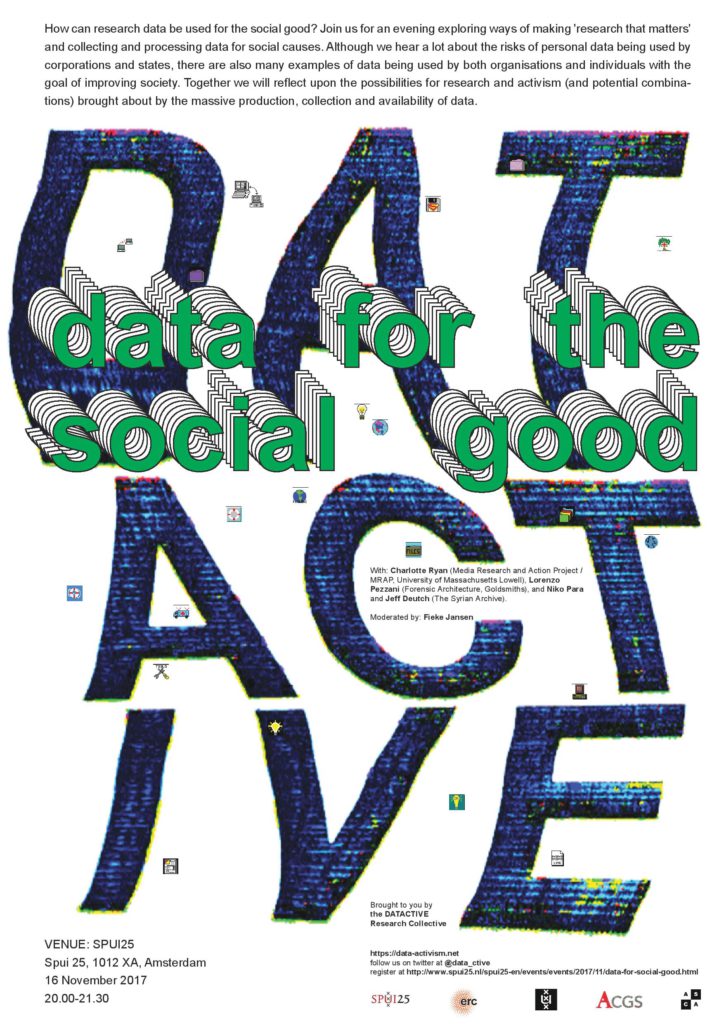
We are happy to share with you the report of our two-day Data for the Social Good event the 16th and 17th of November. The report includes both the first public evening organised at Spui25 *, and our invitation-only second day of lectures in the morning and workshops in the afternoon. To all participants, thank you for joining us for this great event and thanks to Spui25 for hosting us!

Please find the report included below, and do feel free to help share / disseminate our collective findings.

A PDF version can be downloaded here.

Also, we would give our thanks to all the speakers, Charlotte Ryan (Associate Professor of Sociology at the University of Massachusetts), Lorenzo Pezzani (architect and researcher, and lecturer at the Goldsmith University of London), Jeff Deutch (Syrian Archive, PhD candidate at the Humboldt-University in Berlin), Niko Para (Syrian Archive, lead technologist), and moderator Fieke Jansen (independent researcher).

* Click here to watch the public event @Spui25


DATACTIVE_DataSocialGood2017_Report


Data for the Social Good brings together scholars and practitioners to explore the politics of big data from the perspective of activism and civil society.

Data for the Social Good is sponsored by the European Research Council (ERC), the Amsterdam Centre for Globalisation Studies (ACGS) and the Amsterdam School of Cultural Analysis (ASCA).

 

ERC

acgs-logo

asca-logo-hippo-m

b_1_q_0_p_0 (2)

Stefania keynotes at workshop on slow computing, Maynooth, Ireland, 14 December

Stefania will take part in ‘Slow computing: A workshop on resistance in the algorithmic age’, organised by Rob Kitchin and Alistair Fraser and hosted by the  Programmable City project, the Social Sciences Institute and the Department of Geography of Maynooth University, Ireland. “In line with the parallel concepts of slow food (e.g. Miele & Murdoch 2002) or slow scholarship (Mountz et al 2015), ‘slow computing’ (Fraser 2017) is a provocation to resist”, reads the call for papers. Check out the program and the line-up. Stefania’s presentation is titled “Resist, subvert, accelerate. Towards an ethics of engagement in the age of the computational theocracy”.

Conheça o trabalho de Stefania Milan @Latin American Network of Surveillance, Technology and Society Studies (PT)

Ativismo em tempos de Big Data: conheça o trabalho de Stefania Milan, conferencista do Simpósio Lavits 2017

Find the original article (in portuguese) here

Stefania Milan publicou recentemente “Big Data (a partir) do Sul: O começo de uma conversa necessária”, em parceria com Emiliano Treré, como uma convite para fomentar o debate sobre Big Data por meio de estudos coletivos sobre o papel e o impacto que ele tem no Sul Global. O documento resume as discussões e aponta para possíveis desdobramentos do evento ‘Big Data from the South: From media to mediations, from datafication to data activism’, uma conferência realizada em Cartagena (Colômbia) com foco no questionamento da mitologia e do universalismo da ideia de “datificação” com base em uma epistemologia a partir do Sul.

Em trabalhos recentes, a pesquisadora do DATACTIVE Project e professora Novas Mídias e Culturas Digitais na Universidade de Amsterdam, afiliada também com a Universidade de Oslo, formulou o conceito de data ativismo e empregou-o em um estudo de caso sobre o InfoAmazônia, que fornece análises e notícias sobre as mudanças ambientais na maior floresta tropical do planeta.

O data ativismo tem como característica marcante “a forma pela qual trata o Big Data tanto como meio quanto como fim de sua luta”[1]. Nesse sentido, Milan identifica o data ativismo como uma nova fronteira do mídia-ativismo, na medida em que “se apropria da inovação tecnológica para propósitos políticos.”[2]

A partir dessa definição, a autora escreveu um texto[3], em coautoria com Miren Gutierrez, no qual elas dividem o data ativismo em duas frentes: a proativa e a reativa. Enquanto a primeira é composta por cidadãos que se valem das possibilidades do Big Data para embasar propostas políticas e mudança social, a segunda diz respeito a esforços de proteção e resistência contra a coleta massiva de dados e intervenção política. A InfoAmazônia, enquanto rede de jornalistas e organizações que oferecem atualizações sobre a situação e ameaças ambientais, é classificada pelas pesquisadoras como um exemplo de data ativismo proativo.

“A InfoAmazônia e a emergência de organizações similares anunciam a chegada de formas sem precedentes de considerar e explorar a infraestrutura de dados tendo em vista a mudança social. Apenas o futuro dirá se isso é de fato uma nova, promissora e sustentável base para o ativismo latino-americano conectar atuação política com dados e tecnologia.”

Esse trabalho é apontado por Milan e Treré no texto sobre o evento em Cartagena como “uma das muitas possíveis formas de se ‘virar de cabeça para baixo’ o que sabemos sobre datificação”. Tanto a contraposição à processos que dilaceram a opressão e as assimetrias quanto práticas para a mudança social são apontadas como possibilidades para “concretizar a transição da datificação ao ativismo de dados”.

5º Simpósio Internacional Lavits: “Vigilância, Democracia e Privacidade na América Latina: vulnerabilidades e resistências”
Conferência de abertura: Stefania Milan

29 de novembro, às 10h
Faculdade de Ciências Campus JGM UdeChile – Auditório Maria Ghilardi. (Las Palmeras 3425 Ñuñoa, Santiago).
Gratuito e aberto

Foto: networkcultures/flickr licenciado sob Creative Commons – Atribuição 2.0 Internacional (CC BY-NC-SA 2.0)

[1] Milan, Stefania, Data Activism as the New Frontier of Media Activism. Em “Media Activism in the Digital Age”, Escrito em 2016 e editado por Goubin Yang e Viktor Pickard, Routledge (2017). Disponível em SSRN: https://ssrn.com/abstract=2882030

[2] Idem.

[3] Gutierrez, Miren and Milan, Stefania, Technopolitics in the Age of Big Data: The Rise of Proactive Data Activism in Latin America. 2017. A ser publicado em breve sob o título ‘Networks, Movements & Technopolitics in Latin America: Critical Analysis and Current Challenges’, editado por F. Sierra Caballero e Tommaso Gravante. Disponível em SSRN: https://ssrn.com/abstract=2935141

Connecting to the Masses – 100 Years from the Russian Revolution @IIHS with Stefania & Lonneke

Internetional Institute for Social History in Amsterdam

Mon, Nov 13, 2017, 9:00 AM –
Tue, Nov 14, 2017, 6:00 PM

Together with Athina Karatzogianni and Andrey Rezaev, Stefania Milan organises ‘Connecting to the Masses – 100 Years from the Russion Revolution: From Agitprop to the Attention Economy’. The two-day event will be helt November 13th to the 14th at the International Institute for Social History and the University of Amsterdam. Lonneke van der Velden will be present ‘Daguerrotypes of protest: the Paris Commune’s media activism and present-day ‘social media revolutions’ on Day two. For more information about the schedule and tickets, check the eventbrite page.

About the two-day event

The relationship between governments and the people they govern has been always hostage to rhetoric, propaganda, and strategic public relations, as well as aggressive marketing and the influence of contemporary media industries, altering the dynamics of healthy political communications. Often, this relationship has thrived on charismatic leaders, the “avant-garde”, who could feel the pulse of their population’s grievances, demands and hopes for the future. Whether the Russian revolution of 1917 is interpreted as a product of class struggle, as an event governed by historic laws predetermined by the alienation of the masses by monopoly industrial capitalism, or as a violent coup by a proto-totalitarian Bolshevik party, the Russian revolutionaries understood and connected to the masses in a way that the autocracy, bourgeois elites and reformists alike failed to do.

In the midst of rage, desperation and harsh everyday life conditions, due to the pressure and failures of WW1 against Germany, food shortages, growing poverty, inequality and alienation, the Bolsheviks felt the undercurrents in the seas of history and spoke to the people, exactly when the relationship between the Tsar and the population, and between the Provisional government and the Soviets were at a crucial tipping point. The Bolsheviks grasped the opportunity to change the world for themselves in the here and now, rather than waiting to reform in the future for their children. They did so violently and unapologetically with the effects of their move running through the Cold War and the confrontation with the West, all the way to the complex and intense relations between Russia and the United States, in terms of failed engagements of the past 25 years since the fall of the USSR, the first socialist state in the world.

About the organisers

The conference is organised through a collaboration between Athina Karatzogianni from the School of Media, Communication and Sociology of the University of Leicester; Stefania Milan from the DATACTIVE research group at the Media Studies department of the University of Amsterdam; Andrey Rezaev from the Department of Sociology at St. Petersburg State University; the International Institute of Social History, Amsterdam; and the State Museum of Contemporary Art, Thessaloniki.


logo (1)asca-logo-hippo-m uol logo logo-en


Stefania at the Conférence Erasme-Descartes 2017 “Big Data: toepassingen en uitdagingen”, November 10

Stefania will speak at the Conférence Erasme-Descartes 2017 dedicated to “Big Data/Mégadonnées : usages et enjeux”/“Big Data: toepassingen en uitdagingen”, in Amsterdam on November 10. She will join Eric Leandri (Qwant), Mélanie Peters (Rathenau Institut) and André Vitalis (Centre d’Études sur la Citoyenneté, l’Informatisation et les Libertés) on a roundtable discussing “Big Data, kans of bedreiging voor de maatschappij?”.

The description of the event (in Dutch) is below.

Sinds 2002 dragen de Erasmus-Descartes conferenties bij aan de dialoog en uitwisseling tussen Nederland en Frankrijk. Ze bevorderen de bilaterale samenwerking op nieuwe gebieden.

Met de keuze voor “Big Data” als thema van de 15e Erasmus-Descartes conferentie bouwen we voort op alle onderwerpen die in eerdere edities aan bod zijn gekomen. “Big Data” raakt namelijk aan een groot aantal wetenschappelijke, technologische, economische, industriële, sociale en maatschappelijke kwesties. Ze roepen complexe vragen op, in het bijzonder voor wat betreft het behoud, de relevantie en het gebruik van gegevens. Alle sectoren zijn ermee gemoeid: de deeleconomie, de levenswetenschappen, het infrastructuuronderhoud, de energietransitie enbijvoorbeeld intelligente voertuigen. Veel Franse en Nederlandse industriële spelers hebben dus te maken met “Big Data”.

DATACTIVE presents… ‘Data for the Social Good’ (Amsterdam, 16-17 Nov)

As every aspect of our daily lives becomes susceptible of turning into data being collected, analyzed and repurposed, the question arises what kind of consequences this process will bring for society. The goal of this event is to reflect upon how activism, data, and research may be mobilized for social good. The speakers (see below) are experts developing projects related to topics such as human rights, environmental justice, and international law, from an approach located at the crossroads of academia and civil society.

The event is in two parts: an evening session on November 16 open to the public and organized in collaboration with SPUI25 and a day-long session on November 17 with restricted participation, and a combination of talks (in the morning) and moderated sessions in the afternoon.


Please find the report on this event here.


DAY 1: Data for the Social Good (SOLD OUT)

16 November 2017, 8pm-9.30pm, @ SPUI25, Spui 25, 1012 XA, Amsterdam
This event is fully booked, but tickets might become available just before the start. Also, a live-stream will be set up by Spui25 here at 8pm.

Join us for an evening about ‘research that matters’, exploring ways of collecting and processing data for social causes. Just as socioeconomic data about us are used by institutions to decide upon the allocation of budgets for public health, housing or urban planning, and behavioural data helps businesses to determine their location or set their prices, digital data are also mobilised by activists to legitimize their struggles against poverty, racism or injustice. Recently, as every aspect of our daily lives has turned into data susceptible of being quantified, processed and repurposed, it is not only the metrics created about us that are used as input for all kinds of decision-making, but those generated by us through the daily use of different types of technologies.

Although we hear a lot about the risks of (personal) data being used by corporations and states, there are also many examples of usage by organisations or individuals with the goal of improving society. From crowd-sourced maps about the ‘femicide’ epistemic in Latin America to the analysis of videos and photos to reconstruct drone attacks, data produced by people is mobilised for social good. The goal of this event is to reflect upon the possibilities for research and activism (and potential combinations) brought about by the massive production, collection and availability of data.

With the help of Charlotte Ryan (Media Research and Action Project/ MRAP, University of Massachusetts Lowell), Lorenzo Pezzani (Forensic Architecture, Goldsmiths), and Jeff Deutch and Niko Para (The Syrian Archive), the event will focus on discussing different dimensions of activist research. Fieke Jansen will be moderating the evening.


DAY 2: Data for the Social Good: A Focused Encounter

17 November 2017 9am-4pm, @E-Lab, Turfdraagsterpad 9 (room 0.16*), 1012 XT Amsterdam
* turn right after the entrance, room 0.16 is located at the end.

Should you want to participate, please drop an email to jeroen@data-activism.net. Seating is limited but we particularly welcome scholars interested in exploring the relationship between academia, action and policy.

DATACTIVE: Focused Encounter will be an exploration into ‘data activist research’ through a one-day workshop. The event will be the first in a series of seminars organized by DATACTIVE as an attempt to bridge theory and praxis, as well as to establish a network of activist-researchers and researching-activists working on themes of mutual interest around the politics of datafication.

DATACTIVE explores the responses to datafication and massive data collection, as they are implemented by citizens and organized civil society. As part of this program, we have adopted an ‘engaged’ approach to research by virtue of which we produce scientifically sound knowledge, while simultaneously paying attention to the impact this process might have on people and communities (see Milan, 2010). Furthermore, since we want to contribute to empower activists and citizens to think critically about datafication, empowerment and surveillance, we are currently exploring experimental research methods capable of bringing together activist communities and academia to develop joint research questions and/or projects. In this sense, on a more practical level, the goal of this first Focused Encounter is to start charting out a ‘data activist’ research agenda that takes into account this community building, mutual learning and knowledge-sharing mission. On a theoretical level the goal of the Focused Encounter is to discuss different aspects of inclusion and democracy, evidence and knowledge production, and the promises and perils of data activism and datafication more in general.

The event will consist of a morning program (9:15 – 12:30) featuring three speakers who will showcase ways of doing engaged research as well as the related challenges, followed by a moderated discussion. After lunch there is room for discussion and knowledge exchange in small moderated groups, for those who are interested (highly recommended), followed by about an hour of focused discussion and brainstorming. We will work together until approximately 16:00 and then have drinks.


Schedule

Morning:
9:15 -9:30 Welcome by Stefania Milan.
9:30 -10:00 Charlotte Ryan. “Building sustained research collaborations.”
10:00 – 10:30 Lorenzo Pezzani (Forensic Architecture). “Forensic Oceanography: Documenting the violence of the EU’s Maritime Frontier.”
10:30 – 10:45 COFFEE BREAK
10:45 – 11:15 Jeff Deutch and Niko Para (Syrian Archive). “Archiving for accountability: Collaboratively preserving, verifying and investigating open-source documentation of rights abuses in Syria.”
11:15 – 12:30 Discussion on ‘Data activist research’, moderated by Lonneke van der Velden.

Afternoon:
The afternoon session will provide space to reflect and look forward. What is needed, for us as a data-activist community, is to accelerate and expand our engaged and action-oriented research practices? Based on the diverse expert insights we gained during the morning session we will collectively start crafting an engaged research agenda for data activist research.

13:30 -14:00 Collective brainstorm. Moderator: Kersti Wissenbach.
14:00 – 16:00 Break- out sessions
15:30 – 16:00 Reporting back.
16:00 Closure

After 16:00 Drinks @Cafe de Jaren (Nieuwe Doelenstraat 20 – 22, 1012 CP / Amsterdam)


About the speakers

The speakers are invited to present their research projects, experiences and results, and to discuss with DATACTIVE members and attendees questions relating to research ethics, engaged research as well as data activism, its problems and outcomes.

Charlotte Ryan is an Associate Professor of Sociology at the University of Massachusetts, Lowell, and the co-founder (with Bill Gamson) of the Movement/Media Research and Action Project (a research group that aims to strengthen progressive social movements working toward social justice and inclusive and participatory democracy). Ryan worked also as an organizer in labor, community, health and anti-intervention movements, and has extensive experience with collaborative work between academia and activism. She is also a member of the DATACTIVE Ethics Board.

Lorenzo Pezzani is an architect and researcher. He is currently Lecturer at Goldsmiths, University of London, where he leads the MA studio in Forensic Architecture. His work deals with the spatial politics and visual cultures of migration, with a particular focus on the geography of the ocean. Since 2011, he has been working on Forensic Oceanography, a collaborative project that critically investigate the militarized border regime in the Mediterranean Sea, and has co-founded the WatchTheMed platform. Together with a wide network of NGOs, scientists, journalists, and activist groups, he has produced maps, videos and human right reports that attempt to document and challenge the ongoing death of migrants at sea.

Jeff Deutch & Niko Para are members of The Syrian Archive, a Syrian-led collective of human rights activists dedicated to preserving open-source visual documentation relating to human rights violations committed by all sides during the Syrian conflict. Through collecting, curating, verifying and investigating digital content, the Syrian Archive aims to preserve data as a digital memory, to establish a verified database of human rights violations for reporting and advocacy purposes, and to act as an evidence tool for legally implementing justice and accountability efforts as concept and practice in Syria. Jeff Deutch is a fellow at the Centre for Internet and Human Rights and a PhD candidate at the Humboldt-University in Berlin. He has developed workflows and methodologies for open-source investigations of human rights violations. Niko Para is The Syrian Archive’s lead technologist, where he develops the Sugarcube sequential data investigation pipeline for secure collection, preservation, transformation of user-generated content. He has worked with Tactical Technology Collective, Global Witness, as well as numerous smaller agricultural, artistic, and musical organisations and collectives. He unapologetically plays the banjo.

Fieke Jansen is an independent researcher. Until recently, she worked on the Politics of Data programme for Tactical Tech. Previous to that, she helped set up and manage the digital emergency programme for human rights defenders and activists at Hivos. She also co-authored the book Digital AlterNatives.


DATACTIVE lecture series: Daniel Trottier

Save the date! On Tuesday 19 September from 3 until 5 pm, room 0.16 (BG1) we will host the first of this year’s DATACTIVE Speakers Series. This time we team up with the rMA and Thomas Poell for a session on digital vigilantism and data activism. We have invited Daniel Trottier (EUR) and our own Lonneke van der Velden (UvA) to share their thoughts. You can find the abstracts of their talks below.


Digital vigilantism – Daniel Trottier
Digital media enable citizens to hold fellow citizens accountable, often resulting in shaming and harassment. This project examines digital vigilantism (DV) in a global context. DV is a process where citizens are collectively offended by other citizen activity, and respond through coordinated retaliation on digital media, including mobile devices and social media platforms. The offending acts range from mild breaches of social protocol to terrorist acts and participation in riots. In addition to shaming the targeted individual, participants may also share additional information about the target, resulting in a harmful and lasting mediated visibility.

Digital vigilantism is an interdisciplinary concern that requires both conceptual and empirical advancement. Drawing upon existing research on digital media cultures, online policing and surveillance, this five-year project considers the cultural factors surrounding DV, in contradistinction to embodied vigilantism. It also considers the social impact on the various actors involved, as well as how this complicates conventional policing and state power. While online shaming and coordination can transcend borders, this project will remain attentive to national contexts in the Netherlands, the United Kingdom, China and Russia. This project will develop a theoretical framework that advances the frontier of knowledge of DV in relation to key disciplines and interdisciplinary fields. Next, the research will deliver a comprehensive analysis of news media as well as other sources of public discourse that render DV meaningful. This will be followed by an account of DV from the perspectives of those who encountered or contributed to it in a personal or professional context. These theoretical and empirical findings will inform a conceptually rigorous and nuanced understanding of the motivations and practices that surround DV, alongside recommendations for key stakeholders.


OSINT and data activism – Lonneke van der Velden
This presentation discusses instances of Open Source Intelligence in the context of “data activism”. As datafication progressively invades all spheres of contemporary society, citizens grow increasingly aware of the critical role of information as the new fabric of social life. This awareness triggers new forms of civic engagement and political action. “Data activism” indicates the range of sociotechnical practices that interrogate the fundamental paradigm shift brought about by datafication. This includes ways of affirmative engagement with data (“proactive data activism”, e.g. data-based advocacy) and tactics of resistance to massive data collection (“reactive data activism”, e.g. encryption practices), understood as a continuum along which activists position and reposition themselves and their tactics.

‘Big Data y la Imaginación Sociológica’ in Bogotá, Colombia

On August 8, 2017, Stefania will give a talk at the Universidad Javeriana in Bogotá, Colombia, with the title ‘Big Data y la Imaginación Sociológica. Estudio de datos, activismo de datos y periodismo de datos. Su importancia para los estudios en comunicación”. The event will take place at the Auditorio, Centro Ático, at 9am.

DATACTIVE presents ‘Big Data from the South: From media to mediations, from datafication to data activism’ (July 15)

big_data_south

DATACTIVE is proud to present ‘Big Data from the South/desde el Sur’, a one-day conference interrogating the mythology and universalism of datafication and big data from an epistemology of the South perspective. The event is co-organized with Emiliano Trerè (Scuola Normale Superiore), and sponsored by DATACTIVE with Fundacion Karisma (Bogotà, Colombia). Critical scholarship has exposed how big data brings along new and opaque regimes of population management, control, and discrimination. Building on this scholarship, the pre-conference engages in a dialogue with traditions that critique the dominance of Western approaches to datafication that do not recognize the diversity of the Global South. Moving from datafication to data activism, this event will examine the diverse ways through which citizens and the organized civil society in the Global South engage in bottom-up data practices for social change as well as resistance to “dark” uses of big data that increase oppression and inequality.

Special thanks go to Guillen Torres (DATACTIVE) and Carolina Botero (Fundacion Karisma) for the organizational support, to Amparo Cadavid (Uniminuto) and the local committee of IAMCR and Universidad Tecnological Bolivar for making the space available.

Check out the program, and stay tuned for the next steps in this exciting and much needed conversation.
Preliminary Program
Note: the asterisk denotes video presentations
 9:30 Welcome by Emiliano and Stefania
10:00 Panel 1: Big Data from the South: Case Studies and Experiences
+ Data Activism as an Ongoing Civic Enactive Critique on Big Data and Software User/Developer Divides. Offray Luna and Carlos Barrenche (mutabiT/HackBo, Javeriana University)
+ #NiUnaMenos: Data Activism from the Global South. Jean-Marie Chenou. Carolina Cepeda (Universidad de los Andes/Pontificia Universidad Javeriana)
+ Between Data Activism and Data Sovereignty: Contesting a Civic Internet at the Periphery and the Case of Brazil’s ‘Marco Civil da Internet’. Guy Hoskins (University of Toronto)
+ Data Activists Foster Accountability for the Haze-related Health Risk in Southeast Asia. Ana Berti Suman (Tilburg University) [*]
+ Big Data in Law Enforcement: An examination of use sentiment analysis in social media monitoring in India. Amber Sinha and Hans Verghese Mathews (The Centre for Internet and Society) [*]
12:00 Panel 2: Critical Perspectives
+ Consequences of Open Data and Transparency Policies in Brasil: How the Open Data Movement is Generating Inequality and Harnessing Citizen Privacy. Cristiana de Oliveira (State University of Campinas)
+ Los Datos o La vida. Jabobo Nájera, Paola Ricaurte, Jesús Robles (Enjambre Ditigal/Tecnológico de Monterrey)
+ [Big]Data, Power and the North-in-South: The Curious Case of Australia. Angela Daly and Monique Mann (Queensland University of Technology)  [*]
+ Fostering Awareness about Online Trackin in Media and Health Sectors. Towards a Cleaner Web-ecosystem. Claudio Agosti and Joana Varon (OTF/Coding Rights)
13:30 Lunch Break
14:30 Panel 3: Conceptual Work
+ Contributions to Think an “(Urban) Humanitarian Data Activism” from the South. Virginia Brussa (Universidad Nacional de Rosario)
+ Decolonizing Communication. Nick Couldry and Ulises A. Mejías (London School of Economics/State University of New York)
+ Technical Futures, Digital Memory and Networked Time at the Periphery. Anita Say Chan. (University of Illinois, Urbana-Champaign)
+ Tropicalizing Surveillance: How Big Data Policing “Migrated” from New York to São Paulo. Claudio Altenhain (Universität Hamburg/ELTE Budapest)
16:30 Panel 4: Interrogating Methods and Epistemologies
+ Who Will Pay for the Wall? Twitter, Donald Trump and Mexico: a Big Data Approach. María Elena Meneses, Alejandro Martín del Campo and Hector Rueda (Tecnológico de Monterrey)
+ Technopolitcs and Recent Global Social Movements in Spain and Portugal: Data, Activism and Epistemologies from the South. Jesus Sabariego, José Candón Mena and David Montero (Centro de Estudos Sociais, Portugal/Universidad de Sevilla, España)
+ Mixed Perspectives for the Analysis of Digital Cultural Objects: A Tour Around Mexico City in Instagram. Gabriela Sued and Paola Ricaurte (Tecnológico de Monterrey)
+ How Iranian Green Movement Activists Perceive and Respond to Online Repression. Ali Honari (Vrije Universiteit Amsterdam) – TBC
18:00 Conclusions
Drinks