Author: Jeroen

DATACTIVE presents… ‘Data for the Social Good’ (Amsterdam, 16-17 Nov)

As every aspect of our daily lives becomes susceptible of turning into data being collected, analyzed and repurposed, the question arises what kind of consequences this process will bring for society. The goal of this event is to reflect upon how activism, data, and research may be mobilized for social good. The speakers (see below) are experts developing projects related to topics such as human rights, environmental justice, and international law, from an approach located at the crossroads of academia and civil society.

The event is in two parts: an evening session on November 16 open to the public and organized in collaboration with SPUI25 and a day-long session on November 17 with restricted participation, and a combination of talks (in the morning) and moderated sessions in the afternoon.


Please find the report on this event here.


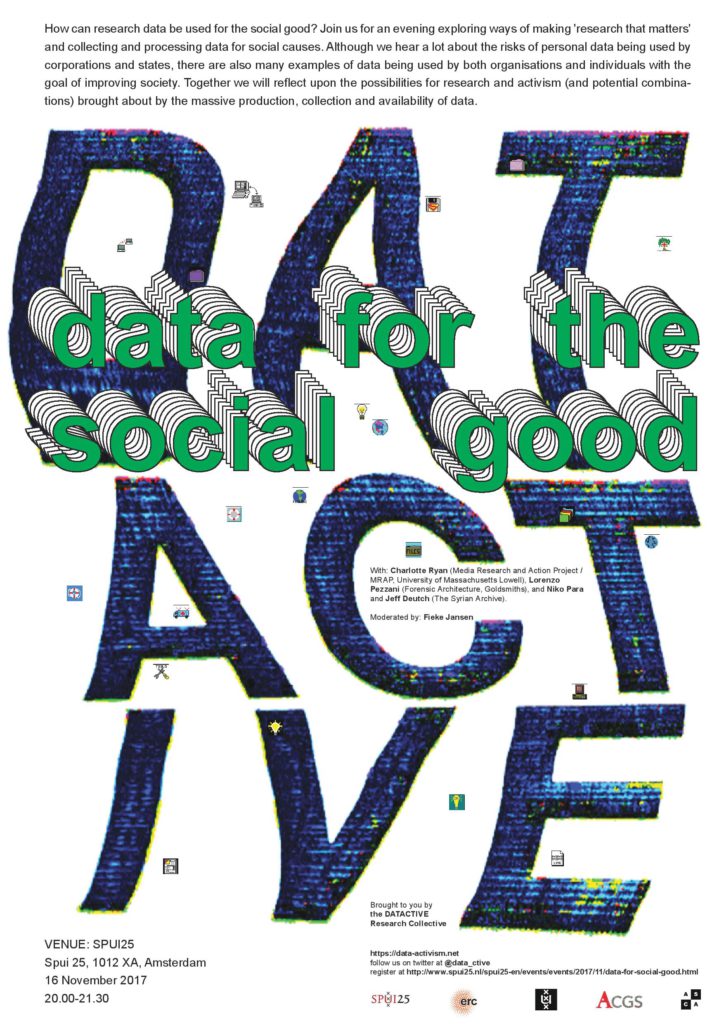
DAY 1: Data for the Social Good (SOLD OUT)

16 November 2017, 8pm-9.30pm, @ SPUI25, Spui 25, 1012 XA, Amsterdam
This event is fully booked, but tickets might become available just before the start. Also, a live-stream will be set up by Spui25 here at 8pm.

Join us for an evening about ‘research that matters’, exploring ways of collecting and processing data for social causes. Just as socioeconomic data about us are used by institutions to decide upon the allocation of budgets for public health, housing or urban planning, and behavioural data helps businesses to determine their location or set their prices, digital data are also mobilised by activists to legitimize their struggles against poverty, racism or injustice. Recently, as every aspect of our daily lives has turned into data susceptible of being quantified, processed and repurposed, it is not only the metrics created about us that are used as input for all kinds of decision-making, but those generated by us through the daily use of different types of technologies.

Although we hear a lot about the risks of (personal) data being used by corporations and states, there are also many examples of usage by organisations or individuals with the goal of improving society. From crowd-sourced maps about the ‘femicide’ epistemic in Latin America to the analysis of videos and photos to reconstruct drone attacks, data produced by people is mobilised for social good. The goal of this event is to reflect upon the possibilities for research and activism (and potential combinations) brought about by the massive production, collection and availability of data.

With the help of Charlotte Ryan (Media Research and Action Project/ MRAP, University of Massachusetts Lowell), Lorenzo Pezzani (Forensic Architecture, Goldsmiths), and Jeff Deutch and Niko Para (The Syrian Archive), the event will focus on discussing different dimensions of activist research. Fieke Jansen will be moderating the evening.


DAY 2: Data for the Social Good: A Focused Encounter

17 November 2017 9am-4pm, @E-Lab, Turfdraagsterpad 9 (room 0.16*), 1012 XT Amsterdam
* turn right after the entrance, room 0.16 is located at the end.

Should you want to participate, please drop an email to jeroen@data-activism.net. Seating is limited but we particularly welcome scholars interested in exploring the relationship between academia, action and policy.

DATACTIVE: Focused Encounter will be an exploration into ‘data activist research’ through a one-day workshop. The event will be the first in a series of seminars organized by DATACTIVE as an attempt to bridge theory and praxis, as well as to establish a network of activist-researchers and researching-activists working on themes of mutual interest around the politics of datafication.

DATACTIVE explores the responses to datafication and massive data collection, as they are implemented by citizens and organized civil society. As part of this program, we have adopted an ‘engaged’ approach to research by virtue of which we produce scientifically sound knowledge, while simultaneously paying attention to the impact this process might have on people and communities (see Milan, 2010). Furthermore, since we want to contribute to empower activists and citizens to think critically about datafication, empowerment and surveillance, we are currently exploring experimental research methods capable of bringing together activist communities and academia to develop joint research questions and/or projects. In this sense, on a more practical level, the goal of this first Focused Encounter is to start charting out a ‘data activist’ research agenda that takes into account this community building, mutual learning and knowledge-sharing mission. On a theoretical level the goal of the Focused Encounter is to discuss different aspects of inclusion and democracy, evidence and knowledge production, and the promises and perils of data activism and datafication more in general.

The event will consist of a morning program (9:15 – 12:30) featuring three speakers who will showcase ways of doing engaged research as well as the related challenges, followed by a moderated discussion. After lunch there is room for discussion and knowledge exchange in small moderated groups, for those who are interested (highly recommended), followed by about an hour of focused discussion and brainstorming. We will work together until approximately 16:00 and then have drinks.


Schedule

Morning:
9:15 -9:30 Welcome by Stefania Milan.
9:30 -10:00 Charlotte Ryan. “Building sustained research collaborations.”
10:00 – 10:30 Lorenzo Pezzani (Forensic Architecture). “Forensic Oceanography: Documenting the violence of the EU’s Maritime Frontier.”
10:30 – 10:45 COFFEE BREAK
10:45 – 11:15 Jeff Deutch and Niko Para (Syrian Archive). “Archiving for accountability: Collaboratively preserving, verifying and investigating open-source documentation of rights abuses in Syria.”
11:15 – 12:30 Discussion on ‘Data activist research’, moderated by Lonneke van der Velden.

Afternoon:
The afternoon session will provide space to reflect and look forward. What is needed, for us as a data-activist community, is to accelerate and expand our engaged and action-oriented research practices? Based on the diverse expert insights we gained during the morning session we will collectively start crafting an engaged research agenda for data activist research.

13:30 -14:00 Collective brainstorm. Moderator: Kersti Wissenbach.
14:00 – 16:00 Break- out sessions
15:30 – 16:00 Reporting back.
16:00 Closure

After 16:00 Drinks @Cafe de Jaren (Nieuwe Doelenstraat 20 – 22, 1012 CP / Amsterdam)


About the speakers

The speakers are invited to present their research projects, experiences and results, and to discuss with DATACTIVE members and attendees questions relating to research ethics, engaged research as well as data activism, its problems and outcomes.

Charlotte Ryan is an Associate Professor of Sociology at the University of Massachusetts, Lowell, and the co-founder (with Bill Gamson) of the Movement/Media Research and Action Project (a research group that aims to strengthen progressive social movements working toward social justice and inclusive and participatory democracy). Ryan worked also as an organizer in labor, community, health and anti-intervention movements, and has extensive experience with collaborative work between academia and activism. She is also a member of the DATACTIVE Ethics Board.

Lorenzo Pezzani is an architect and researcher. He is currently Lecturer at Goldsmiths, University of London, where he leads the MA studio in Forensic Architecture. His work deals with the spatial politics and visual cultures of migration, with a particular focus on the geography of the ocean. Since 2011, he has been working on Forensic Oceanography, a collaborative project that critically investigate the militarized border regime in the Mediterranean Sea, and has co-founded the WatchTheMed platform. Together with a wide network of NGOs, scientists, journalists, and activist groups, he has produced maps, videos and human right reports that attempt to document and challenge the ongoing death of migrants at sea.

Jeff Deutch & Niko Para are members of The Syrian Archive, a Syrian-led collective of human rights activists dedicated to preserving open-source visual documentation relating to human rights violations committed by all sides during the Syrian conflict. Through collecting, curating, verifying and investigating digital content, the Syrian Archive aims to preserve data as a digital memory, to establish a verified database of human rights violations for reporting and advocacy purposes, and to act as an evidence tool for legally implementing justice and accountability efforts as concept and practice in Syria. Jeff Deutch is a fellow at the Centre for Internet and Human Rights and a PhD candidate at the Humboldt-University in Berlin. He has developed workflows and methodologies for open-source investigations of human rights violations. Niko Para is The Syrian Archive’s lead technologist, where he develops the Sugarcube sequential data investigation pipeline for secure collection, preservation, transformation of user-generated content. He has worked with Tactical Technology Collective, Global Witness, as well as numerous smaller agricultural, artistic, and musical organisations and collectives. He unapologetically plays the banjo.

Fieke Jansen is an independent researcher. Until recently, she worked on the Politics of Data programme for Tactical Tech. Previous to that, she helped set up and manage the digital emergency programme for human rights defenders and activists at Hivos. She also co-authored the book Digital AlterNatives.
 

Guillén at The Expert Session on Human Rights Defenders

Author: Guillén Torres

On Monday 9th of October, I was very happy to participate in the Expert Session on Human Rights Defenders, organized by Justice and Peace Netherlands. The goal of the event was to reflect upon the role that Data (Big and Small) can play in the defense of Human Rights around the world.

The workshop was also a platform for the presentation of the Index of Human Rights Defenders, developed jointly by Justice and Peace and the University of Maastricht in the Netherlands. This new index aims to facilitate the identification of tangible actions that are needed to improve precarious situations for human rights defenders worldwide.

My intervention was centered on strategies to turn (Big) Data into policy recommendations, which is one of the interests of the DATACTIVE project. Since there is currently no general agreement on a specific methodology to achieve this goal, I decided to prepare an exploratory talk to share recent findings in academic research on the topics of evidence-informed public policy and Big Data. In addition, I proposed the participants to colonize the field of Business Analytics, which has been very productive in developing various frameworks for the production of Actionable Insights out of Big Data but focuses almost exclusively on the creation of economic value.

I was lucky enough to present next to Hisham Almirat, a research associate at Datactive, and Hyeong-sik Yoo, from HURIDOCS, who shared with the participants of the workshop thoughts and techniques on ethical data collection.

Miren Gutiérrez will be our in-house visiting scholar in October and November

Miren Gutierrez will be in Amsterdam on October 3-14 and November 6-18. She hopes to engage with the Datactive team in exploring new research venues and opportunities, and to participate in the events, conferences and activities in which the team is involved.

About Miren
Miren is a Research Associate at Datactive. She is also a professor of Communication, director of the postgraduate programme “Data analysis, research and communication”, and member of the research team of the Communication Department at the University of Deusto, Spain. Miren’s main interest is proactive data activism, or how the data infrastructure can be utilized for social change in areas such as development, climate change and the environment. She is a Research Associate at the Overseas Development Institute of London, where she leads and participates in data-based projects exploring the intersection between biodiversity loss, environmental crime and development.

She holds a PhD in Communication Sciences. Her dissertation “Bit and Atoms: Proactive data activism and social change from a critical theory perspective” explores the relationship between people, data and technologies.

Kersti on political participation and data activism in a sub-Sahara African context (Bonn)

VHS Bonn (VolksHochSchule), Adult Education Centre
Monday, September 25, 2017, 18: 00-19: 30

Kersti Wissenbach will give a public lecture about political participation and data activism in a sub-Sahara African context. The talk is part of the ‘Afrikanische Aspekte’ lecture series, organizing every semester by the German African Center together with the adult education center with the aim to open up these issues to a wider audience. Other speakers this year are from the German Development Bank, The German Institute for Development (DIE), Uni Bonn, GIGA German Institute of Global and Area Studies, Germanwatch e. V.

On the talk

New technological developments offer more and more opportunities for citizen participation. New civil society actors, such as Civic Tech, and Open Data activists are taking advantage of this opportunity. They demand greater transparency from governments, public authorities to take responsibility, and open doors for direct political participation.

But what does involvement of the citizens in the digital age really look like when the power dynamics and socio-political contexts determine which data are collected and used for political decision-making? How can new technologies and new actors positively influence such dynamics and relationships in the African context?

Find more information on the talk here (in German).

DATACTIVE lecture series: Daniel Trottier

Save the date! On Tuesday 19 September from 3 until 5 pm, room 0.16 (BG1) we will host the first of this year’s DATACTIVE Speakers Series. This time we team up with the rMA and Thomas Poell for a session on digital vigilantism and data activism. We have invited Daniel Trottier (EUR) and our own Lonneke van der Velden (UvA) to share their thoughts. You can find the abstracts of their talks below.


Digital vigilantism – Daniel Trottier
Digital media enable citizens to hold fellow citizens accountable, often resulting in shaming and harassment. This project examines digital vigilantism (DV) in a global context. DV is a process where citizens are collectively offended by other citizen activity, and respond through coordinated retaliation on digital media, including mobile devices and social media platforms. The offending acts range from mild breaches of social protocol to terrorist acts and participation in riots. In addition to shaming the targeted individual, participants may also share additional information about the target, resulting in a harmful and lasting mediated visibility.

Digital vigilantism is an interdisciplinary concern that requires both conceptual and empirical advancement. Drawing upon existing research on digital media cultures, online policing and surveillance, this five-year project considers the cultural factors surrounding DV, in contradistinction to embodied vigilantism. It also considers the social impact on the various actors involved, as well as how this complicates conventional policing and state power. While online shaming and coordination can transcend borders, this project will remain attentive to national contexts in the Netherlands, the United Kingdom, China and Russia. This project will develop a theoretical framework that advances the frontier of knowledge of DV in relation to key disciplines and interdisciplinary fields. Next, the research will deliver a comprehensive analysis of news media as well as other sources of public discourse that render DV meaningful. This will be followed by an account of DV from the perspectives of those who encountered or contributed to it in a personal or professional context. These theoretical and empirical findings will inform a conceptually rigorous and nuanced understanding of the motivations and practices that surround DV, alongside recommendations for key stakeholders.


OSINT and data activism – Lonneke van der Velden
This presentation discusses instances of Open Source Intelligence in the context of “data activism”. As datafication progressively invades all spheres of contemporary society, citizens grow increasingly aware of the critical role of information as the new fabric of social life. This awareness triggers new forms of civic engagement and political action. “Data activism” indicates the range of sociotechnical practices that interrogate the fundamental paradigm shift brought about by datafication. This includes ways of affirmative engagement with data (“proactive data activism”, e.g. data-based advocacy) and tactics of resistance to massive data collection (“reactive data activism”, e.g. encryption practices), understood as a continuum along which activists position and reposition themselves and their tactics.

Becky at 4S conference in Boston

Society for Social Studies of Science (4S), 2017
Boston, Massachusetts, August 30 – September 2, 2017


STS (In)Sensibilities

If sensibility is the ability to grasp and to respond, how might we articulate the (in)sensibilities of contemporary technoscience? How, similarly, can we reflect on the extent and limits of our own sensibilities as STS scholars, teachers, and activists? The conference theme invites an open reading and exploration of how the world is made differently sense-able through multiple discourses and practices of knowledge-making, as well as that which evades the sensoria of technoscience and STS. Our aim is that the sense of ‘sense’ be read broadly, from mediating technologies of perception and apprehension to the discursive and material practices that render worlds familiar and strange, real and imagined, actual and possible, politically (in)sensitive and ethically sensible. Find the detailed program here.


Becky presents ‘Calculating & Countering Surveillance Risks: Translations in Practice’

With the proliferation of digital surveillance, how to act under the presumption of monitoring and tracking has become a central subject of concern to civil society. The responsibility of the ‘surveillance subject’ extends to the ability to anticipate the likelihood of one kind of security threat over another; to apply risk management strategies to determine the appropriate course of action in fearful and uncertain circumstances; and to own responsibility for the impacts of any ensuing threats. With the risks of emerging phenomena like the ‘internet of things’, ‘smart cities’, intelligent autonomous systems, and preemptive security, the responsibilities placed on chronically under-resourced civil society actors are greater than ever. This paper investigates the practices civil society actors and affiliated technical communities turn to in order to calculate and counter these emerging risks, using translations and boundary objects as an analytical lens to understand security in practice.

The paper draws upon my doctoral research, which bridges surveillance studies and STS approaches to the study of risk, security, and information infrastructures, including the work of Michel Callon and John Law (2005) on calculative practices and Geoffrey Bowker and Susan Leigh Star on ‘boundary objects’ and ‘boundary infrastructures’(1989; 1999), with the work of critical data and critical security scholars such as Louise Amoore and Claudia Aradau.

The research is done through participant observation, document analysis, and extensive semi-structured interviewing, crossing national boundaries in order to trace transnational interactions. The paper draws upon document analysis of different risk and threat modeling frameworks, and data from interviews conducted with privacy engineers, human rights defenders, activists, and security industry professionals.


About 4S

The Society for Social Studies of Science (4S) is an international, nonprofit scholarly society founded in 1975. 4S fosters interdisciplinary and engaged scholarship in social studies of science, technology, and medicine (a field often referred to as STS). Membership in the society is open to anyone interested in understanding developments in science, technology, or medicine in relation to their social contexts.

[blog] Hopes and Fears at SHA2017

Authors: Davide & Jeroen

A few weeks ago, a contingent of the DATACTIVE team attended SHA (Still Hacking Anyway), the periodic worldwide hacker camp hosted in the Netherlands. The great variety of people hanging around included IT pen-testers, system administrators, activists, developers, advocacy groups, journalists -and, of course, hackers. Around 3.300 attendants, 100 gigabit (!) of bandwidth, 320 talks, mixed with lights, music, artifacts of all kind -and a fair amount of drinks- contributed to characterize the gathering as a concrete embodiment of the hackers’ ethos of ‘work&play’.

We had the chance to attend dozens of talks and debates; to participate in the activity of the Technopolitics village TSJA; to interview dozens of participants; to give our own talk on mailing list analysis; to engage in chats, activities, and drinks with plenty of people.

Eager to trigger discussion, we asked ourselves: with this great group of people, why not conduct a small informal survey in the evening hours, exploiting the generally relaxed atmosphere characterizing this moment of the day?

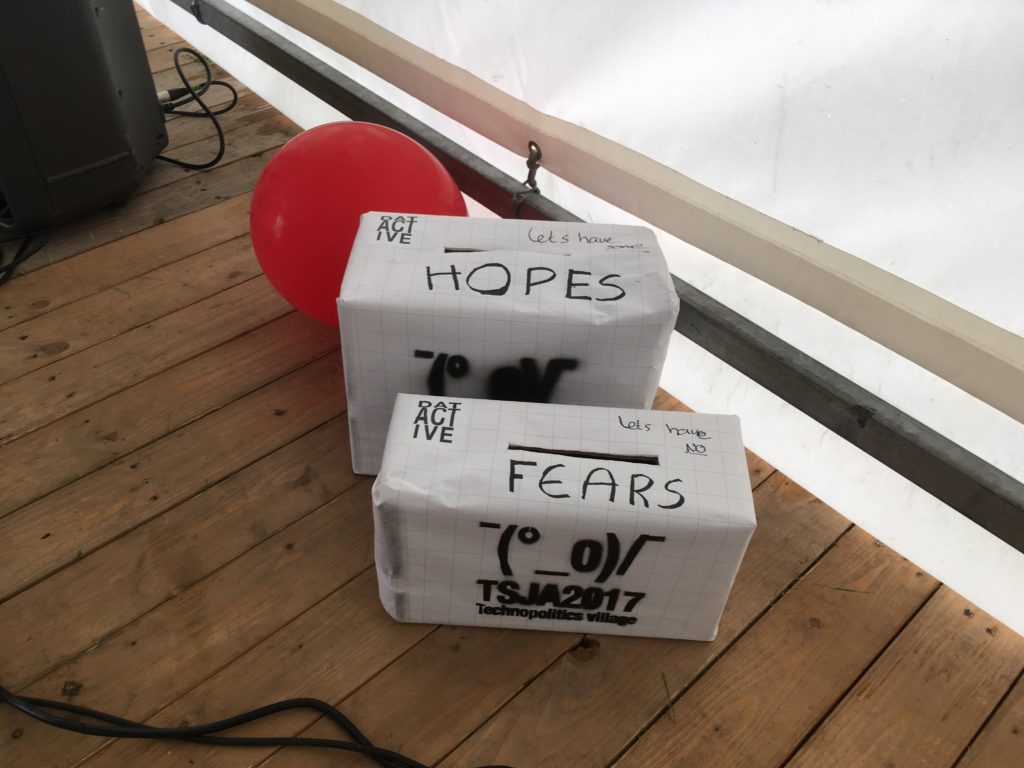
Assisted by a bottle of vodka (to lure into the discussion the more reluctant ;-), we walked around in order to harvest peoples’ “hopes and fears” related to the inexorable process of datafication. After Jonathan Gray, we understand datafication as “[a way] of seeing and engaging with the world by means of digital data” (2016). Its political relevance descends by the fact that “data can also actively participate in the shaping of the world around us” (ibid.). Activists, advocates, techies, hackers and interested citizens are more and more concerned both with the threats and the opportunities that the transformation of every aspect of reality into data brings along. What do people fear the most? What is (if any) their biggest hope?

It is interesting to notice that quite often people would at first have a puzzled reaction: ‘What do you exactly mean?’ and ‘isn’t there a neutral-answer option?’ were frequent instinctive responses. However, while not yet completely fleshed out for the purpose of a poll, the question worked well as a trigger for small discussion and, in many cases, people would then start to recognize quite some fears and hopes they bring, engaging in animated conversations with us.

The fears of SHA participants seem to circulate very much around the general topic of control, and that of prediction mechanisms in relation to algorithms. Pessimistic answers include the recognition that “[those] who control communication (infrastructure) control society”, denote a strict concern for “[people] predicting the wrong answer (or the wrong things)” and the fear “to be categorized” and a to experience a “lack of control over data collection”. The hopes, instead, largely insisted on how blockchain technologies, open data, and hacking might contribute to a more decentralized (and thus controllable-from-below) world.

It must be said that (quite unexpectedly), the hopes outnumbered the fears. To be fair, whereas blunt optimism doesn’t seem to find roots in this community, we have to register some hopeless reactions, as the one whose only hope is that we run out of metal on our planet (and whose fear is that the mining industry might outsource to Mars…).

Overall, the theme of (lack of) control over peoples’ own lives seems to be the red thread. Data (as Kranzberg’s law on technology reminds us) are not good nor bad in themselves -but neither neutral, since who, when, how, and for what purposes gain control over them determines their oppressive or liberating potential. In other words, ‘big data’ are political issues, and people at SHA are much aware of that.

To conclude, two methodological notes. The term ‘datafication’, despite sometimes obscure to the respondents and overly-general for the quite structured question, worked well as a floating signifier to trigger people into discussion about the topic. The vodka, instead, would have worked better with some orange juice next to it -lesson learned.


If you wanna look it up yourself, here is a transcript of both fears and hopes:

Fears on datafication:

  • who controls the communication (infrastructure) controls society
  • centralization will limit knowledge and sharing until control over the population is complete
    lack of control over data collection
  • fascism
  • even if algorithms are neutral, the data they work with are biased
  • to be categorized → filter bubble
  • predict the wrong answer (or the wrong things)
  • self-fulfilling prophecy as a service
  • advancement of face recognition techniques
  • people do not question algorithms
  • they start mining metals on Mars
  • genocide

Hopes on datafication:

  • we run out of metal atoms to share all the data
  • 42
  • blockchain as a technology of socialism
  • societies move in waves like everything in life. Future will require revolution
  • the democratization of mapping data
  • balancing power through open data
  • people learn to question algorithms like they do with politicians
  • new generations will be more aware and hack more
  • It will prove mankind is hopeless
  • helps with daily life
  • that the data is used to solve problems of society
  • it’s just a hype
  • they (doing it) notice they are themselves getting fucked by categorization and negative impact on their lives
  • decentralization through blockchain tech will give us the freedom to reclaim control over communication infrastructures


References

Gray, Jonathan (2016), “Datafication anddemocracy: Recalibrating digital information systems to address broader societal interests”, Juncture, Volume 23, ISSUE 3

DATACTIVE at SHA2017

Many of the DATACTIVE people are attending SHA [Still Hacking Anyway], taking place from the 4th until the 8th of August in Zeewolde (NL). You can often find us hanging out around at the Technopolitics village.

About SHA 2017

SHA2017 is an international non-profit outdoor hacker camp/conference taking place in The Netherlands in 2017 on August 4th to 8th. It is the successor of a string of similar events happening every four years: GHP, HEU, HIP, HAL, WTH, HAR and OHM. Similar events are EMF 2016 in the UK, CCC Camp in Germany.

The camp is organized for and by volunteers from and around all facets of the international hacker community. Knowledge sharing, technological advancement, experimentation, connecting with your hacker peers and of course hacking are some of the core values of this event.

DATACTIVE at the DMI Summer School 17 on the accessibility of open data portals

From the 3rd until the 7th of July, Guillen, Umberto, and Jeroen of the DATACTIVE team participated in the Digital Methods Initiative Summer School 2017. They conducted a one-week research around the question as to how to assess accessibility of government-facilitated open data portals. Just a glimpse of the final report (to be published soon on the DMI wiki):

Open Data Portals are one of the main ways in which data users and data providers interact. The goal of this project was to identify mechanisms to assess the accessibility of Data Portals using Digital Methods. The project was particularly focused on tracing alternative voices to the ubiquitous celebration of Open Data, for two reasons: on the one hand, searching for contestation by both users and developers was considered as a good starting point to locate the shortcomings of Data Portals, and on the other, we were interested in identifying what elements of the critical discourse about the Open Data phenomenon (such as that built by Jo Bates) could be specifically connected to Data Portals.”

For more information, please find the presentation on the topic.

[blog] Big Data and Civil Society: Researching the researchers

In March-May 2017, I had the opportunity to join the DATACTIVE project as a research trainee, at the Media Studies Department of the University of Amsterdam. I first met the DATACTIVE team during the 2015 Winter School of the Digital Method Initiative (also at the Media Studies Department, UvA). At the time, we worked on tracing social networks through leaked files, and I very much appreciated the methods they use, and the great care they put into privacy consideration when dealing with people’s data. For these reasons, when I got the opportunity to enroll in a research traineeship abroad as part of my PhD project, I decided to go back to Amsterdam.

My research activities within DATACTIVE focused primarily on monitoring and reviewing the scope of and methods used by other research lab dealing with big data and civil society. More specifically, the aim of this research was to try and understand in which way DATACTIVE can learn from the research projects in question. This task lies at the exact intersection of the DATACTIVE research goals and my own skills and interests. My background bridges across political communication and Big Data: I completed a master in Big Data Analytics & Social Mining at the University of Pisa only some weeks before traveling to Amsterdam.

I analyzed about 23 projects from seven research labs, exploring a multitude of interesting methodologies and theoretical frameworks. It was sometimes challenging for me to deal with the many different aims, methods, and point of views represented in these different projects, but I had the possibility to familiarize myself with tools and methods used in other research labs. In what follows, I provide an overview of the most interesting findings, however hard it might be to do justice to all of them!

What have I studied?

1. Thanks to the Share Lab projects (The Share Foundation located in Serbia) I learned about the importance of meta-data, and how detailed information about people can be retrieved just exploring fragments of data, like mail headers or browsing internet histories (Metadata Investigation: Inside Hacking Team, Browsing Histories: Metadata Explorations).

2. Another research from Share Lab showed how Facebook algorithms work to match people with ads (Human Data Banks and Algorithmic Labour), and how an electoral campaign can be manipulated and dominated on the web (Mapping and quantifying political information warfare).

3. Analyzing projects developed with the CorText platform (set up by LISIS a research project located at Université Paris-Est Marne-la-Vallée in Paris) showed how text can be elaborated upon in a free and easy way to perform a more complex analysis. It can do for instance semantic networks analysis in a bunch of scientific articles (Textdrill), topic extraction and clusterization from newspaper articles (Pulseweb), or geographical clusterization through text analysis (GeoClust).

4. Forensic Architecture (Goldsmiths, University of London) exemplifies how videos, photos, interviews and other kind of (social) data retrieved on the web, could be useful to reconstruct the “truth” in hard-to-reach war scenarios such as the Al-Jinah Mosque case (in which they performed an architectural analysis of a building destroyed in a US Airstrike in Syria on March 16th 2016), MSF Supported Hospital (in which researchers, asked by MSF, tried to understand which national air force, between Russian or Syrian, carried the airstrike), and Rafah: Black Friday in which Forensic collaborated with Amnesty International to reconstruct war operations in Gaza during 1-4 August 2014. It was emotionally challenging to read the reports while keeping an academic distance. This was the case, for instance, in the reconstruction of “the left to die boat” case, a vessel left to drift in the middle of the Mediterranean sea in which sixty-three migrants (seventy-two in total) lost their lives, or the report on what happens in the Saydnaya prison in Syria in which witnesses reported abuses and tortures. These are only some examples of what I encountered during my research.

But this was not a solitary research endeavor. Being involved in all the DATACTIVE discussions, meetings, conferences, and reading groups over the period of three months shed new light on qualitative research in context of “data activism”. For example, we discussed how to code activists’ interviews in terms of research aims and coding methods.

Thanks to the DATACTIVE experience and to the analysis of some projects (i.e. The Snowden Disclosures, Technical Standards, and the Making of Surveillance Infrastructures, Marginalisation, Activism and the Flip Sides of Digital Technologies), I better learned the importance to take care of personal data, and pay more attention to the multiple sides of technologies, which we often take as a black box. I have also reflected extensively on how digital technologies could be of help to a broad range of research activities, starting from simple tasks to perform complex “counter” analysis that allows understanding how the global financial system works (Corpnet, University of Amsterdam) or how a more equal and collaborative economy could be developed (Dimmons, Internet Interdisciplinary Institute, Open University of Catalonia). I am also convinced that all these research and outputs should be known and shared also beyond academia, not only among scholars, for their ability to speak to the world we live in.

I think that the experience and knowledge gained in this research traineeship will definitely add up to my PhD work: entering such a huge field of research has indeed broadened my own perspective on political communication and Big Data. Finally, I really appreciated being part of the DATACTIVE research team and being exposed to their collaborative way of working, and I really enjoyed the cultural and life experience in. I hope to come back.

See you soon.

about Antonio Martella

Antonio is a PhD student at the Political Science Department of the University of Pisa. His research project is focused on political leaders, populism, and social media. He graduated in Business communication and human resource policy and has a postgraduate master in “Big Data Analytics & Social Mining” by the University of Pisa along with the CNR of Pisa.

Featured image: Edward Snoweden WIRED magazine cover on news stand 8/2014 by Mike Mozart of TheToyChannel