Author: Jeroen

Davide Beraldo @ SPUI25

what: ‘The Paradox of Social Movements’

where: Spui 25, Amsterdam

when: april 6th, 17.00 – 18.00

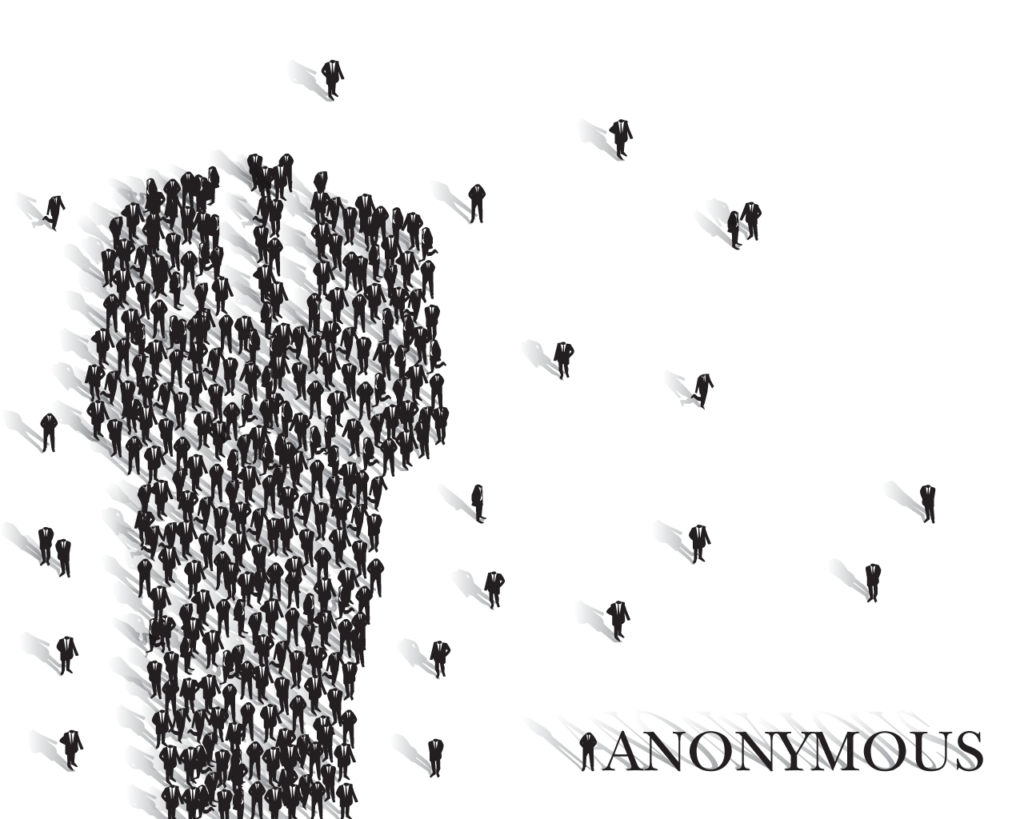
Davide Beraldo will give a talk at SPUI25, April 6 at 5h, as part of the series ‘Cheers to Science’. The lecture, ‘The Paradox of Social Movements’, will cover the topics of his PhD thesis. It will present the empirical findings of a digital exploration of Anonymous, showing its contradictory composition and the role of ‘ontological paradoxes’ in the self-reproduction of this ‘contentious brand’. The talk will be followed by drinks.

For more information and to register: http://www.spui25.nl/programma/item/the-paradox-of-social-movements.html


Lonneke van der Velden at the DataPublics workshop


Under the header ‘governing publics’, Lonneke van der Velden presented her work at the DataPublics conference April 1st. For more detail on the outline and schedule of the event, see their website.

The presentation can be watched online!


The materiality of surveillance publics

This presentation discusses the materiality of surveillance publics. Notions of material publics are particularly useful to think about activist interventions into surveillance. Digital surveillance is considered to be a rather intangible phenomenon. However, now and then, surveillance gets ‘exposed’, for example through leaks that disclose surveillance technologies or by using software that can detect online tracking. These interventions (sometimes dubbed ‘countersurveillance’ or ‘sousveillance’) manage to transform digital surveillance practices into public knowledge repositories that can be studied and, in some cases, this results into new online investigative tools. In the presentation I demonstrate how surveillance can become ‘public matter’: in the process of turning surveillance into a matter of concern, surveillance becomes itself ‘datafied’, and this material can be used for public ends. In other words, they give rise to ‘data publics’. Moreover, these interventions assemble very specific data publics: these publics are situated in socio-technical environments in which intelligence, secrecy, and privacy practices codetermine the modes of working, and thus, interestingly, making things private coincides with ways of making things public.


DataPublics will investigate the diverse ways in which publics are, and can be, constituted, provoked, threatened, understood, and represented. This includes examining the role played in the formation of publics by new on- and offline infrastructures, data visualisations, social and economic practices, research methods and creative practices, and emerging and future technologies. Specifically, the event will facilitate cross-cutting conversations between designers, social scientists and creative technologists to explore the new challenges and opportunities afforded by thinking and working with “Data Publics”.

DATACTIVE at RightsCon

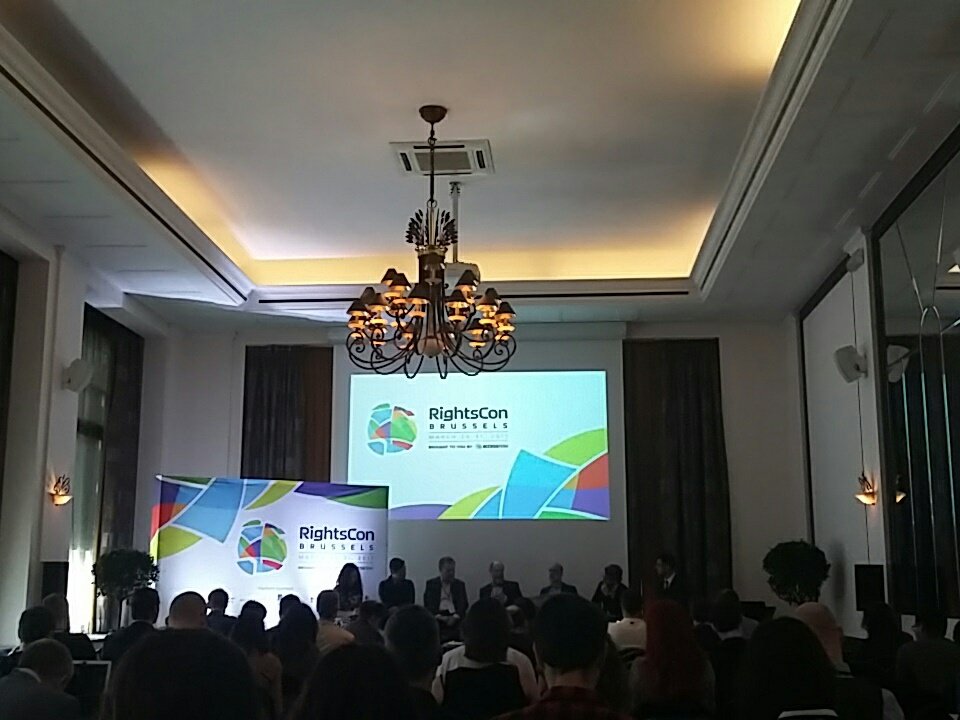
DATACTIVE co-organizes, jointly with Vidushi Marda of the Centre for Internet & Society (Bangalore, India), a session on fake news and regulation at RightsCon titled “Resisting content regulation in the post-truth world: How to fix fake news and the algorithmic curation of social media?”. RightsCon will take place March 29-31 2017 in Brussels.

In addition, three DATACTIVE team members (Stefania, Becky, Davide and Guillen) will be in attendance for fieldwork purposes.

See the draft program of RightsCon here.

RightsCon is the world’s leading event on the future of the internet. Convening civil society leaders, business visionaries, government representatives, activists, legal experts, technologists, and more from across the globe. This year, RightsCon Brussels will include three full days of programming to tackle some of today’s most challenging issues. With over 200 sessions and more than 1,000 participants anticipated, RightsCon 2017 will provide unparalleled opportunities to engage with community leaders in sessions, private meetings and discussions, satellite events, parties, movie screenings, and social events.


Gabriella (Biella) Coleman visits DATACTIVE

We are delighted to have Biella paying DATACTIVE a visit march 28th in the afternoon for an informal meetup.

bio

Gabriella (Biella) Coleman holds the Wolfe Chair in Scientific and Technological Literacy at McGill University. Trained as an anthropologist, her scholarship explores the intersection of the cultures of hacking and politics, with a focus on the sociopolitical implications of the free software movement and the digital protest ensemble Anonymous.

She has authored two books, Coding Freedom: The Ethics and Aesthetics of Hacking (Princeton University Press, 2012) and Hacker, Hoaxer, Whistleblower, Spy: The Many Faces of Anonymous (Verso, 2014), which was named to Kirkus Reviews’Best Books of 2014 and was awarded the Diana Forsythe Prize by the American Anthropological Association. Her work has been featured in numerous scholarly journals and edited volumes. Committed to public ethnography, she routinely presents her work to diverse audiences, teaches undergraduate and graduate courses, and has written for popular media outlets, including the New York Times, Slate, Wired, MIT Technology Review, Huffington Post, and the Atlantic. She sits on the board of Equalitie, The Tor Project, and the Social Science Advisory Board of the National Center for Women and Information Technology.

[blog] The politics of network graphs

Author: Jeroen de Vos, humanities scholar, entrepreneur and research assistant at DATACTIVE.

Schermafdruk van 2017-03-22 10-40-49

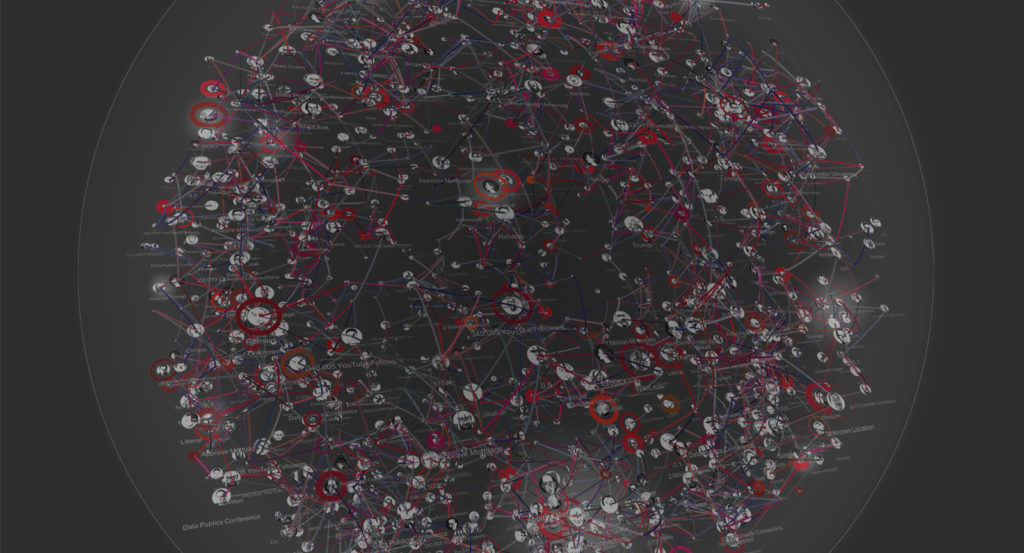
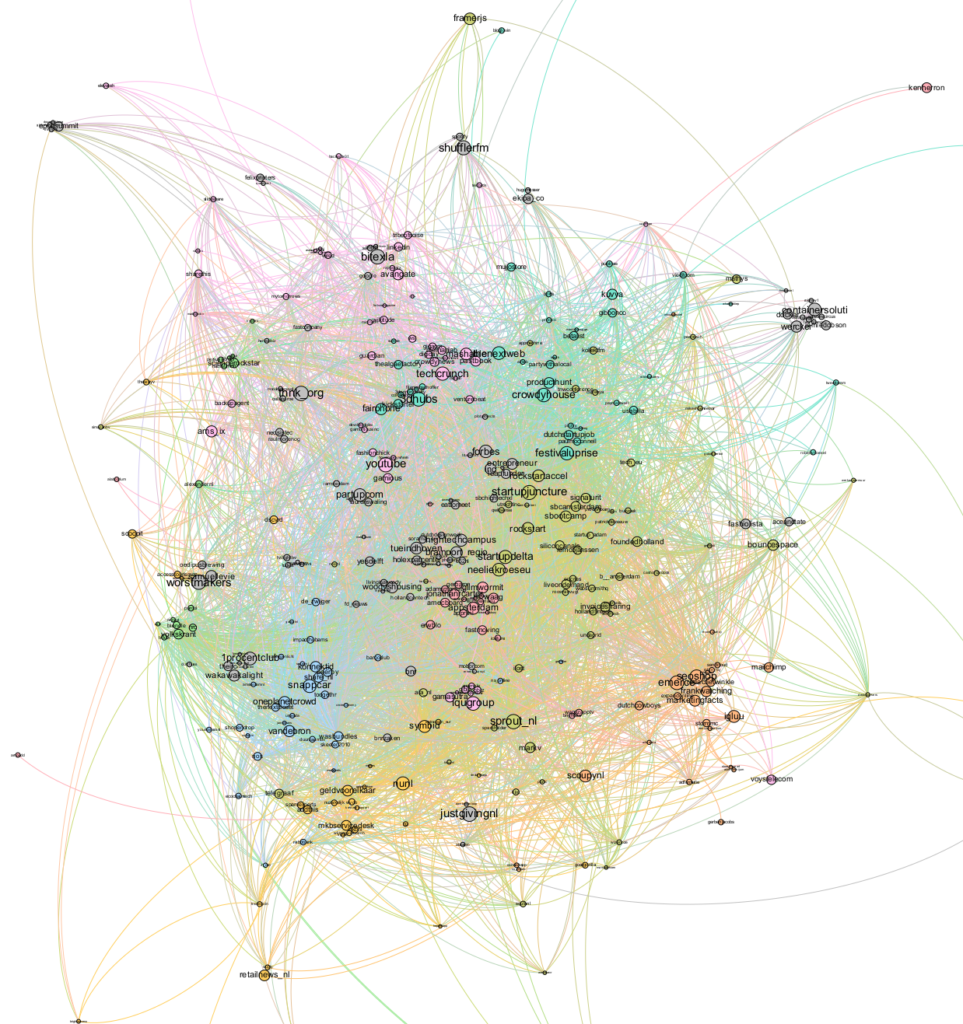
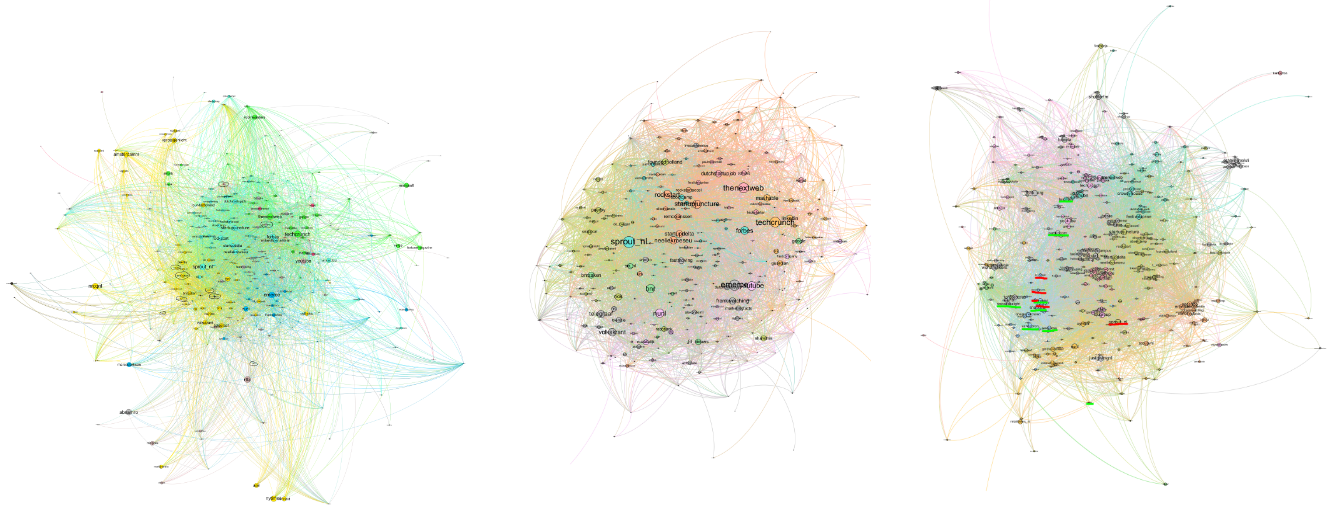
How do the graphs above differ? With their different colors, layouts and visual densities, they seem to each adhere to their own unique network. However, as an image they consist of the same kind of materiality: a network plotted in nodes and edges, dots and their connections, actors and their ties. What if I would say they actually present exactly the same network? That would challenge our notion of a network as one uniformly tangible, portrayable, showable and renderable object. This short blogpost will introduce ‘collaborative reading’ as a method to question the affordances these graphs have in a research setting -it reflects DATACTIVE’s quest for more mixed- and interdisciplinary research methods.

Collaborative readings

It builds on a larger research effort to map the Dutch entrepreneurial ecosystem using mixed methods, which combined an analysis of the Twitter-data of Dutch startup entrepreneurs with exploratory semi-structured interviews. In such interviews, I would introduce one of the graphs above to any of the Dutch entrepreneurs in question, together with a descriptive explanation of the method and logic of its production. This would look something like: [Every node [dot] represents a Twitter user account / If one user mentions another, this creates an edge [link] between the two nodes / The more mentions, the stronger the traction between the nodes / The node size represents a number of times the user is mentioned / The colours express statistical communities]. I would leave the floor open to see how the interviewees reacted, and in a follow-up question invite them to interpret the graph for me. Obviously, the process of triangulating the product of social network analyses by providing it to the subject of research is as old as early anthropological attempts to annotate kinship structures through early categorization practices (ie. Anthropologist Lewis Henry Morgan, 1818–1881). However, just giving back a networked representation as a form of consent or reciprocity is different from an actively collaborative reading the graph in question. Internalizing the validation of your methods through the practice of collaborative readings can serve multiple purposes.

Complications

This technique, that is clearly resonating with other naive interview techniques (DeWalt & DeWalt, 2010), helped to flesh out the role of the graph as an actor intervening in the space between the interviewee, the researcher, the Twitter accounts in question, and the colorful dots that represent their contested place in a field of other actors.

  1. The first complication of using these network graphs was the fact that as a researcher, one often has little explanation for the statistical correlations that are continuously rendered in various network plots. Since these networked correlations are not self-evident, every methodological step taken to work towards a single readable visual network can be challenging. The researcher often has little understanding of the underlying mechanism that could either support or discourage a particular way of plotting. This problem coincides with the discussion between social- and data scientists on the question whether data-correlations are self-explanatory, or that we still need a man-made hypothesis to allow structural knowledge gathering (boyd & Crawford, 2012; Burrows & Savage, 2014).
  2. A second consequence of working with these visuals as a means to represent the ecosystem was the constant struggle over readability. With the sheer size and ‘messiness’ of network representations, the collaborative reading consisted of much panning in zooming. It shows the inherent constraints of forcing a (3d) network to be visualized on a small rectangular screen, and other researchers experimented with other ways to plot a network graph, as a poster, a large map on the floor in which actors can be enacted. Nevertheless, the mere size and inclusivity of larger network representations inevitably force to constantly switch, in which the overview will typically be as insightful as the detail.
  3. Lastly, with its graphical inclusivity, many respondents read the networks as some form of entirety. Rather than providing a self-contained overview, the Dutch entrepreneurial ecosystem is produced through a series of very specific sociotechnical criteria. This is the result of many people sending tweets in a particular context, often with an (imagined) audience in mind – data which is re-appropriated for mapping purposes. The subsequential visual representations clearly demarcate one set of actors which evokes an understanding of the entrepreneurial ecosystem which might be somewhat superficial. The graphs float in a void like the contours of a nation-state map. They thereby surpass the idea that any peripheral node is again center of other social networks inherent part of any network analysis.

What ecosystem

Which brings me to my last point, regarding the contribution to entrepreneurial ecosystem studies. The study of ecosystems arose from the socioeconomic economic cluster analyses. From early comparative research comparing the proliferation of (mostly US-based) economic clusters in the 1980s (Saxenian, 1996), the effort to map and understand the entrepreneurial ecosystem infused with the promise to reproduce success (Hospers, Desrochers, & Sautet, 2009; Moore, 1996). This lead to many scholars and experts in the field contributing to case-studies and ideal types (Feld, 2012; Isenberg, 2011). However, the notion of an economic cluster as an ecosystem might be criticized. Drawing on the biological metaphor of ‘a heterogeneous set of interdependent living and nonliving actors’, the ecosystem metaphor is used to denote an inherently closed system in which everything coexists into some form of natural equilibrium. It presupposes the same kind of delimitations that is one of the pitfalls of the network graphs above: in their serenity, they invite to interpret an all inclusive and finalized representation. Instead, this post is meant to invite to think beyond the delimited ecosystem analyses, to be able to create a more flexible framework which can better bare notions of messy, unfinalized and impartial perspectives. What would such a representation look like?

For more information:

See the research website or the full thesis, or simply drop a line using jeroen@data-activism.net

This research project has originally been established with the help of Dealroom and in a collaboration with Digital Methods Initiative [UvA].


References

boyd, danah, & Crawford, K. (2012). CRITICAL QUESTIONS FOR BIG DATA: Provocations for a cultural, technological, and scholarly phenomenon. Information, Communication & Society, 15(5), 662–679. https://doi.org/10.1080/1369118X.2012.678878

Burrows, R., & Savage, M. (2014). After the crisis? Big Data and the methodological challenges of empirical sociology. Big Data & Society, 1(1). https://doi.org/10.1177/2053951714540280

DeWalt, K. M., & DeWalt, B. R. (2010). Participant observation: A guide for fieldworkers. Rowman Altamira.

Feld, B. (2012). Startup communities: Building an entrepreneurial ecosystem in your city. John Wiley & Sons.

Hospers, G.-J., Desrochers, P., & Sautet, F. (2009). The next Silicon Valley? On the relationship between geographical clustering and public policy. International Entrepreneurship and Management Journal, 5(3), 285–299.

Isenberg, D. (2011). The entrepreneurship ecosystem strategy as a new paradigm for economic policy: Principles for cultivating entrepreneurship. Institute of International European Affairs, Dublin, Ireland.

Moore, J. F. (1996). The death of competition: leadership and strategy in the age of business ecosystems. HarperCollins Publishers.

Saxenian, A. (1996). Inside-out: regional networks and industrial adaptation in Silicon Valley and Route 128. Cityscape, 41–60.


DATACTIVE featured as success story at ERC 10th anniversary

We are very proud to share that DATACTIVE is featured in the ERC 10th anniversary celebrations as one of the success stories!

The European Research Council turns ten this year. The anniversary program ‘Beyond the first ten years‘, scheduled for March 21st in Brussels, highlights the key achievements and some among the successful ERC funded projects, while setting the stage for the coming years. During this event, Stefania Milan (DATACTIVE PI) will talk about ‘data politics at the grassroots’ in the section ‘ERC development’ stories. She will also participate in the evening talk show ‘Beyond the first 10 years’, discussing ideas for ameliorating ERC funding schemes. On March 20th she will participate in a dinner hosted by the ERC President to discuss with stakeholders how to ‘stimulate excellence’ and get more bottom-up research across the EU. You can find more about the celebration on the dedicated website. The program for March 21st will be live streamed.

The European Research Council (ERC) was set up by the EU in 2007 to fund excellent scientists and their most creative ideas. It supports cutting-edge research in all fields, and helps Europe keep and attract the best researchers of any nationality. Today, the ERC is a key component of Horizon 2020, the EU’s programme for Research and Innovation. Check out the ERC achievements!

Interview with Stefania Milan on ‘Communicatie’ (in Dutch)

In a more personal interview in the Dutch Magazine Communicatie (check the online version), Stefania Milan explains her dedication to activism in relation to her academic endeavors. To give a glimpse of the content of the interview, these are the introductory paragraphs, for the full interview in Dutch, click here.

What has changed in activism through social media?

“I’m fascinated by the fact that activists does not always take shape in form of protest. It increasingly implies being present as a witness at the scene of the crime, and tweeting or reporting on Facebook. There is less fights and more individual stories. Older protest movements are used to be a more cohesive group with a strong leader. ”

Is that a good thing?

“It is good that you can start a movement with the internet giving it a more international scope. It is easier for a local malpractice can get worldwide attention. But with the large scale, involvement might be somewhat superficial. Would you put at risk for a stranger or fellow activist who is in prison on the other side of the world?”

Where does your social engagement come from?

“From my parents. They have a certain sensitivity to the people who are affected less. When I was two years old, they took me to the occupation of a chemical plant where working conditions were very poor. I grew up in a protected and white environment, but my gaze was directed outwards. I was aware of inequality and social injustice. ”

To read more in Dutch, click here.

DATACTIVE takes part in the launch of the Data Justice Lab at Cardiff University

Stefania Milan will represent DATACTIVE in the launch of the Data Justice Lab at the Cardiff University on the 17th of March 2017. More info, and a profile of the lab below:

Our financial transactions, communications, movements, relationships, and interactions with government and corporations all increasingly generate data that are used to profile and sort groups and individuals. These processes can affect both individuals as well as entire communities that may be denied services and access to opportunities, or wrongfully targeted and exploited. In short, they impact on our ability to participate in society. The emergence of this data paradigm therefore introduces a particular set of power dynamics requiring investigation and critique.

The Data Justice Lab is a new space for research and collaboration at Cardiff University that has been established to examine the relationship between datafication and social justice. With this launch event, we ask: What does social justice mean in age of datafication? How are data-driven processes impacting on certain communities? In what way does big data change our understanding of governance and politics? And what can we do about it? The Lab seeks to advance a research agenda that examines the intricate relationship between datafication and social justice, highlighting the politics and impacts of data-driven processes and big data. The lab is directed by Dr Lina Dencik, Dr Arne Hintz, and Dr Joanna Redden.

Becky Kazansky at IFF

Becky Kazansky is currently attending the Internet Freedom Festival in Spain, The Global Unconference of the Internet Freedom Communities. One can follow her adventures on Twitter.

About the Internet Freedom Festival

Since its beginning as the Circumvention Tech Festival in 2015, the Internet Freedom Festival (IFF) has grown into one of the largest, most diverse and inclusive gatherings in the Internet Freedom community.

Challenges to digital rights and online freedom expression have increased in reach and complexity, and so have the communities of practice which have grown and organized to address them. As the evolving Internet Freedom space explores and defines an identity as a community, several realities have become clear:

1. Online threats to human rights and freedom of expression affect us all
These issues have grown in sophistication and scope, with more and more closing spaces for open discussion of these obstacles both online and offline.

2. Networks of practice who address these threats are stronger now than ever before
So is the need to bring these networks together to learn from each other’s experience, to organize collective efforts that are more inclusive and better coordinated.

3. Opportunities for participants to set the agenda are few and far between
More often than not, participants in Internet Freedom community events must find space within a ready-built agenda to have the conversations they want, and need, to have.

4. Diversity of voice is fundamental to the health of a community.
A community with a truly comprehensive grasp of the complex challenges it faces is
possible only through inclusion of all voices – especially those typically underrepresented.

DATACTIVE lecture series: Elizabeth Losh


We are happy to announce that Elizabeth Losh will present on gender and technology in the discourse surrounding Hillary Clinton’s email scandal as part of DATACTIVE Speaker’s Series and in collaboration with the DMI’s data sprint. Please find the outline and bio below.

Date: 8 March, 15.30 – 17.00 in OMHP C0.17


I Did Not Have Text with that Server: 
Gender, Technology, and Digital Literacy in the 2016 U.S. Presidential Campaign

This presentation argues that the rhetoric surrounding failed U.S. presidential candidate Hillary Clinton’s 2016 email scandals can be understood as a consequence of a particular confluence of gender and technology in which excessive digital privacy is represented as a feminized user choice and calls for digital transparency are presented in terms of masculinist norms. Using techniques from discourse analysis and the theoretical framework of feminist technology studies, Losh analyzes materials in the @realDonaldTrump Twitter archive, the Fox News website, the WikiLeaks database that indexes hacked emails from Hillary Clinton and John Pedestal, and FBI documents from the agency’s website. Additionally, it references visual culture depicting Clinton as a user of personal mobile devices in public places, where she is shown as a secretive technology user claiming privacy in the public sphere, and popular Internet memes that associated her email conduct with sexual impropriety and dishonesty about a lack of digital purity. This talk explores how a political official’s relationships to non-human servers, peripherals, and portable devices could be perceived of as potentially threatening to the sexual order and by extension threatening to political sovereignty.

Bio:
Elizabeth Losh is an Associate Professor of English and American Studies at William and Mary with a specialization in New Media Ecologies. Before coming to William and Mary, she directed the Culture, Art, and Technology Program at the University of California, San Diego. She is a core member and former co-facilitator of the feminist technology collective FemTechNet, which offers a Distributed Open Collaborative Course and part of the international organizing team of The Selfie Course.

She is the is the author of Virtualpolitik: An Electronic History of Government Media-Making in a Time of War, Scandal, Disaster, Miscommunication, and Mistakes (MIT Press, 2009) and The War on Learning: Gaining Ground in the Digital University (MIT Press, 2014). She is the co-author of the comic book textbook Understanding Rhetoric: A Graphic Guide to Writing (Bedford/St. Martin’s, 2013) with Jonathan Alexander.