Author: Jeroen

Call for papers: Disinformation, misinformation and hyper-information in contemporary digital networks (ENG, ES, PT)

Liinc em Revista is inviting submission of articles, subject to double-blind evaluation, for publication in Vol. 13, n. 2 (November 2017). We accept unpublished articles in Portuguese, Spanish and English. Author guidelines and submission form can be found here.

This issue will present a dossier on “Disinformation, misinformation and hyper-information in contemporary digital networks”, organized by Guest Editors Arthur Bezerra (Ibict), Stefania Milan (University of Amsterdam) and Fabio Malini (UFES), within the theme proposed below.

Digital networks have expanded the possibilities of information production and sharing. However, the ongoing tendencies towards hyper-information, misinformation and disinformation show how the volume and speed of diffusion, as well as the quality and reliability of the content that circulates in such networks, represent severe challenges for the social appropriation of information.

Contemporary truth regimes have become susceptible to the processes of information automation shaping online networks and social media, leading to the emergence of an algorithmic mediation of opinion formation and content distribution. Meanwhile, the population of human profiles keeps growing, contributing to the ideological spread of content (false or true). In this context, it is symptomatic that the term “post-truth” (related to circumstances in which objective facts have less influence in shaping public opinion than appeals to emotion and personal beliefs) has been elected by Oxford Dictionaries the ‘word of the year’ for 2016. Discussions about the possible transitory nature of the phenomenon do not undermine the fact that the notion and perception of truth seems to be at stake particularly when political debates are mediated by social media and other digital platforms.

This special issue wishes to explore these questions. Therefore, we intend to address topics like:

– hyper-information, disinformation, misinformation and the social production of ignorance;

– the evolution of political debate on social media;

– computational automation and network-mediated opinion production;

– machine learning and emerging methods for the study of information diffusion on digital networks;

– algorithmic filtering of information;

– algorithmization of social network relationships, belief production and truth regimes;

– “post-truth”: analysis and critique of the term;

– information literacy and critical information literacy;

– ethics in the production of information.

Talk with Stefaan Verhulst @NYU (GovLab) in March

The 2nd of March, we will have the opportunity to meet with Stefaan Verhulst, Co-Founder and Chief Research and Development Officer of the Governance Laboratory. Verhulst’s latest scholarship centers on how technology can improve people’s lives and the creation of more effective and collaborative forms of governance. Discussion topics might include:

Data Responsibility: How data originally collected for private purposes was exchanged for public ends: an act of data responsibility.

Data Collaboratives: Data Collaboratives are a new form of collaboration, beyond the public-private partnership model, in which participants from different sectors — in particular companies -  exchange their data to create public value.


bio

Stefaan G. Verhulst is Co-Founder and Chief Research and Development Officer of the Governance Laboratory @NYU (GovLab) where he is responsible for building a research foundation on how to transform governance using advances in science and technology. Specifically, he is interested in the perils and promise of collaborative technologies and how to harness the unprecedented volume of information to advance the public good.

Interview with Stefania Milan @CanalEuropa

Stefania Milan, PI of DATACTIVE, has been interviewed by Miren Gutiérrez as part of the Canal Europa live series. In this short lecture meeting, she introduces DATACTIVISM and the way in which research can question the role of big data in popular narratives. Originally aired February 7th, the entire interview can be watched on Canal Europa.

Canal Europa is proposed as an open space for the spreading of knowledge. A meeting point for artists, writers, scientists, and professionals in fields such as economy, medicine or political sciences, providing us with their knowledge, their reflections, the routes and the goals of their creativity.

[blog] Taking a look at institutional resistance to citizen empowerment

By Guillén Torres

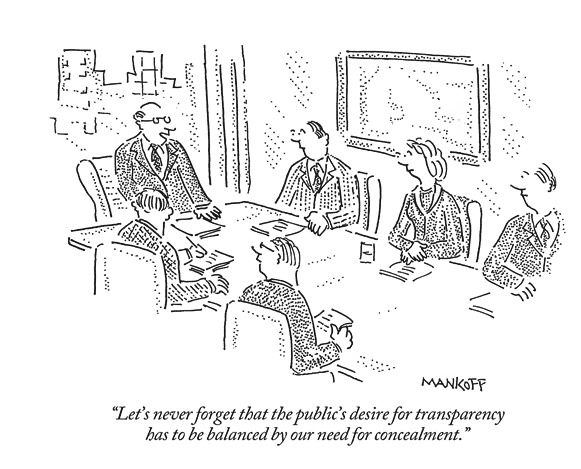
(Image copyright: Bob Mankoff)

To celebrate the 50th anniversary of the Freedom of Information Act (FOIA) in July, 2016, ProPublica, a U.S. nonprofit newsroom, published a long essay titled Delayed, Denied, Dismissed: Failures on the FOIA Front, in which several journalists detailed their frustrating experiences when requesting government data from U.S. institutions. In the comments section of ProPublica’s website, a reader captured the general feeling of the article as follows:

“To summarize: byzantine internal processes governed by antiquated laws operate with insufficient resources and no sense of urgency or accountability, and are shepherded by sometimes incompetent or dishonest public servants to produce documents that often have self-serving redactions or outright denials (sic)”.

This grim picture of the U.S. Government’s openness -with recent concerns related not only to Trump, but also Obama– is not an isolated case, unfortunately. Around the world, other governments have been accused by journalists and activists of discursively pushing openness forward, despite effectively making the use of government data difficult. For example, the Mexican government takes pride in having one of the most advanced transparency legislations, yet is currently discussing a new General Archives Law that will leave in the discretional and unaccountable hands of the Ministry of Interior the decision of what information should be preserved, and hence what data exists to be accessed. Moreover, the federal government is still struggling to make a buggy National Transparency Platform work, almost a year after it was presented as the main tool to guarantee Mexican citizens’ right to information. In the opposite side of the world, India’s recent public consultation to draft its License for Open Data use ended with a blatant disregard of the advice given by citizens, producing a regulation that does not offer any warranty against errors or omissions in the data held by the government, and transfers the liability for misuse to the citizens (instead of the data controller).

These examples point to the existence of a reactive process to citizen empowerment, in which some governments have found institutional ways to resist civil society’s access to data, hindering its ability to influence political processes. The research I will be conducting within the DATACTIVE project aims to locate empirically and frame theoretically this institutional reaction to citizen empowerment, to describe how it influences the configuration of the power relation between the State and citizens, and more broadly, how it affects the practice of data activism. To do so, I will start with a question originating in my own experience as an activist in Mexico: what if institutional resistance to public use of data is a political strategy, instead of the result of non-political flaws in the regulation related to Government Data?

By not taking for granted the State’s compromise to openness, I will explore whether the sociomaterial practices related to the production, dissemination and use of Government Data might make possible not only the empowerment of citizens, but also the State’s monopoly over some political issues which, according to the ideals of modern democracy, should be subject of collective discussion. The point of departure will be the work of proactive data activists who, while looking to mobilise Government Data to strengthen their attempts to influence public policy or oversee governmental action, have struggled to get the information they seek. In a second stage, I will look at how institutional actors deploy their resistance strategies, tracing the regulatory and material components involved in the process. Finally, I will develop a similar analysis over the strategies used by activists to counter institutional resistance. In the process, I hope to contribute to the study of the role played by data in configuring the power relation between citizens and the State in the age of Open Government, as well as helping to identify (and ideally produce) formal and informal mechanisms that activists can implement to keep rogue institutions under citizen control.

I am always interested in hearing about instances where public institutions do not follow through on their claims of making data effectively open and accessible to interested activists. If you have any examples or experiences, please drop me a line: guillen@data-activism.net

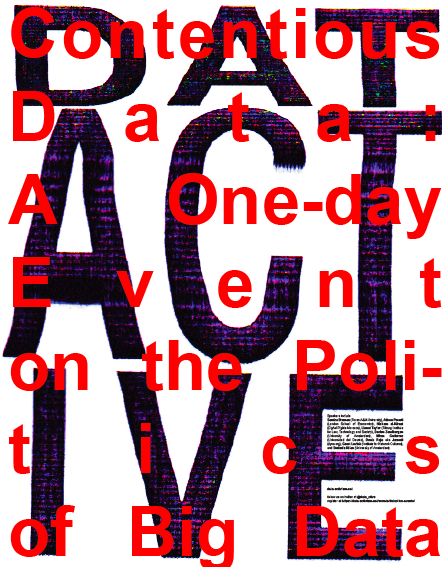
Report: Contentious Data and the Politics of Big Data for Activism

We are very happy to announce that the report from our September ‘Contentious Data’ workshop is ready for publication and circulation. The report is included below or can be downloaded here. Text continues below the report.

With special thanks all speakers, including Sandra Braman (Texas A&M University), Alison Powell (London School of Economics), Hisham al-Miraat (Digital Rights Morocco), Linnet Taylor (Tilburg Institute for Law, Technology and Society), Dorien Zandbergen (University of Amsterdam), Jaromil/Denis Rojo (dyne.org), Geert Lovink (Institute for Network Cultures), and Stefania Milan (DATACTIVE Principle Investigator).


DATACTIVE_report_Contentious_Data


Contentious Data brings together scholars and practitioners to explore the politics of big data from the perspective of activism and civil society.

Contentious Data is sponsored by the European Research Council (ERC), the Amsterdam Centre for Globalisation Studies (ACGS), the Amsterdam School of Cultural Analysis (ASCA), and the Amsterdam Institute for Social Science Research (AISSR).


Meeting with Federico M. Rossi

Yesterday we had the honour to meet with Federico M. Rossi, Latin America expert with a particular research interest focus on the relational study of social movements – state dynamics, and on the historical analysis of strategy-making. He paid us a visit as part of his book tour through the Netherlands.

bio

Federico M. Rossi is a Research-Professor of CONICET at the School of Politics and Government of the National University of San Martín. Rossi received his PhD in Political and Social Sciences from the European University Institute in Florence, Italy. His work has been published in more than fifteen edited volumes, in Latin American Politics and Society, Latin American Perspectives, Social Movement Studies, Mobilization, International Sociology, Desarrollo Económico, and in América Latina Hoy, among others. He is the author of The Poor’s Struggle for Political Incorporation: The Piquetero Movement in Argentina (Cambridge University Press, 2017) and coeditor with Marisa von Bülow of Social Movement Dynamics: New Perspectives on Theory and Research from Latin America (Routledge-Mobilization Series, 2015).

Visiting scholar Dağhan Irak

For the second week of January, we have Dağhan Irak visiting us. He is here to acquire methodological knowledge on the use of data activism in new social movements around the world and share his own findings during his research on the issue. Moreover, he is currently advancing the paper titled: ““Can you spot a party-state on Twitter?” An exploratory study on Turkey’s AKP and its state apparatuses”.

bio
Dağhan Irak is affiliated with the University of Strasbourg. After having received his undergraduate degree in journalism, and Master’s degree in history, he worked as a journalist and a political social media analyst. He has currently been conducting a doctoral research on the online politicisation of football fans in Istanbul, using DMI-TCAT for data collection and Social Network Analysis. Irak has also published indexed articles and book chapters on the use of SNA to detect political polarisation and media concentration. His research interests are digital sociology, sociopolitics of media and sociology of sports.

Lunch Seminar with Nathalie Maréchal

The 30th of November we had the honour to share our lunch with Nathalie Maréchal, Senior Research Fellow at Ranking Digital Rights. In her talk she discussed the Ranking Digital Rights project, a non-profit research initiative housed at New America’s Open Technology Institute, working with an international network of partners to set global standards for how companies in the information and communications technology (ICT) sector should respect freedom of expression and privacy.

More in specific, she eleborated on the findings of the 2015 Ranking Digital Rights Corporate Accountability Index. This research evaluates 16 of the world’s most powerful Internet and telecommunications companies on their public commitments and disclosed policies affecting users’ freedom of expression and privacy. She also discussed her own dissertation project “Defying Censorship, Evading Surveillance: The Political Economy of Circumvention Technology,” and her plans for 2017.

Short bio

Nathalie is Senior Research Fellow at Ranking Digital Rights, a project housed at New America’s Open Technology Institute. She first joined RDR as a COMPASS Fellow in Summer 2014 and was Senior Fellow in Information Controls from February to September 2016. During this time, Nathalie spearheaded RDR’s work on expanding RDR’s Corporate Accountability Index to include software & device companies in the 2017 Index. In her current position as Senior Research Fellow, Nathalie conducts research on topics related to internet policy, business and human rights, and continues to contribute to RDR’s global engagement and outreach efforts.

Kersti Wissenbach at Centre on Social Movement Studies, Florence

Between October and December Kersti stayed as a guest research fellow with the Centre on Social Movement Studies (COSMOS) of the Scuola Normale Superiore in Florence, Italy. She used the time at COSMOS to investigate ways forward to strengthen the relationship between Communication for Development and Social Movement research. Next to her focus on the intersection of communication and social movement studies she also visited various courses. Among others, she explored the potential of contemporary work on the intersection of democracy and social movements to inform her work on the open governance movement and civic tech activism in particular.

Kersti will return to Florence in Spring for her research and as a speaker in the workshop “Protest Media Ecologies: Communicative Affordances for Social Change in the Digital Era”.