Category: show on landing page

[BigDataSur-COVID] Riesgos e incertidumbres en las aplicaciones para el rastreo de contagios (1/2)

by Javier Sánchez-Monedero (Data Justice Lab)

Originally published in El Salto Diario

[EN] After weeks of debate on the implications of contact-tracking applications to fight COVID-19, there is an urgent need to interrogate their effectiveness and social impact beyond privacy and data protection issues. The recent proposal by Google and Apple imposes a model of governance of the pandemic that has been already adopted by many countries. However, the applications are useless in the face of the scarcity of other resources, such as health personnel with specific training, availability of reliable and rapid diagnostic tests, legal reforms or socio-health responses. In addition, tracing systems based on apps could systematically exclude vulnerable social groups as well threatening individual and collective rights.

[ES] Tras semanas de debate sobre las implicaciones de las aplicaciones de rastreo de contactos para luchar contra la COVID-19 urge analizar su eficacia e impacto social más allá de la privacidad y protección de datos. La alianza de Google y Apple de facto un modelo de gobernanza sanitaria desde las multinacionales que ya han aceptado muchos países. Sin embargo, las aplicaciones son inútiles ante la escasez de otros recursos, como personal sanitario con formación específica, disponibilidad de pruebas diagnósticas fiables y rápidas, reformas legales o respuestas sociosanitarias en caso de contagio, que a día de hoy, siguen siendo insuficientes. Además, los sistemas de rastreo mediante móviles podrían excluir sistemáticamente a grupos sociales vulnerables, además de presentar riesgos para los derechos individuales y colectivos.

El despliegue de sistemas de vigilancia casi nunca es temporal

En 2003 entraba en funcionamiento el sistema EURODAC, una base de datos biométricos para coordinar las peticiones de asilo en Europa. Los datos eran sencillos, las huellas dactilares y el país de entrada en la UE de quien demandaba asilo, y el objetivo único:  evitar peticiones de asilo en más de un país a la vez. Tras varias reformas, en la actualidad EURODAC es utilizado para controlar la inmigración irregular, deportar y separar a familias y es empleado por las fuerzas de seguridad como una base de datos de criminales. El ámbito e interoperabilidad de este sistema sigue ampliándose. La actual propuesta de reforma, en trámite, incluye la ampliación de datos (biografía, documentos, fotografía…), la reducción de la edad obligatoria para el registro a 6 años, la integración sistemática de los datos en los sistemas de visado, viajeros y policiales europeos y la cesión de datos a terceros países. Así, una herramienta sencilla y con un único fin se ha ido ampliando y reformando, incluyendo el marco legal, hasta convertirse en un sistema de vigilancia a escala continental de colectivos vulnerables.

Inmersos en el debate continuo sobre la gestión de la pandemia, las narrativas oficiales insisten en que si algo tienen en común las diferentes estrategias de éxito es el rol de la tecnología en la vigilancia epidemiológica de la población. En las últimas semanas, se ha intensificado el debate sobre la necesidad de adoptar aplicaciones de rastreo en nuestros móviles que permitan notificar a los usuarios que han estado en contacto con una persona infectada. Para ello, se registraría la línea temporal de desplazamientos y/o la lista de personas con las que se interactúa para informar a una persona que ha estado en contacto con un caso positivo. Se nos presentan China, Singapur o Corea del Sur como casos de éxito basados en la tecnología y se sugiere, en aras de controlar la epidemia, sacrificar la privacidad y autonomía permitiendo a estados y empresas gestionar, a través de la tecnología, aspectos de nuestras vidas a los que hasta ahora no podían acceder como son la libertad de circulación, el acceso a nuestro puesto de trabajo o nuestra libertad para reunirnos con otras personas.

La propuesta, sin precedentes en la historia, ha encendido numerosos debates alertando de los riesgos de que tal información exista o si es posible implementar estos sistemas mitigando al máximo estos riesgos. Al debate se suman Google y Apple con una propuesta de rastreos de contactos descentralizada y que parece ofrecer ciertas garantías de privacidad, aunque no debemos olvidar que estas dos empresas ya tienen en su poder el historial de movilidad de la mayor parte de los usuarios de sus terminales. En este texto interrogamos críticamente las opciones tecnológicas que se están barajando en Europa y España y cuestionamos tanto su función técnica como su rol desde la economía política y los riesgos que entrañan. En un momento de shock colectivo conviene no aceptar sistemas de control social irreversibles. La experiencia de casos como EURODAC nos dice que una vez puestos en marcha no se vuelven a apagar.

El (fracasado) modelo de Singapur

El debate viene presentado por el “éxito” del  modelo empleado en Singapur, país que aparentemente había controlado la pandemia en marzo gracias, en parte, al rastreo de contactos a través de los móviles, y de un estudio matemático publicado en Science el 30 de marzo (ver Ferretti et al. 2020). Frente a la idea de registrar dónde ha estado una persona, Singapur implementó el rastreo de contactos, es decir, con quién ha estado esa persona. Si tenemos una base de datos de contactos entre personas, cuando una presente síntomas y se confirme su caso, se podrá notificar a la lista de personas que estuvieron en contacto con esta persona. Este sistema funciona utilizando los sensores bluetooth de los móviles para poder establecer qué dispositivos están cerca de otros. Para ello, una aplicación emite periódicamente una serie de señales que son detectadas y almacenadas por los móviles de otras personas.

Frente a esta propuesta, otras opciones pasan por registrar todos los movimientos de una persona para ver si se ha coincidido en lugar y hora con una persona infectada o ha accedido a un recinto cerrado donde estuvo esta persona. Esto se implementaría, como ya lo hace Google para fines publicitarios, utilizando todos los sensores disponibles del móvil (GPS, wifi, bluetooth, brújula, acelerómetro, etc.). Además de estas opciones, los estados pueden implementar otras, como ocurre en el caso polaco o taiwanés, donde las personas en cuarentena deben activar la ubicación de su móvil y sacarse una fotografía en el interior de su casa tres veces al día o de lo contrario recibirán la visita de la policía. El catálogo de aplicaciones, como vemos, es variado.

Recientemente, el caso de “éxito” de Singapur dejó de serlo cuando a finales de abril el país tuvo que adoptar el confinamiento de la población ante la imposibilidad de controlar la expansión del virus por medios tecnológicos. Las causas son múltiples, por ejemplo se ha apuntado al hacinamiento de trabajadores inmigrantes pero también al exceso de confianza en las capacidades del sistema de seguimiento de contactos a través de móviles. Este sistema de rastreo de móviles de Singapur no ha funcionado por varias razones: 1) sólo 1 de cada 6 personas había instalado la aplicación; 2) para que la aplicación funcionase correctamente el móvil necesitaba estar desbloqueado y la aplicación en primer plano (es decir, no se podía utilizar otra función del móvil simultáneamente); 3) y fuera del objetivo de este texto, el porcentaje tan alto de personas contagiosas asintomáticas no diagnosticadas reduce mucho su eficacia. Además, aunque se nos presente el caso como un éxito basado en la tecnología, el gobierno de Singapur insiste en el que el sistema requería de una buena cantidad de rastreadores humanos para tener un control efectivo de los casos. Esta segunda parte de la historia no suele estar presente entre los promotores de estos sistemas automáticos.

Propuestas europeas y modelos con “privacidad desde el diseño”

El modelo de rastreo de movilidad ha sido descartado por la mayoría de países europeos tanto por la presión de la opinión pública como por la regulación de protección de datos de la UE. De este modo, muchos países como Alemania, Francia, SuizaReino Unido o Italia están estudiando o desarrollando sistemas de rastreo de interacciones entre personas. La posición de España aún no es clara al respecto. En todo caso, la UE acaba de publicar un serie de recomendaciones para el rastreo de contactos: las autoridades sanitarias deberán aprobar las aplicaciones y ser responsables del cumplimiento de la normativa europea de protección de datos incluyendo a las autoridades nacionales de protección de datos; los usuarios deben tener control total sobre sus datos; la instalación de la app debe ser voluntaria; no se podrán rastrear los movimientos de las personas; los datos deben almacenarse de forma cifrada únicamente en los móviles; las apps deben ser interoperables entre países de la UE y deberían desactivarse en cuanto no sean necesarias. Un ejemplo es la aplicación propuesta por la Generalitat de Catalunya, encargada a una empresa de marketing y geofencing, que incumpliría muchas de estas recomendaciones y probablemente cualquier reglamento europeo de protección de datos.

La mayoría de las soluciones caben en dos categorías, centralizadas o descentralizadas, y se diferencian en los grados de protección de la privacidad para la ciudadanía. El punto común es que todas se basan en el uso de bluetooth para detectar a personas a nuestro alrededor con las que hemos coincidido.

La opción centralizada consiste en el envío sistemático de información de interacciones de riesgo con personas a un servidor central. En este caso, se intenta mantener el anonimato dando al móvil un código (o pseudo-identificador) que permite que el servidor central notifique alguna interacción con un positivo de COVID-19 pero no permite identificar a la persona.

La opción descentralizada y con “privacidad desde el diseño” consiste en mantener los datos exclusivamente en el móvil de una persona (descentralizada) y evitar el uso de identificadores que puedan revelar la identidad de la persona pero que permitan que el sistema funcione. Este sería el ejemplo de DP-3T, que surge de un grupo multidisciplinar de investigadores en privacidad y seguridad de varias instituciones europeas. En este caso, cada terminal genera una serie de identificadores efímeros (cadenas de caracteres aleatorias) que emite a través de bluetooth. Estas cadenas cambian cada poco tiempo de manera que otros terminales pueden guardarlas y estimar cuánto tiempo han estado cerca de una persona sin saber quién es esta persona. En este caso, tanto los identificadores efímeros producidos como detectados se almacenan únicamente en el teléfono. Ante un caso positivo los identificadores efímeros generados desde un terminal se añadirían a una base de datos central que los teléfonos de todos los ciudadanos descargarían periódicamente para comprobar que los identificadores que han ido almacenando coinciden con los de alguna persona que haya dado positivo. De esta forma no se puede revelar la identidad de ninguna persona ni el lugar de la interacción. Para más detalles sobre el protocolo DP-3T animamos a consultar la documentación oficial y la versión en castellano del cómic explicativo.

A este tipo de diseños se les considera “privacidad desde el diseño” porque la privacidad se garantiza a nivel de diseño y código, y no se implementa en base a confianza a terceras partes. El equipo detrás del DP-3T genera confianza por varios factores que no se dan a la vez en otras propuestas: privacidad por diseño, el equipo tiene experiencia y es interdisciplinar, la documentación y código son abiertos y discutibles, el sistema está siendo auditado por terceras partes, etc. Por último, el nivel de centralización o descentralización pueden ser graduales. Este es el caso de Reino Unido, donde una clave de cifrado maestra protege, basándonos en nuestra confianza en el buen uso y custodia del organismo correspondiente, que se puedan usar los pseudo-identificadores (que luego se utilizan para generar identificadores efímeros) que genera la app al instalarse para identificar a personas reales. Por lo demás, esta opción tiene bastantes similitudes funcionales con DP-3T. Es complejo entrar en más detalles sobre el funcionamiento de las propuestas, ya que los cambios van por días (de hecho, en el momento de escribir este artículo el NHS está considerando descentralizar su propuesta en parte para cumplir con los requisitos técnicos y de privacidad que impone Apple, como veremos a continuación). Sea cual sea la opción, para completar el puzle, es necesario un servidor central, de la autoridad sanitaria, donde registrar los códigos de las personas diagnosticadas con COVID-19

Hace un mes, Google y Apple anunciaban una alianza para desarrollar un sistema de seguimiento de contactos a través de los móviles. Su propuesta se inspira en el protocolo de seguimiento DP-3T: detección de contactos con personas a través de las balizas bluetooth con identificadores efímeros que se almacenan y verifican siempre en el terminal del usuario. La propuesta de Google y Apple se implantaría a nivel del sistema operativo en próximas actualizaciones y no queda claro cómo podría aceptarla o rechazarla el usuario, aunque las primeras versiones desveladas apuntan a que sería una opción más de la configuración. La alianza ya ha publicado las especificaciones de la interfaz de programación para impulsar el desarrollo de aplicaciones que hagan uso de estos datos. La idea es que, si bien las multinacionales proporcionarán esta funcionalidad a nivel del sistema operativo, sea cada organismo local (estado, autoridad sanitaria, etc.) quién desarrolle una aplicación que haga uso de esos datos y los integre dentro del sistema de salud. Por ejemplo, en España el Ministerio de Sanidad podría desarrollar una aplicación que gestione qué acciones se disparan después de que nuestro terminal detecte que hemos estado con una persona diagnosticada de COVID-19.

En cualquier caso, las soluciones de cualquier tipo tendrán que pasar obligatoriamente por el visto bueno de Google y Apple si quieren ser operativas. Esto tiene varias razones técnicas: 1) cualquier solución pasa por la “adopción” masiva por la población, y esto probablemente se conseguirá con un sistema implantado a nivel del sistema operativo y/o una notificación a cada persona sugiriendo instalar la aplicación de la autoridad sanitaria correspondiente; 2) los dispositivos de Apple no permiten que una aplicación se ejecute en segundo plano por seguridad (fuente de enfrentamiento reciente entre el Gobierno Francés y Apple); 3) los sensores bluetooth de Android y Apple, a pesar de estar estandarizados, no son capaces de interaccionar correctamente sin una serie de modificaciones en las que trabajan las dos compañías. Como vemos, esta solución tecnológica impone de facto un modelo de gobernanza sanitaria desde las multinacionales que ya han aceptado países como Suiza.

[to be continued]

Gracias a todo el colectivo de La Paradoja de Jevons y a Elena Ruiz Peralta por sus correcciones y aportaciones.

Author’s bio

Javier Sánchez Monedero is Research Associate at Cardiff’s School of Journalism, Media and Culture and the Data Justice Lab. With a background in Computer Science, his current research aims at filling the knowledge gap between social and media researchers and technology as well as to perform technological auditing and design proposals in the intersection of intelligent information systems.

[BigDataSur-COVID] Rescatar lo común. Redes de cuidados en España

[EN] Children from precarious families have been more affected during the coronavirus pandemic due to their economic condition. The organization of citizens through social movements has been extremely effective in showing the lack of public policies to serve the poorest families.

[ES] Los niños de las familias vulnerables han sido uno de los grandes afectados durante la  pandemia del coronavirus por su situación económica. La organización de los ciudadanos a través de los movimientos sociales ha sido necesaria para mostrar las debilidades de las políticas públicas para ayudar a las familias más pobres

by Irene Ortiz 

Estos tiempos de pandemia, por su excepcionalidad como acontecimiento, así como de las medidas que los diferentes gobiernos han debido tomar en nombre de salud pública, son tiempos difíciles para todos. Sin embargo, los menores que eran beneficiarios de las becas de comedor de la Comunidad de Madrid, capital de España, alrededor de 11.500 niños, han visto su condición todavía más precarizada. Estos niños percibían estas becas de comedor por la situación de vulnerabilidad en la que se encontraban sus familias, beneficiarias de la renta mínima de inserción, que consiste en una cuantía de entre 512,67€ al mes para núcleos familiares de dos personas y de 587,78 para tres personas, con la posibilidad de llegar a un máximo de 950€ para todo el núcleo familiar. Estos niños recibían a través de las becas de comedor, en sus centros de estudios, una comida sana al día. La Comunidad de Madrid rescindió los contratos que tenía con las empresas de catering en los centros escolares el 11 de marzo, y seis días después, el 17 de marzo, la presidenta de la comunidad, Isabel Díaz Ayuso, anunció que había firmado un nuevo convenio con las empresas de comida Telepizza y Rodilla. El menú aprobado para los más de 11.000 niños en situación de exclusión consiste en pizzas, hamburguesas, ensaladas y nuggets de pollo, por parte de Telepizza, y sándwiches, ensaladas y bocadillos acompañados de dos piezas de fruta a la semana, ofrecidos por Rodilla.

Además, los niños de familias en situación de vulnerabilidad económica se enfrentan a otro problema: la interrupción de su educación. Al suspenderse las clases presenciales en los colegios e institutos por el covid-19, los niños y las niñas más vulnerables han sufrido serios problemas para continuar las clases que, desde entonces, son todas online. La falta de ordenadores o tablets, así como la conexión a internet ha mostrado cómo afecta la brecha tecnológica a los más vulnerables (un 3% de las familias con menores en España, según el Instituto Nacional de Estadística). De momento, la oenegé Save the Children ha tenido que atender a más de 1.500 familias para proporcionarles las herramientas necesarias para continuar con el curso.

El confinamiento ha mostrado sin ambages la profundidad de los problemas a los que se enfrentan las familias más vulnerables en España. No es solo la privación material severa que se traduce en la imposibilidad de continuar con sus clases, sino también los problemas mentales derivados de la falta de espacio. Según un informe de la oenegé Cáritas, 769 menores viven en una habitación en un piso compartido con su familia en la ciudad de Barcelona dada la imposibilidad de pagar un espacio más grande. No es admisible que algo tan básico como la vivienda se deje en manos de especuladores que convierten al fondo de inversión Blackstone en el mayor casero de España, porque nunca antepondrán el derecho a la vivienda a sus beneficios económicos.

Según la Red Europea de Lucha contra la Pobreza y la Exclusión social, un 21,6% de la población en España se encuentra dentro de la tasa de riesgo de pobreza. La crisis del coronavirus ha hecho visible la fragilidad de los niños de estas familias con escasos recursos económicos. Sin embargo, las familias, las asociaciones, las oenegés y las fundaciones llevan muchos años alertando de la precariedad en la que se encuentran más de 10.000.000 de personas en España, entre ellas el 30% de los niños del país. La pregunta que deberíamos hacernos es por qué se permite que los niños de familias pobres se alimenten con comida basura durante casi dos meses o por qué no ha sido una prioridad del gobierno garantizar la educación de los niños sin recursos.

Tejiendo redes

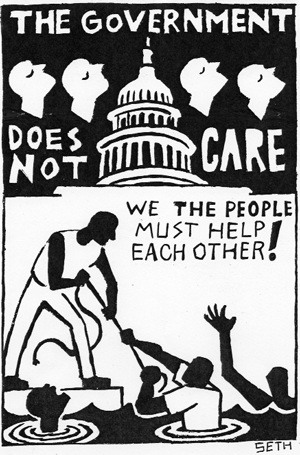
Por suerte, los movimientos vecinales, las asociaciones de padres y madres de los colegios, los diferentes movimientos sociales por la vivienda, así como varias oenegés, han creado redes de apoyo para las familias más vulnerables en estos momentos. Además del apoyo con material tecnológico por parte de Save the Children, algunas Asociaciones de Madres y Padres de Alumnos han querido colaborar donando ordenadores para los niños más vulnerables. También hemos visto cómo algunos vecinos han hecho turnos en los supermercados para solicitar la colaboración ciudadana para donar comida a los bancos de alimentos o cómo se han organizado redes para ir a hacer la compra a las personas que no podían salir de sus casas, entre los que debemos destacar la organización del Sindicato de Vendedores Ambulantes de Barcelona, que ha creado un banco de alimentos para las personas que se dedicaban a la venta ambulante y han visto su actividad interrumpida por las medidas adoptadas durante la cuarentena. Los vecinos voluntarios de Malasaña, Conde Duque y Chueca han creado un banco de alimentos que, de momento, entrega comida a 55 familias a la semana. Todos estos movimientos comparten una tónica común: el recurso de las soluciones tecnológicas para conseguir fines estrictamente sociales. Algunos movimientos que ya existían antes de la pandemia, como el Sindicato de Vendedores Ambulantes de Barcelona o el colectivo Malasaña Acompaña han adaptado sus actividades a las necesidades derivadas de la crisis sanitaria y las redes sociales han desempeñado un papel fundamental durante la crisis a la hora de difundir estas actividades y poder llegar a un mayor número de beneficiarios. Otras iniciativas, surgidas durante la pandemia, se han definido desde el inicio por su marcado carácter digital. Por ejemplo, el colectivo @Efecto_Llamada es un movimiento rigurosamente digital que está teniendo un impacto, de momento, en más 200 personas. Esta iniciativa ha aprovechado la cuarentena para conectar a través de Twitter a personas migrantes que quieran aprender castellano con voluntarios para conversar. De esta forma, a través de videollamadas, se da toda la libertad a las parejas participantes para ajustar sus horarios y participar de la forma que mejor les convenga. El uso de diferentes hashtags (#despensasolidaria,#RegularizacionYa o #HuelgaAlquileres) ha permitido lanzar campañas para solicitar ayuda, como el caso de los bancos de alimentos, pero también para demandar soluciones institucionales, como es el caso de #RegularizacionYa, que exige la regularización de las personas migrantes que, por su condición administrativa, se ven expulsados del sistema de derecho.

Es necesario poner de relieve que esta crisis sanitaria ha demostrado, una vez más, la importancia del cuidado de la vida desde lo comunitario. Las formas de lo común se han revelado en las diferentes iniciativas de cooperación que se han ido tejiendo en el cuidado de los otros durante la pandemia, curiosamente enmarcados en una época de distanciamiento social. La posibilidad de un mundo común se manifiesta en la existencia de estas redes que niegan la privatización de la existencia. Porque la pobreza de nuestras ciudades no nos puede ser indiferente, sigamos construyendo tejido social.


Author’s bio

Ph.D in Philosophy, unemployed.  Interested in biopolitics and philosophy of law. Student of International Relations. Contact: irene.ortiz.gala@gmail.com

[BigDataSur] The Challenge of Decolonizing Big Data through Citizen Data Audits [3/3]


Author: Katherine Reilly, Simon Fraser University, School of Communication

Data Stewardship through Citizen Centered Data Audits

In my previous two posts (the first & the second), I talked about the nature of data audits, and how they might be applied by citizens. Audits, I explained, check whether people are carrying out practices according to established standards or criteria with the goal of ensuring effective use of resources. As citizens we have many tools available at our disposal to audit companies, but when we audit companies according to their criteria, then we risk losing sight of our own needs in the community. The question addressed by this post is how to do data audits from a citizen point of view.

Thinking about data as a resource is a first step in changing our perspective on data audits. Our current data regime is an extractive data regime. As I explained in my first post, in the current regime, governments accept the central audit criteria of businesses, and on top of this, they establish the minimal protections necessary to ensure a steady flow of personal data to those same corporate actors.

I would like to suggest that we rethink our data regime in terms of data stewardship. The term ‘stewardship’ is usually applied to the natural environment. A forest might be governed by a stewardship plan which lays out the rights and responsibilities of resource use. Stewardship implies a plan for the management of those resources, both so that they can be sustained, and also so that everyone can enjoy them.

If the raw material produced by the data forest is our personal information, then we are the trees, and we are being harvested. Our data stewardship regime is organized to support that process, and audits are the means to enforce it. The main beneficiaries of the current data stewardship regime are companies who harvest and process our data. Our own benefits – our right to walk through the forest and enjoy the birds, or our right to profit from the forest materially – are not contemplated in the current stewardship regime.

It is tempting to conclude that audits are to blame, but really, evaluation is an agnostic concept. What matters are the criteria – the standards to which we hold corporate actors. If we change the standards of the data regime, then we change the system. We can introduce principles of stewardship that reflect the needs of community members. To do this, we need to start from the audit criteria that represent the localized concerns of situated peoples.

To this end, I have started a new project in collaboration with 5 fellow data justice organizations in 5 countries in Latin America: HiperDerecho in Chile, Karisma in Colombia, TEDIC in Paraguay, HiperDerecho in Peru and ObservaTIC in Uruguay. We will also enjoy the technical support of Sula Batsu in Costa Rica.

Our focus will be on identifying alternative starting points for data audits. We won’t start from the law, or the technology, or corporate policy. Instead, we will start from people’s lived experiences, and use these as a basis to establish criteria for auditing corporate use of personal data.

We will work with small groups who share a common identity and/or experience, and who are directly affected by corporate use of their personal data. For example, people with chronic health issues have a stake in how personal data, loyalty programs and platform delivery services mediate their relationship with pharmacies and pharmaceutical companies. The project will identify community collaborators who are interested in working with us to establish alternative criteria for evaluating those companies.

Our emerging methodology will use a funnel-like approach, starting from broad discussions about the nature of data, passing through explorations of personal practices and the role of data in them, and then landing on more specific and detailed explorations of specific moments or processes in which people share their personal data.

Once the group has learned something about the reality of data in their daily lives – and in particular the instances where data is of particular concern from them – we will facilitate group activities that help them identify their data needs, as well as the behaviors that would satisfy those needs. An example of a data need might be “I need to feel valued as a person and as woman when I interact with the pharmacy.” A statement of how that need might be satisfied could be, for example, “I would feel more valued as a person and as a woman if the company changed its data collection categories.”

We are particularly interested to think through the application of community criteria to companies who have grown in power and influence during the Covid-19 pandemic. Companies like InstaCart, SkipTheDishes, Rapi, Zoom, and Amazon are uniquely empowered to control urban distribution chains that affect the welfare of millions. What do community members require from these companies in terms of their data practices, and how would they fare against an audit based on those criteria?

We find inspiration for alternative audit criteria in data advocacy projects that have been covered by DATACTIVE’s Big Data from the South Blog. For example, the First Nations Information Governance Centre (FNIGC) of Canada has established the principles of ownership, control, access and permission for the management of First Nations data, and New Zealand has adopted Maori knowledge protocols for information systems used in primary health care provision (as reported by Anna Carlson). Meanwhile, the Mexican organization Controla tu Gobierno argues that we need to view data “less as a commodity – which is the narrative that constantly tries to make us understand data as the new oil – and more as a source of meaning” (Guillen Torres and Mayli Sepulveda, 2017).

From examples like these, and given the concept of data stewardship, we can begin to see that data is only as valuable as the criteria used to assess it, and so we urgently need alternative criteria that reflect the desires, needs and rights of communities.

How would corporate actors fare in an audit based on these alternative criteria? How would such a process reposition the value of data within the community? Who should carry out these evaluative processes, and how can they work together to create a more equitable data stewardship regime that better serves the needs of communities?

By answering these questions, we can move past creating data literate subjects for the existing data stewardship regime. Instead, we can open space for discussion about how we actually want our data resources to be used. In a recent Guardian piece, Hare argued that “The GDPR protects data. To protect people, we need a bill of rights, one that protects our civil liberties in the age of AI.”2 The content of that bill of rights requires careful contemplation. Citizen data audits allow us to think creatively about how data stewardship regimes can serve the needs of communities, and from there we can build out the legal frameworks to protect those rights.


About the author: Dr. Katherine Reilly is Associate Professor in the School of Communication at Simon Fraser University in Vancouver, Canada. She is the recipient of a SSHRC Partnership Grant and an International Development Research Centre grant to explore citizen data audit methodologies alongside Derechos Digitales in Chile, Fundacion Karisma in Colombia, Sula Batsu in Costa Rica, TEDIC in Paraguay, HiperDerecho in Peru, and ObservaTIC in Uruguray.

WomenonWeb censored in Spain as reported by Magma

Author: Vasilis Ververis

The Magma project just published new research on censorship concerning womenonweb.org, a non-profit organization providing support to women and pregnant people. The article describes how the major ISPs in Spain are blocking womenonweb.org’s website. Spanish ISPs have been blocking this website by means of DNS manipulation, TCP reset, HTTP blocking with the use of a Deep Packet Inspection (DPI) infrastructure. Our data analysis is based on network measurements from OONI data. This is the first time that we observe Women on Web being blocked in Spain.

About Magma: Magma aims to build a scalable, reproducible, standard methodology on measuring, documenting and circumventing internet censorship, information controls, internet blackouts and surveillance in a way that will be streamlined and used in practice by researchers, front-line activists, field-workers, human rights defenders, organizations and journalists.

About the author: Vasilis Ververis is a research associate with DATACTIVE and a practitioner of the principles ~ undo / rebuild ~ the current centralization model of the internet. Their research deals with internet censorship and investigation of collateral damage via information controls and surveillance. Some recent affiliations: Humboldt-Universität zu Berlin, Germany; Universidade Estadual do Piaui, Brazil; University Institute of Lisbon, Portugal.

[BigDataSur-COVID] La otra epidemia: Los feminicidios que no se cuentan

by Teresa Villaseñor

Antes del Covid-19, México ya sufría otra epidemia que durante el 2019 reclamó miles de vidas: los feminicidios. ¿Qué están haciendo las mujeres mexicanas para visibilizar la violencia de género en tiempos de cuarentena?

English abstractAs the COVID-19 virus spreads across Central America, another pandemic remains under the radar: domestic violence, which worsens as a consequence of the lockdown induced by the pandemic. This blog post explores the efforts of Mexican women to raise awareness of gender violence, reflecting on how data activism is helping to make this happen.

Mientras la pandemia provocada por el Covid-19 avanza en Latinoamérica, existe otra pandemia que sigue invisible: la creciente cantidad de casos de violencia de género que arrasa en México. Los números siguen aumentando, como la consecuencia no deseada de la cuarentena impuesta por el gobierno para combatir el contagio del virus. Esta violencia de género es la otra epidemia que lleva años cobrando vidas en México. ¿Qué están haciendo las mujeres mexicanas para visibilizar la violencia de género en tiempos de cuarentena?

Violencia de género en México y la movilización feminista

La violencia de género ya era una epidemia en México cuando se dieron los primeros casos positivos de Covid-19 en el país. Durante el 2019 asesinaron a 3,825 mujeres, cifra que la geofísica María Salguero ha rastreado a través de su mapa de feminicidios, el cual se nutre de los asesinatos a mujeres reportados en la prensa, proyecto que lleva desde 2016. Es decir, en México se asesinaba por lo menos a diez mujeres al día. Cabe notar que estas no son cifras oficiales gubernamentales, las cuales difieren mucho de las de este proyecto generado por la ciudadanía.

En febrero de este año las redes sociales se llenaron de los hashtags #JusticiaParaTodas y #CosasQuePasanPorSerMujer. La sociedad mexicana se había enfurecido por los asesinatos de la pequeña Fátima e Ingrid Escamilla. El caso de Fátima se trató de una niña de 7 años secuestrada, asesinada y mutilada por sus vecinos. Ingrid Escamilla fue una mujer asesinada y mutilada, cuyas imágenes del cuerpo sin vida fueron publicadas en varios medios de comunicación. Como resultado, las fotografías fueron compartidas en las redes sociales. Esto causó que muchos usuarios etiquetaran fotografías hermosas con el nombre de Ingrid Escamilla, para “limpiar” su nombre y hacer que se perdieran las imágenes publicadas por los medios de comunicación amarillistas.

Este año, el 8 de marzo, Día Internacional de la Mujer, fue muy especial para las mexicanas. Ese día salieron a la calle cientos de mujeres para protestar contra la violencia de género, un problema que lleva años en la sociedad latinoamericana y que cada vez parece empeorar. Las manifestantes demandaron un cambio en la estructura social para que ya no se permita la violencia sexual, exigieron igualdad de género en las políticas públicas y la no impunidad a los agresores, y la transparencia en los datos sobre violencia de género.

Hasta ese momento, todo el cambio que se había logrado venía desde las mismas sociedades, de las mujeres reunidas bajo un objetivo y sin el apoyo del gobierno mexicano.

Cuatro días después, el 12 de marzo, se declaró la pandemia mundial, y en México el 20 de marzo el gobierno federal declaró la cuarentena. Pero esto no fue lo peor para las mujeres mexicanas. La mayoría de los casos de violencia de género se dan en los hogares, y ahora muchas mujeres se vieron obligadas a estar encerradas junto con sus agresores.

Sin mecanismos para frenar la violencia de género durante la pandemia

En México se están haciendo esfuerzos para frenar el contagio de Covid-19, pero no existen mecanismos para frenar la violencia doméstica de género. Esto hace que las mujeres mexicanas no sólo tengan miedo de un contagio, sino que también aumenta el miedo a sufrir violencia en sus casas, sin contar el número de mujeres que viven en condición de pobreza. 

En el Banco Nacional de Datos e Información sobre Casos de Violencia contra las Mujeres (BANAVIM), se declaró que del 20 de marzo al 2 de mayo se registraron 19,602 agresiones contra la mujer, y el 90% de estas agresiones fueron cometidas por personas que viven bajo el mismo techo. El Secretariado Ejecutivo del Sistema Nacional de Seguridad Pública (SESNSP) mencionó que durante el mes de marzo se recibieron 64,858 llamadas al 911 debido a violencias contra la mujer, con un aumento del 23% en comparación con el mes anterior. 

Esto indica que cada día de cuarentena se denuncian de manera formal 490 casos de violencia, uno cada tres minutos. Este cálculo no cuenta el número de casos que se dan en casa y no son denunciados a las autoridades. Hasta el mes de abril se declararon al menos 210 feminicidios en el país.

Todos los esfuerzos que se han hecho para medir el índice de contagios de Covid-19 han desviado la mirada al problema que afectaba a las mujeres desde hace años. La crisis provocada por la pandemia Covid-19 es más visible porque ocurre a nivel mundial y se compara a México con otros países. De esta manera, los recursos gubernamentales han sido recortados de los programas de violencia de género para darlos a la infraestructura en el sector salud, a pesar de que la violencia contra las mujeres sigue creciendo.

Las respuestas desde abajo

Como ahora están prohibidos los eventos masivos, las marchas y las protestas como las ocurridas el ocho de marzo, la mejor opción para las mujeres mexicanas es recurrir al activismo digital, como se vio en los casos de Fátima e Ingrid Escamilla. El 6 de mayo, el presidente de México, Andrés Manuel López Obrador, fue cuestionado sobre las políticas contra la violencia doméstica durante la cuarentena. López Obrador negó que los índices hubieran aumentado. Los días posteriores, diversas organizaciones feministas como Brujas del Mar y Luchadoras alzaron la voz, y junto con otras asociaciones de derechos humanos hicieron declaratorias públicas en sus redes sociales.

Desde el lunes once de mayo, muchísimas mujeres se unieron a exigir que se visibilice la violencia de género doméstica bajo el hashtag #NosotrasTenemosOtrosDatos, para pedir transparencia en la identificación y publicación de casos de violencia doméstica en todo el país.

Debido a la pandemia, el activismo de datos -es decir el uso estratégico de información para generar un cambio social- es cada vez más relevante y necesario para visualizar todos los problemas que enferman a la sociedad, no sólo las infecciones de Covid-19 sino también las otras epidemias como la violencia de género.


Teresa Villaseñor es feminista, bibliotecóloga y actualmente es estudiante de la maestría en Desarrollo Económico y Cooperación Internacional en la Benemérita Universidad Autónoma de Puebla.


[BigDataSur-COVID] The Russian “Sovereign Internet” Facing Covid-19

What does the Covid-19 crisis say about the Russian state’s digital power, and the challenges it poses to public freedoms?

By Olga Bronnikova, Françoise Daucé, Ksenia Ermoshina, Francesca Musiani, Bella Ostromooukhova, Anna Zaytseva

Originally published in French on The Conversation France on April 29, 2020, under a Creative Commons BY-NC license. Translated by Francesca Musiani.


Despite the evolution of the Covid-19 pandemic in Russia, a state of emergency has not been declared in the country: only a state of “high alert” has entered into force in Moscow and in specific regions since early April. “Compulsory holidays” are only partially respected by a population plunged into a growing vagueness that is health-related, legal and economic at once. In this context, Russia is deploying and updating its digital strategy and infrastructure, which have been carefully scrutinized in recent years because of their (increasingly) strong centralizing and authoritarian dimensions. What does the Covid-19 crisis say about the Russian state’s digital power, and the challenges it poses to public freedoms?

The Russian state facing Covid-19: Digital ambitions put to the test

The Russian authorities very early advocated the massive use of digital tools to control the movements of citizens and limit the circulation of the virus. These uses aimed at “securitization” are inspired by foreign examples (China, Korea, Singapore), but they are also part of the “sovereignty” logic of the Russian Internet (Runet), already engaged before the start of the epidemic, and they are consolidating surveillance systems whose existence dates back several years (e.g. video surveillance cameras, aggregation of geolocation data supplied to the authorities by mobile operators).

As of February, Sergei Sobyanin, the mayor of Moscow, proposes the use of facial recognition to monitor people returning from abroad, using the surveillance cameras of the “Safe City” program, in force since 2018. Between February and March, 200 people who broke their quarantine were thus identified, including a man who took out his trash. But as a study by IT and SORM (a blog on Telegram devoted to Runet surveillance and regulation issues, with more than 73,000 subscribers) shows, this device is a catalyst for inequality: these surveillance cameras are mainly installed in the modest districts of Moscow because those who decide their location, who themselves reside in the upscale districts, do not wish their activities to be monitored.

On March 20, 2020, faced with an increase in contaminations, Prime Minister Mikhail Mishustin recommends monitoring citizens who are or have been in contact with infected people, by collecting geolocation data from operators, and transmitting them to local administrations. A patient monitoring application, “Social monitoring”, is made available on April 1 on GooglePlay. It quickly becomes controversial, as its surveillance goes far beyond the movement of patients and offers little protection of personal data; the application is finally withdrawn.

However, digital tracking of citizens has not been abandoned. Since April 13, all trips within Moscow that involve public transportation are carried out, under penalty of fines, with a digital pass, to be generated on an official website. In response to criticism of the “Social Monitoring” application, the Moscow municipality declares that with this new device, personal data will be stored on Russian territory (in accordance with the 2014 law, targeting in particular “giant” United States-based platforms such as Google) and will be deleted when the “high alert” state will be over. The same system works in Tatarstan and the Primorye region; QR-Code passes are also available and recommended but not mandatory in Nizhny-Novgorod, while other Russian regions resort to lighter measures.

Resistance and mobilisations of the free Internet

The use of digital data to strengthen surveillance of the population while coping with the disease is causing concern for defenders of online freedoms. Technologists, engineers and developers discuss government projects and conduct independent investigations to uncover security vulnerabilities, technical issues and other controversial aspects of the technologies deployed by the Russian state.

Several associations and independent media alert Internet users to the growing attacks on the protection of personal data and the development of online surveillance. The NGO Roskomsvoboda published, on March 27, a vademecum on digital rights in a pandemic period, stressing that the use of personal data, especially biometric data, legally requires the consent of individuals. But “the use of facial recognition is in a gray area,” argues lawyer Sarkis Darbinyan. The association is also launching, with other associations in the post-Soviet space, an inventory of restrictions on digital freedoms around the world, while the Agora association is opening a legal aid service linked to the pandemic. Its lawyers are also concerned about the use of facial recognition to enforce quarantine. Activists close to government-opposing personality Alexei Navalny (Society for the Protection of Internet) denounce, even more boldly, the establishment of a “digital gulag”, and call on citizens not to transmit their personal data to the applications that control movements and trace contacts.

At the same time, solidarity initiatives are developing on the Internet, aimed at supporting the poorest citizens and the caregivers. The Makers vs. Covid collective uses 3D printing techniques to provide doctors with the protective gear they need. An online hackathon, “Covidhack”, is developing a bot for Telegram that helps produce a citizen database allowing people with coronavirus to speak anonymously and map their symptoms and requests.

Internet infrastructures are also being weakened by the pandemic, due to the growth in traffic linked to the new digital habits of confinement. Russian networks are frequently down, but the on-site work of technicians and cable operators employed by the three thousand and more Internet service providers (ISPs) that manage these networks comes at the risk of legal threats. OrderKom, a consulting firm for ISPs, offers these workers legal support which includes the preparation of authorizations for movements due to on-site work, and legal defense in the event of a fine.

Faults and paradoxes of digital surveillance

Over the days and the weeks, gaps emerge between the authorities’ security ambitions and the realities of their implementation. Digital surveillance and health-related solutions are delegated to many public and private, federal and regional players, who often make contradictory decisions. The paradoxes and dysfunctions documented by online freedom activists show the limits of the announced “securitization” design. Perhaps the most obvious failure is that of digital passes in Moscow. The Nedoma.mos.ru site, developed to generate them, uses foreign hosting servers; the government was therefore accused of putting its own project of sovereign Runet in jeopardy.

Digital freedom activists, such as Mikhail Klimarev (Society for the Protection of the Internet), point to the ineffectiveness of technological solutions; Covid-19 strategies should focus on civic responsibility, while digital surveillance infantilizes citizens and is likely to be circumvented. This crisis highlights the lack of mutual trust between citizens and the state. Indeed, the information on the epidemic disseminated by the state is viewed with suspicion, oscillating between “they are hiding the true extent of the disaster to us” and “it is a plot to muzzle us even more”. If the authorities take the Covid-19 crisis as an opportunity to re-open their hunt for “fake news”, on their end, Youtubers and independent journalists denounce the incomplete or questionable information disseminated by representatives of power, and their behavior in public (such as that of Vladimir Putin’s spokesperson, who showed up at a press conference with a highly contested virus “blocker” badge). Sometimes, events are borderline ironic, such as the Ministry of Foreign Affairs’ opening of a thread of information for its nationals abroad on the Telegram application… officially banned in Russia.

Thus, part of civil society, without questioning the need for confinement, mobilizes against the threatening initiatives of the Russian Big Brother. It denounces the incompetence of the authorities to manage the implementation of technical devices as well as the institutional power’s violation of its own laws (like the provision on the storage of Russian data on Russian territory), as well as the non-protection of personal data, which exposes them to leaks in the databases black market.

While the wide and ambitious Russian Internet surveillance and sovereignty project is gaining strength during the coronavirus crisis, its implementation is uncertain and often contradictory. The pandemic demonstrates the limits of the Internet infrastructure centralization project, and the government ends up being obliged to relax specific regulatory measures, such as the Yarovaya law (which requires ISPs to keep the history and metadata of users for the purpose of legal interception and fight against terrorism). However, this apparent complexity is not necessarily synonymous with ineffectiveness. It is part of the flexible reconfigurations of digital constraints in Russia, adjusting as best it can to the recently rising challenges, and – legitimately so – raises the concerns of digital freedoms defenders.


About the authors. Olga Bronnikova, Associate Professor at Université Grenoble Alpes. Françoise Daucé, Professor at EHESS, Director of CERCEC. Ksenia Ermoshina, Assistant Research Professor at CNRS, Centre for Internet and Society. Francesca Musiani, Associate Research Professor at CNRS, Deputy Director, Centre for Internet and Society. Bella Ostromooukhova, Associate Professor at Sorbonne Université. Anna Zaytseva, Associate Professor at Université Toulouse 2 Jean Jaurès.

All authors are members of the ANR-funded ResisTIC research project. Thanks to Grégory Rayko for guiding the original article to publication.

[BigDataSur] The Challenge of Decolonizing Big Data through Citizen Data Audits [2/3]


A First Attempt at Citizen Data Audits

Author: Katherine Reilly, Simon Fraser University, School of Communication

In the first post in this series, I explained that audits are used to check whether people are carrying out practices according to established standards or criteria. They are meant to ensure effective use of resources. Corporations audit their internal processes to make sure that they comply with corporate policy, while governments audit corporations to make sure that they comply with the law.

There is no reason why citizens or watchdogs can’t carry out audits as well. In fact, data privacy laws include some interesting frameworks that can facilitate this type of work. In particular, the EU’s General Data Privacy Regulation (GDPR) gives you the right to know how corporations are using your personal data, and also the ability to access the personal data that companies hold about you. This right is reproduced in the privacy legislation of many countries around the world from Canada and Chile to Costa Rica and Peru, to name just a few.

With this in mind, several years ago the Citizen Lab at the University of Toronto set up a website called Access My Info which helps people access the personal data that companies hold about them. Access My Info was set up as an experiment, so the site only includes a fixed roster of Canadian telecommunications companies, fitness trackers, and dating apps. It walks users through the process of submitting a personal data request to one of these companies, and then tracks whether the companies respond. The goal of this project was to crowdsource insights from citizens that would help researchers learn what companies know about their clients, how companies manage personal data, and who companies share data with. The results of this work have been used to advocate for changes to digital privacy laws.

Using this model as a starting point, in 2019, my team at SFU, and a team from the Peruvian digital rights advocate HiperDerecho, set up a website called SonMisDatos (Son Mis Datos translates as “It’s My Data”.) Son Mis Datos riffed on the open source platform developed by Access My Info, but made several important modifications. In particular, HiperDerecho’s Director, Miguel Morachimo, made the site database-driven so that it was easier to update the roster of corporate actors or their contact details. Miguel also decided to focus on companies that have a more direct material impact on the daily lives of Peruvians – such as gas stations, grocery stores and pharmacies. These companies have loyalty programs that are involved in collecting personal data about users.

Then we took things one step further. We used SonMisDatos to organize citizen data audits of Peruvian companies. HiperDerecho mobilized a team of people who work on digital rights in Peru, and we brought them together at two workshops. At the first workshop, we taught participants about their rights under Peru’s personal data protection laws, introduced SonMisDatos, and asked everyone to use the site to ask companies for access to their personal data. Companies need time to fulfill those requests, so then we waited for two months. At our second workshop, participants reported back on the results of their data requests, and then I shared a series of techniques for auditing companies on the basis of the personal data people had been able to access.

Our audit techniques explored the quality of the data provided, corporate compliance with data laws, how responsive companies were to data requests, the quality of their informed consent process, and several other factors. My favorite audit technique reflected a special feature of the data protection laws of Peru. In that country, companies are required to register databases of personal information with a state entity. The registry, which is published online, includes lists of companies, the titles of their databases, as well as the categories of data collected by each database. (The government does not collect the contents of the databases, it only registers their existence.)

With this information, our auditors were able to verify whether the data they got back from corporate actors was complete and accurate. In one case, the registry told us that a pharmaceutical company was collecting data about whether clients had children. However, in response to an access request, the company only provided lists of purchases organized by date, skew number, quantity and price. Our auditors were really bothered by this discovery, because it suggested that the company was making inferences about clients without telling them. Participants wondered how the company was using these inferences, and whether it might affect pricing, customer experience, access to coupons, or the like.

In another case, one of our auditors subscribed to DirecTV. To complete this process, he needed to provide his cell phone number plus his national ID number. He later realized that he had accidentally typed in the wrong ID number, because he began receiving cell phone spam addressed to another person. This was exciting, because it allowed us to learn which companies were buying personal data from DirecTV. It also demonstrated that DirecTV was doing a poor job of managing their customer’s privacy and security! However, during the audit we also looked back at DirecTV’s terms of service. We discovered that they were completely up front about their intention to sell personal information to advertisers. Our auditors were sheepish about not reading the terms of the deal, but they also felt it was wrong that they had no option but to accept these terms if they wanted to access the service.

On the basis of this experience, we wrote a guidebook that explains how to use Son Mis Datos, and how to carry about an audit on the basis of the ‘access’ provisions in personal data laws. The guide helps users think through questions like: Is the data complete, precise, unmodified, timely, accessible, machine-readable, non-discriminatory, and free? Has this company respected your data rights? What does the company’s response to your data request suggest about its data use and data management practices?

We learned a tonne from realizing these audits! We know, for instance, that the more specific the request, the more data a company provides. If you ask a company for “all of the personal data you hold about me” you will get less data that if you ask for “all of my personal information, all of my IP data, all of my mousing behaviour data, all of my transaction data, etc.”

Our experiments with citizen data audits also allow us to make claims about how companies define the term “personal data.” Often companies define personal data very narrowly to mean registration information (name, address, phone number, identification number, etc.). This lies in extreme contrast to the academic definition of personal data, which is any information that can lead to the identification of an individual person. In the age of big data, that means pretty much any digital traces you produce while logged in. Observations like these allow us to open up larger discussions about corporate data use practices, which helps to build citizen data literacy.

However, we were disappointed to discover that our citizen data audits worked to validate a data regime that is organized around the expropriation of resources from our communities. In my first blog post I explained that the 5 criteria driving data audits are profitability, risk, consent, security and privacy.

Since our audit originated with the law, with technology, and with corporate practices, we ended up using the audit criteria established by businesses and governments to assess corporate data practices. And this meant that we were checking to see if they were using our personal and community resources according to policies and laws that drive an efficient expropriation of those very same resources!

The concept of privacy was particularly difficult to escape. The idea that personal data must be private has been ingrained into all of us, so much so that the notion of pooled data or community data falls outside the popular imagination.

As a result, we felt that our citizen data audits did other people’s data audit work for them. We became watchdogs in the service of government oversight offices. We became the backers of corporate efficiencies. I’ve got nothing personal against watchdogs — they do important work — but what if the laws and policies aren’t worth protecting?

We have struggled greatly with the question of how to generate a conversation that moves beyond established parameters, and that situates our work in the community. With this in mind, we’ve begun to explore alternative approaches to thinking about and carrying out citizen data audits. That’s the subject of the final post in this series.


About the author: Dr. Katherine Reilly is Associate Professor in the School of Communication at Simon Fraser University in Vancouver, Canada. She is the recipient of a SSHRC Partnership Grant and an International Development Research Centre grant to explore citizen data audit methodologies alongside Derechos Digitales in Chile, Fundacion Karisma in Colombia, Sula Batsu in Costa Rica, TEDIC in Paraguay, HiperDerecho in Peru, and ObservaTIC in Uruguray.

[blogpost] Thinking Outside the Black-Box: The Case for ‘Algorithmic Sovereignty’ in Social Media

Urbano Reviglio, Ph.D. candidate of the University of Bologna in collaboration with Claudio Agosti, the brain behind tracking.exposed just pubished a new academic article on Algorithmic Sovereignty in Social  Media + Society (SAGE). Find an extended abstract below, and the full paper here

Everyday algorithms update a profile of “who you are” based on your past preferences, activities, networks and behaviours in order to make a future-oriented prediction and suggest you news (e.g. Facebook and Twitter), videos (e.g. Youtube), movies (e.g. Netflix), songs (e.g. Spotify), products (e.g. Amazon) and, of course, ads. These algorithms define the boundaries of your Internet experience, affecting, steering and nudging your information consumption, your preferences, and even your personal relations.

Two paradigmatic (and likely most influential) examples clarify well the importance of this process. On Facebook, you can encounter 350 posts on average, prioritized on about 1.500. As such, you can be exposed only to 25% of the information, while roughly 75% is actually hidden. This is Facebook’s newsfeed algorithm that is choosing for you. And it is rather good at that. Think also of Youtube; its recommendations already drive more than 70% of the time you spend in the platform, meaning you are mostly “choosing” in a pre-determined set of possibilities. In fact, 90% of the ‘related content’ on the right side of the website is already personalized for you. Yet, this process occurs largely beyond your control and it is mostly based on implicit personalization — behavioural data collected from subconscious activity (i.e. clicks, time spent etc.) — rather than on deliberate and expressed preferences. Worryingly, this might become a default choice in future personalization, essentially because you may be well satisfied without further questioning the process. Do you really think the personalization that recommends you what to read and watch is indeed the best you could experience?

Personalization is not what is narrated by mainstream social media platforms. There are a number of fundamental assumptions that are nowadays shared by most researchers, and these need clarifications. Profiling technologies that allow personalization create a kind of knowledge about you that is inherently probabilistic. Personalization, however, is not exactly ‘personal’. Profiling is indeed a matter of pattern recognition, which is comparable to categorization, generalization and stereotyping. Algorithms cannot produce or detect the complexities of yourself. They can, however, influence your sense of self. As such, profiling algorithms can trivialize your preferences and, at the same time, steer you to conform to the status quo of your past actions chosen by ‘past selves’, narrowing your “aspirational self.” They can limit the diversity of information you are exposed to, and they can ultimately perpetuate existing inequalities. In other words, they can limit your information self-determination. So, how can you fully trust proprietary algorithms that are naturally designed for ‘engagement optimization’ — to hook you up to the screen as much as possible — and not explicitly designed for your personal growth and society’s cohesion?

One of the most concerning problems is that personalization algorithms are increasingly ‘addictive by design’. Human behavior indeed can be easily manipulated by priming and conditioning, using rewards and punishments. Algorithms can autonomously explore manipulative strategies that can be detrimental to you. For example, they can use techniques (e.g. A/B testing) to experiment with various messages until they find the versions that best exploit your vulnerabilities. Compulsion loops are already found in a wide range of social media. Research suggests that such loops can work via variable-rate reinforcement in which rewards are delivered unpredictably — after n actions, a certain reward is given, like in slot machines. This unpredictability affects the brain’s dopamine pathways in ways that magnify rewards. You think you liked that post… but you may have been manipulated to like that after several boring posts, with an outstanding perfect timing. Consider how just dozens of Facebook Likes can reveal useful and highly accurate correlations; hundreds of likes can predict your personality better than your mother could do, research suggests. This can be easily exploited. For example, if you are vulnerable to moral outrage. Researchers have found that each word of moral outrage added to a tweet raises the retweet rate by 17%. Algorithms know that, and could feed you with the “right” content at the right time. 

As a matter of fact, personalization systems deeply affect public opinion, and more often negatively. For increasingly more academics, activists, policy-makers and citizens the concern is that social media, more generally, are downgrading our attention spans, a common base of facts, the capacity for complexity and nuanced critical thinking, hindering our ability to construct shared agendas to help to solve the epochal challenges we all face. This supposed degraded and degrading capacity for collective action arguably represents “the climate change of culture.” Yet, research on the risks posed by social media – and more specifically their personalization systems – is still very contradictory; these are very hard to prove and, eventually, to mitigate. In light of the fast-changing media landscape, many studies become rapidly outdated, and this contributes to the broader crisis concerning the study of algorithms; these are indeed “black-boxed”, which means their functioning is opaque and their interpretability may not even be clear to engineers. Moreover, there are no easy social media alternatives one can join in to meet friends and share information. These one day might spread but until that day billions of people worldwide have to rely on opaque personalization systems that ultimately may impoverish them. They are an essential and increasingly valuable public instrument to mediate information and relations. And considering that these even introduce a new form of power of mass behavioral prediction and modification that is nowadays concentrated in very few tech companies, there is a clear need to radically tackle these risks and concerns now. But how?

By analyzing challenges, governance and regulation of personalization, what we argue in this paper is that we as a society need to frame, discuss and ultimately grant to all users a sovereignty over personalization algorithms. More generally, with ‘algorithmic sovereignty’ in social media we intend the regulation of information filtering and personalization design choices according to democratic principles, to set their scope for private purposes, and to harness their power for the public good. In other words, to open black-boxed personalization algorithms of (mainstream) social media to citizens and independent and public institutions. By doing this, we also explore specific experiences, projects and policies that aim to increase users’ agency. Ultimately, we preliminary highlight basic legal, theoretical, technical and social preconditions to attain what we defined as algorithmic sovereignty. To regain trust between users and platforms, personalization algorithms need to be seen not as a form of legitimate hedonistic subjugation, but as an opportunity for new forms of individual liberation and social awareness. And this can only occur with the right and capacity by citizens as well as democratic institutions to make self-determined choices on these legally private (but essentially public) personalization systems. As we argue thoughout the paper, we believe that such endeavor is within reach and that public institutions and civil society could and should eventually sustain its realization.

Protesting online: Stefania interviewed by the Dutch Tegenlicht

Only a few months ago, we were able to walk the streets with for the Women’s or climate march. Now streets are empty and activists, except for a few, stay at home. How to demonstrate in the so-called one-and-a-half meter society?

Stefania has been interviewed in an article by the Dutch critical public documentary series Tegenlicht / BackLight concerning protesting online. In light of COVID what does it mean to protest changes – read the full article here (in Dutch).

[BigDataSur-COVID] Surveillance in the Time of Coronavirus: The Case of the Indian contact tracing app Aarogya Setu

by Soumyo Das (Center of Information Technology and Public Policy at IIIT Bangalore)

Covid-19 has brought governments across the world to the drawing boards trying to design efficient pandemic containment strategies. In India, while reports suggest that the rise in number of cases has reduced from exponential levels, the spread continues. The government, alongside enforcing a complete lockdown of all human activity in non-essential services and sectors, has considered the use of digital technologies (ICTs) to monitor and control the spread of the virus as an informational and preventive model. In tune with other national governments, including those of Singapore and China, on April 2nd, 2020 the Government of India launched the ‘contact tracing technology’ initiative called ‘Aarogya Setu’. Developed in house, namely by the National Informatics Center of the Ministry of Electronics and Information Technology, the mobile application is available in eleven national languages. As April 25, it has reached 7.5 million registered users.

The application, designed to keep track of the travel and contact history of an individual, can be downloaded by users voluntarily. It registers the personal information of users—including name, age, gender, health status, and recent travel history. Asking users to respond to a series of questions designed to assess if the person is Covid-19 positive, Aarogya Setu generates a Unique Digital Identity for the individual. It also assigns the user a Covid-19 status: low risk, high risk, positive, or negative. It uses Bluetooth and GPS to collect all the other data. The connectivity system (Bluetooth) allows the application to record details of other registered users that the registered individual comes in contact with. The location tracking system (GPS) constantly registers the location of a user in 15-minute intervals. In the initial phase, users’ data are stored locally on their mobile device; however, for those who are assessed to be positive, the data is transferred from the mobile device to a national server for assessment and communication purposes—which raises a number of worries.

Aarogya Setu raises privacy and security concerns

Since the application allows to monitor the contact history and location of registered individuals who test positive, it is supposed to empower the Government to analyze the virus spread in a localized area, and informs individuals who came in contact with the positive individuals about self-isolation and further steps. Two things have to be kept in mind about the application. Firstly, its effectiveness is dependent on the individual practice of self-reporting symptoms in an honest and timely manner. Secondly, it has been designed only for smartphone users, and is furthermore voluntary, thus it can effectively monitor a subset of https://www.news18.com/news/tech/smartphone-users-in-india-crossed-500-million-in-2019-states-report-2479529.html. Therefore, as Jason Say, Senior Director of Government Technology Agency, Singapore, argues, ‘automated contact testing is not a panacea’, and ‘a competent human-in-the-loop system with sufficient capacity’ is a more effective strategy than over-relying on techno-centric solutions.

On top of that, Aarogya Setu comes with its fair share of privacy and security problems. To start with, with no comprehensive legislation in the Indian lawbooks which outlines protection of online privacy for individuals, application users have little to no choice but to agree to privacy policies set by the developers as instructed by the Government of India. While said policy provides a sketchy outline of where and for how long individual data would be retained, the majority of the text offers nothing but a string of vague statements which simply miss out on disclosing who owns and controls access to the data. Specifically, the policy reads that ‘persons carrying out medical and administrative interventions necessary in relation to Covid-19’ can have access to the data. Given that practically all ministries and departments of the Government of India are playing an active role in devising strategies and implementing processes to contain the spread of the virus, policy statements like this evoke ample chances of ‘interdepartmental exchanges of people’s personal information’ based on an analysis of the policy outlined in the application, as denounced by the Internet Freedom Foundation.

Beyond the concerns surrounding undisclosed and vague data use and data protection policies, the fact that individuals are assigned a Unique Digital Identifier number raises concerns of privacy as well. Firstly, given that all individuals are provided with a static identity number, there are concrete chances of identity breach. Moreover, all individuals in India have a national Unique Identity number (the so-called ‘Aadhar Number’) associated with the contact details of the same communication device used for the purpose of Aarogya Setu, with amplified risks of identity & data sharing. For example, these two identities might be leaked, which sounds the alarm bells regarding the potential linkage of biographical information, location and contact history of registered users of Aarogya Setu with that of an individual’s Aadhar number. In the meantime, numerous cases have been recorded of the National Unique Identity system being used to link identity metrics including those of an individual’s financial accounts and social welfare program accounts amongst others (Masiero & Das 2019). The same might happen for individual data collected via Aarogya Setu. Finally, fears have multiplied with intel sources reporting that software already available in the market can bypass the system security and extract sensitive information of an individual.

Voluntary adoption?

While downloading the application is voluntary, certain states has made individual registration on the application a mandatory requirement. For example, in New Delhi, Mr. Surjit K. Singh, Director of National Center for Disease Control, has strongly recommended the Delhi government to allow people to enter the city capital only after they have installed the application, therefore setting the tone for the use of the application for monitoring inter-district & inter-state movement of people. Similarly, the Tamil Nadu state government has urged employees of all higher education institutions in the state to use the application. App-based platforms like Zomato has made Aarogya Setu registration mandatory for food delivery personnel, while IT companies have mandated the same for employees who are reporting to office. Furthermore, both government and private organizations are actively pushing individuals to register on the Aarogya Setu application, and with reports of the government working towards procuring thousands of wristbands to be integrated with the application for greater individual monitoring.

A ‘Bridge to Wellness’

With no documentation being available at the time of writing for Aarogya Setu, organizations such as Internet Freedom Foundation and Software Freedom Law Center have raised concerns that the application is something of a black-box. They have called for more transparency on the algorithmic functioning of an application which is developed and promoted by the Government of India and deals with accessing and databasing the personal details of individuals. Ironically, the very same name of the application, which can be roughly translated as ‘Bridge to Wellness’, points to empowerment and better futures. But what would it take for the app to yield that “wellness” it evokes?

It is time for individuals and action groups in the country to raise demands for a greater transparency regarding the functioning of the application. The government must address the privacy concerns of its citizens. It must provide clarity on who owns the data, where it is stored, who can access and use it, and how—and for how long it will be stored. Unless such concerns are addressed, and effective measures taken at the earliest, Aarogya Setu only promises to cross people over to a world of algorithmic surveillance.

Author’s bio: Soumyo Das is a Research Scholar at the Center of Information Technology and Public Policy at IIIT Bangalore. His research primarily focusses on Information Systems in Organisations, and ICT4D. Soumyo holds an undergraduate degree in the applied sciences, and was formerly associated with a technology consulting firm as a Client Associate.