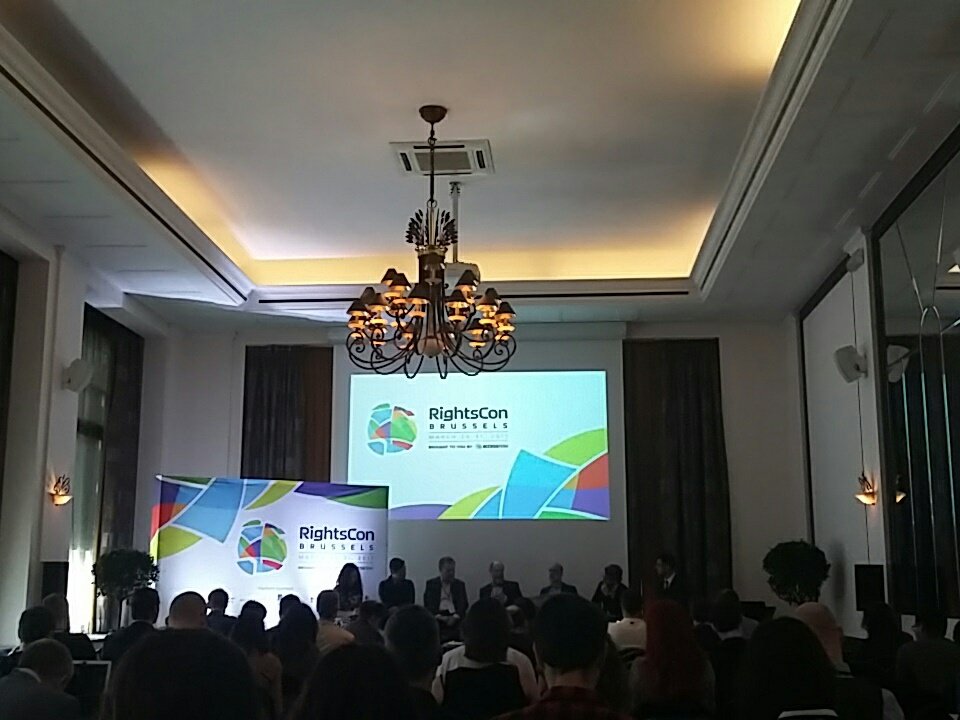
On March 29-31, three brave members of the DATACTIVE team—Davide, Guillen and Stefania, respectively—descended on the lively city of Brussels to attend RightsCon 2017. The RightsCon Summit Series, organized by the US-based non-governmental organization Access Now, is a yearly event bringing together digital rights activists and practitioners with the tech industry. Brussels 2017 was RightsCon’s 4th edition—earlier editions took place in Silicon Valley (2014 and 2016) and Manila, the Philippines (2015). The rich program of RightsCon 2017 counted 21 conference tracks (!), touching upon a wide variety of subjects that mirrored the complex ecosystem of actors and agendas striving for an open and free internet.
Throughout three busy days of this 2017 edition, we had the chance to mingle with activists, researchers, journalists, the industry and law enforcement gathered to collectively think about the future of the internet. We organized our own panel on ‘Resisting Content Regulation in the Post-Truth Age’ in collaboration with Vidushi Marda from the Centre for Internet and Society in Bangalore, India. The panel opened the track ‘The truth is out there’: full house and lively conversation, bringing together the industry, journalism, academia, and multilateral organizations like OSCE. (What this space: a dedicated post will be online soon!). But we also had two other goals in mind. First, we wanted to take advantage of RightsCon’s ability to bring under one roof people from all over the world, with different backgrounds and distinct visions regarding the interplay between the digital and human rights, to make the best of collective learning and look for potential collaboration. Second, we intended to listen to and collect the voices from various projects and organizations currently working towards a free and open internet—in particular, of course, we wanted to swap thoughts with data activists! While we are still re-elaborating the outcome of these conversations, here we provide some reflections on what bubbles in the great minds participating that gathered this year in Brussels. What were the hot topics of RightsCon 2017?
#1 Fake News Fake News Fake News
Although the topic of fake news was dedicated a conference track of its own, the debate was not confined to those panels alone—rather, it permeated several other discussions, too. This is not surprising given the close connection between this fuzzy notion and other topics discussed at RightsCon, such as algorithms, freedom of expression, openness, and transparency. Interestingly, participants seemed to agree on one starting point: what constitutes ‘fake news’ is extremely difficult to determine, and the very same label should probably be abandoned since neither tech corporations nor governments should decide what constitutes ‘truth’ today. In this sense, although the problem of fake news could be tackled both by platforms themselves (for example, by implementing algorithmic curation) or by state institutions (for instance, by creating regulatory legal frameworks), either solution could easily turn into politically motivated censorship. Our own panel, for one, argued that many amongst politicians, experts and the general public are in fact advocating for the wrong fixes to the problem, e.g. content regulation on and by platforms.
However, we did not leave the conference without any suggestions to tackle such a pressing issue. On the contrary, some of the proposals were actually quite far-reaching. For example, it was suggested that although fake news is not entirely a new phenomenon, they have recently turned into a powerful money-making machine due to the fact that economic incentives promote ‘clicks’ and quantity over quality. How can we promote change in the ‘market’ of the Internet, if we are to prevent the spread of information that is specifically meant to deceive? A second productive approach aims at empowering the user and the citizen: ultimately the problem of false or manipulative information spreading on social media is one of digital literacy. Hence, long-term education, more than algorithmic fixes or regulation, is the key answer to the problem. In sum, the problem is socio-technical in nature (rather than solely ‘social’ or solely ‘technical’)—and thus requires a socio-technical response.
#2 Internet infrastructure between censoring and sensing technologies
The fundamental layer of the digital world we experience is the technological infrastructure of the internet. Two recurrent, somehow complementary themes, which appeared to be central to RightsCon 2017 are internet shutdowns and ubiquitous surveillance technologies. It is interesting to consider them together for two reasons. First, they both bring to the surface the importance of the lower layers of communication technology, in an era dominated by ‘apps’, ‘clouds’ and other intangible metaphors. Second, they represent complementary strategies of politicization of data flows: stopping the flow on the one hand, and somewhat multiplying the flow on the other.
In order to keep the internet free and open, one must first keep the internet running. This is an increasingly serious concern, given the often political use of internet shutdowns, ad hoc censorship and network manipulation, to prevent people getting their news or mobilizing to protest. As an example, some noticed a clear connection between the growth in internet shutdowns and the general increase of activism particularly in South East Asia. Consequently, some initiatives emerge in order to test, monitor and report internet shutdowns and censorship. The Open Observatory for Network Interference (OONI) is a spinoff of the Tor Project, which set the stage for “a global observation network for detecting censorship, surveillance and traffic manipulation on the internet”. Another brilliant project along these lines is TurkeyBlocks, which monitors “wide-scale internet slowdown and shutdown incidents using a combination of digital forensic techniques”, with a focus on the delicate Turkish situation.
Next to censoring, another much-debated theme is that of today’s omnipresence of sensing technologies. Alongside the many promises of simplifying life and empowering people, the so-called Internet of Things (IoT) is bringing surveillance technology literally in every corner of our daily life. While activists (and sometimes governments and companies, too) advocate for “privacy-by-design”, the IoT is objectively promoting “surveillance-by-design”. Moreover, especially with the advent of smaller companies in the market, these technologies present not only a higher number of vulnerabilities, but also kinds of vulnerabilities that can hardly be patched, thus representing a permanent threat to individual and group privacy. Consequently, one should not only focus on whether or not this technology is currently used by government to spy on citizens; the urgent need to regulate the market of surveillance products comes from their potential uses, as it is impossible to anticipate their trajectory from country to country, from government to government, and from present to future uses.
#3 Digital Rights in the Global South
Nowhere else in the world is the number of internet users growing more than in the Global South. Unfortunately, this positive trend is usually not adequately accompanied by the creation or reinforcement of the necessary legal frameworks to protect digital rights. Many activists at RightsCon 2017 shared the problems they face when defending their privacy, resisting surveillance and generally struggling to exercise their rights in the Global South. On a positive note, however, the creativity abounds. In Brussels, activists shared the strategies they use to make their voices heard by both states and corporations. A cluster of Latin American organizations emerged, where groups and individuals are pushing for a regional strategy for the defense of digital rights since they have identified that not only the challenges they face are similar, but also that the tools available to overcome them can be mobilized at the transnational level. Among the problems highlighted by the attendees to RightsCon was the perception within governments in the Global South that digital rights are a matter for developed countries, which results in a generalized lack of political will to engage with civil society actors to develop adequate policies. In addition to that, there seems to be a strong historical and cultural connection between the exercise of basic rights and personal data collection policies implemented by institutions. Telling examples are Argentina, where a longstanding tradition of identification has produced countless databases with personal information, whose management is unclear and far from transparent, and Venezuela, where citizens need to surrender their biometric information in order to access basic services like food distribution. Among the strategies showcased by activists to address these issues, strategic litigation in national and international courts was presented as one of the most efficient tools to force governments and corporations alike to respect internet users’ rights. Therefore, a few organizations in South America, led by the Fundación Datos Protegidos, are calling for the creation of a regional network for strategic litigation related to digital rights, with the goal of triggering a process of knowledge transfer among peers in different countries.
All in all, RightsCon 2017 was an enriching experience for the DATACTIVE team—and it was mostly due to all the people we got to meet and to the excellent organization (thanks, Access Now!). We would like to acknowledge everyone who dedicated some of his/her precious time to talk to us: you know who you are, See you at RightsCon 2018, in Toronto, Canada!