Stefania Milan will be one of the keynote speakers at the Data Power conference, june 22nd & 23rd, 2017, a two-day, international conference organized by Carleton and Sheffield universities.
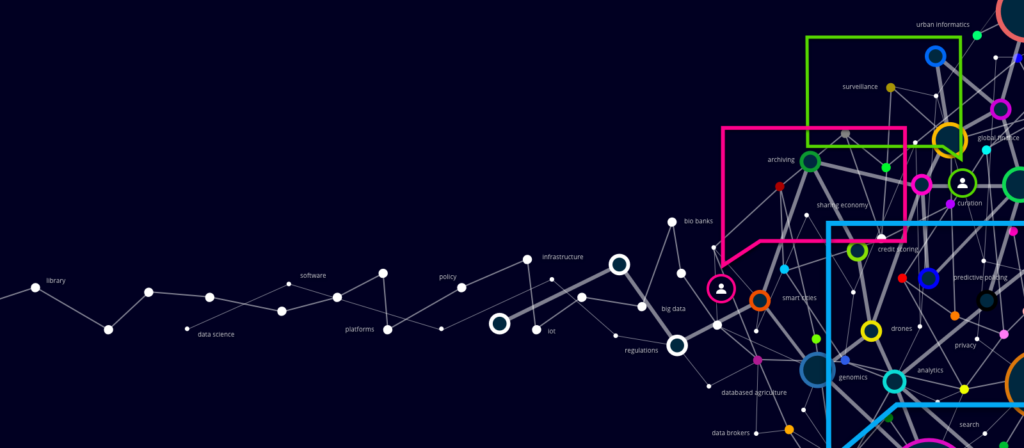
Data Power 2017 follows the successful 2015 conference, held in the UK. The conference focuses on critical questions about data’s power, reflecting on the social and cultural consequences of data becoming increasingly pervasive in our lives. From the internet of things to smart cities, from surveillance to global finance, data (and data infrastructures) shape our lives, as information is generated, collected and analysed through the apps we use, in ways that are both obvious and imperceptible: black-boxed algorithms and opaque systems are used to profile and sort us, direct our spending and travel, and monitor our actions.
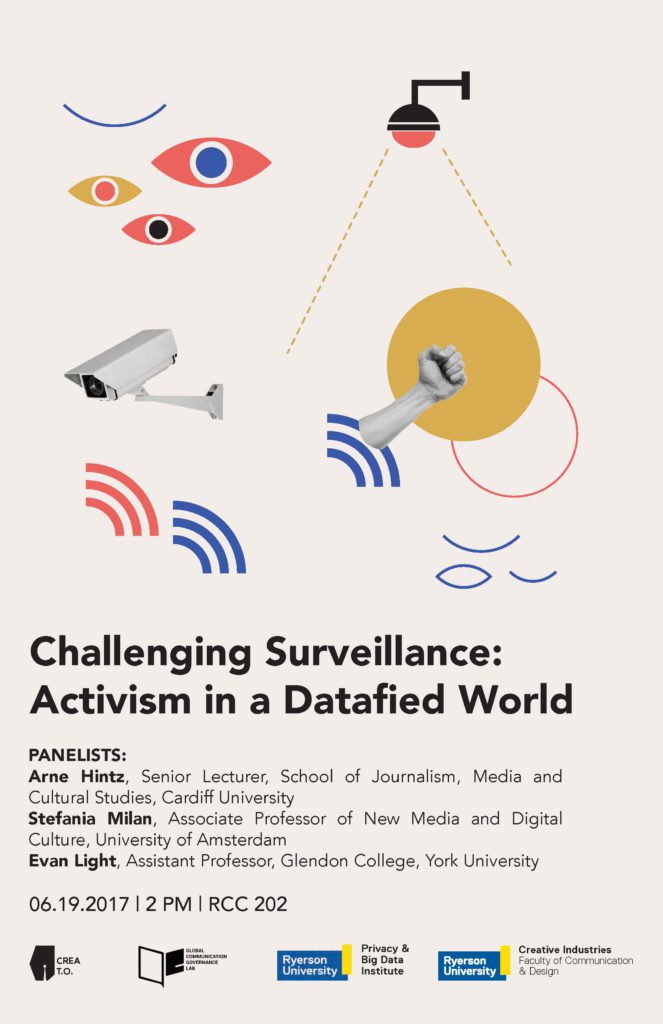
Stefania Milan will join a panel discussion on activism around issues of Data and Surveillance on June 19. The event is hosted by the Global Communication Governance Lab and sponsored by the Ryerson School of Creative Industries, in Toronto, Canada.
To attend the event, please subscribe at Eventbrite. Panelists include:
Arne Hintz, Senior Lecturer, School of Journalism, Media and Cultural Studies, Cardiff University Stefania Milan, Associate Professor of New Media and Digital Culture, University of Amsterdam Evan Light, Assistant Professor, Glendon College, York University
About the speaker series
The CREA T.O. Speaker Series invites leading global thinkers to Toronto to discuss their new books and cutting edge experiences with the Ryerson Community and wider public.
This year’s theme is Surveillance in the Big Data Era. Big Data practices mean that personal data are no longer collected for certain limited, specific and transparent purposes. Rather, Big Data jumps ahead, obtaining bulk data before determining their actual and potential uses and mobilizing algorithms and analytics to predict and intervene before behaviours, events and processes are set in train. Preemptive approaches are a bureaucratic incentive to over-collect data in security and law enforcement. At the same time, promises abound that real-time data analytics will transform aspects of retail, manufacturing, health care and public sector organizations. Some promises may be fulfilled, but what will this mean for democratic freedoms, privacy and the role of information in contemporary life? Bruce Schneier has also suggested that ‘Big Data’ be considered like ‘Big Oil’ or ‘Big Pharma’ – as a political economic category, a key part of what Shoshana Zuboff is calling ‘surveillance capitalism.’ Together, Big Data and Surveillance are transforming our personal, social, cultural, political, economic and ecological worlds, and there is an urgent need for this to be addressed in every sphere and at every level.
June 15, Tallinn, Stefania Milan will be the keynote speaker at the 10th conference of the European University Association/Council for Doctoral Education (the organisation of universities and national rectors’ conferences in Europe), dedicated to “Digitalisation: A game changer for doctoral education?”.
Her session is entitled ‘Digitalisation of Society, the Role of Universities and its Impact on Doctoral Education and Research’. More specifically, she will reflect on “the role of universities in accompanying society in addressing the challenges of digitalisation and on the more specific issues facing doctoral schools as they seek to integrate digital approaches. How can universities provide doctoral candidates with the digital skills they need to advance their research and their careers?”. For more info see the website of the EUA-CDE.
About the EUA-CDE Annual Meeting
The 10th edition of the EUA-CDE Annual Meeting highlights the impact of digitalisation on the role and practice of doctoral education. Societies in general, and universities in particular are facing a transformation brought by the proliferation of digital technologies. For universities, this requires considering the impact of digitalisation on their different missions and doctoral education has an essential role to play given the crucial role of doctoral candidates and early-stage researchers in ensuring the base for knowledge production in the digital era.
The meeting will highlight different perspectives on the changing role of doctoral education in the context of digitalisation, offering concrete examples across different disciplines to show how doctoral schools are adapting their practices to keep up with digitalisation. Doctoral candidates and early-stage researchers find themselves at the forefront of the digital transformation of research and the skills they acquire will be essential for their future careers, be they in academia or in key positions in other fields. The meeting will also explore how universities can develop policies to support and guide young researchers in their endeavours in a coherent and responsible manner.
“Big data”, ¿para qué?. No te pierdas a Stefania Milan (@annliffey), invitada del Programa Experto “Análisis, investigación y comunicación de datos” de la Universidad de Deusto, el lunes 5 de junio, de 18:00 a 19:30 en el espacio Impact Hub, Donostia de Tabakalera. ¿Qué son los big data y cómo se usan? ¿A quién pertenecen? Estamos en una sociedad “datificada”, es decir, casi toda nuestra actividad, tanto offline como online, se traduce en grandes volúmenes de datos y metadatos, que son almacenados y analizados en tiempo real por gobiernos y grandes corporaciones. Muchos entre los primeros lo hacen para darnos mejores servicios públicos y protegernos, pero también vigilarnos y perpetuarse en el poder; los segundos pretenden mejorar sus productos y responder a las necesidades individualizadas de las personas, pero también quieren aumentar sus beneficios. Sin embargo, existen otros usos de las infraestructuras de datos. La sociedad civil está cada vez más utilizándolas para generar cambio social y discursos alternativos. Os animamos a participar en un interesante debate con Stefania Milan –una experta en tecnologías de los movimientos sociales de la Universidad de Amsterdam—sobre los retos y las oportunidades que presentan los big data.
On May 31st Antonio Martella, who has been a visiting scholar with DATACTIVE for the period March-May 2017, presents the outcome of his research project on ‘Big data and activism’, with presents an overview of progressively-minded projects, teams and tools using big data for research purposes.
Antonio is a PhD student at the Political Science Department of the University of Pisa. His research project is focused on political leaders, populism and social media. He graduated in Business communication and human resource policy and has a postgraduate master in “Big Data Analytics & Social Mining” by the University of Pisa along with the CNR of Pisa. His last publication, an article co-authored with Bracciale entitled “Define the populist political communication style: the case of Italian political leaders on Twitter” has recently appeared on Information, Communication & Society. He joined DATACTIVE thanks to a Erasmus + grant.
Stefania couldn’t make it to ‘Data and the Future of Critical Social Research’, a pre-conference to the the 67th Annual Conference of the International Communication Association. Organized by Andreas Hepp and Nick Couldry, the pre-conference took place on May 25 in San Diego, CA. The organizers, however, allowed Stefania to be present in spirit and… video. This is the presentation prepared for the event; below the abstract.
Abstract: Redefining citizenship. For a socio-technical theory of agency in datafied societies by Stefania Milan
Datafication has brought about a fundamental paradigm shift in the contemporary socio-political order. Information has become the one constitutive force in society capable to shape social reality (Braman, 2009). On the one hand, the advent of ‘big data’ has altered our conditions of existence in society. On the other, the crisis that has infected liberal democracy at the turn of the century has been accelerated by the so-called ‘surveillance capitalism’, and democratic norms are challenged by the new expression of power enshrined in the global architecture of data extraction, commodification, and control (Zuboff, 2015). The state-industry surveillant complex, replacing governments as the primary holder of the monopoly over information and control, recursively engages in exercises of definition and activation of the ‘algorithmic citizenship’ (Cheney-Lippold, 2011). This distributed ‘algorithmic power’ has generative properties that leave little room for human agency (Lash, 2007). Linked databases, platforms and apps—the information architecture of datafication—are changing the definition of what constitutes public sphere and participation in the datafied society. Hence we ought to ask what constitutes democratic agency today. How is its nature changing? What practices create or jeopardize it? What makes collectivity nowadays? But also: Who are the drivers of the on-going process of redefinition of citizenship? What sort of spaces, mechanisms, and actors meet the growing demand for citizen participation? How does this redefinition of citizenship change institutions themselves?
This theoretical contribution addresses three notions, namely ‘data citizenship’, ‘data activism’ (Milan & van der Velden, 2016) and ‘data epistemology’. Taking data and datafication simultaneously as objects of contentions and elements of a novel politics of the quotidian, and exploring forms of resilience and mobilization as democratic processes, the presentation explores how contemporary engagement with grassroots and top-down data politics and practices alters the way people enact their democratic agency. While the lack of transparency and the threats to privacy negatively alter the trust relation between people and the ruling institutions, emerging data practices have the ability to carve out space for a new relationship, giving new meaning to the notion of democratic agency and forcing us to rethink the relationship between the state and its citizens. Data citizenship, data activism and data epistemology are offered as the building blocks of an emerging socio-technical theory of agency in the datafied society, needed to meet the ontological challenges datafication poses to established socio-political practices in Western democracies.
Cited works
Braman, S. (2009). Change of state: Information, policy, and power. MIT Press.
Cheney-Lippold, J. (2011). A New Algorithmic Identity Soft Biopolitics and the Modulation of Control. Theory, Culture & Society, 28(6), 164–181.
Lash, S. (2007). Power after hegemony: Cultural studies in mutation. Theory, Culture & Society, 24(3), 55–78.
Milan, S., & van der Velden, L. (2016). The alternative epistemologies of data activism. Digital Culture & Society, 2(2), 57–74.
Zuboff, S. (2015). Big Other: Surveillance Capitalism and the Prospects of an Information Civilization. Journal of Information Technology, 30(1), 75–89.
On May 19, Stefania will present two papers at the conference ‘TILTing Perspectives 2017: Regulating a connected world’ in Tilburg. Both of them tells pieces of the DATACTIVE story. The first features research on internet governance and privacy (and the WHOIS databased in particular), partially told thanks to BigBang, the software DATACTIVE is currently developing with the key help of Research Associate Sebastian Benthall. The paper that follows explores the connection and interaction between software cultures (and hacker values in particular) and the counter-expertise of data activism. The conference is organized by the Tilburg Institute for Law Technology and Society (TILT), of which Stefania is a Research Associate. Check out the amazing program of TILTing 2017!
On May 15-17, Stefania is in Stockholm to attend the Stockholm Internet Forum (SIF) 2017.
SIF an international forum discussing how a free, open and secure internet promotes human rights and development worldwide. With a focus on the global South, the event brings together policymakers, activists, as well as the business and technical community. This year’s theme is “access and power”, and building on the Swedish feminist foreign policy there will be a strong focus on gender equality. SIF debates many topics of interest to DATACTIVE, including for example digital identity, responsible data, smart cities and the platform economy. Stefania will participate in the meetings of the Freedom Online Coalition, as a member of the Working Group 1 “An Internet Free and Secure”, and engage in data collection.
My current work aims to provide a social movement approach in order to study civic tech activism. I am asking How we can account for power dynamics in the strive to open up civil society space for governance engagement through data and technology infrastructure.
During the CosmoShare talk I will introduce my conceptual work aiming to emphasize the central role of communication for power dynamics in social and political change processes. Bringing into dialogue social movement studies and communication theory, I will build on contemporary conceptualisations within media practice theory (Kubitschko 2017; Couldry 2015) by contributing an enlarged framework that explicitly accounts for communication from a non-technical and a non-western perspective. To develop the framework, I turn to Freire and Pasquali’s theorization of communication as human relations.