As every aspect of our daily lives becomes susceptible of turning into data being collected, analyzed and repurposed, the question arises what kind of consequences this process will bring for society. The goal of this event is to reflect upon how activism, data, and research may be mobilized for social good. The speakers (see below) are experts developing projects related to topics such as human rights, environmental justice, and international law, from an approach located at the crossroads of academia and civil society.
The event is in two parts: an evening session on November 16 open to the public and organized in collaboration with SPUI25 and a day-long session on November 17 with restricted participation, and a combination of talks (in the morning) and moderated sessions in the afternoon.
Please find the report on this event here.
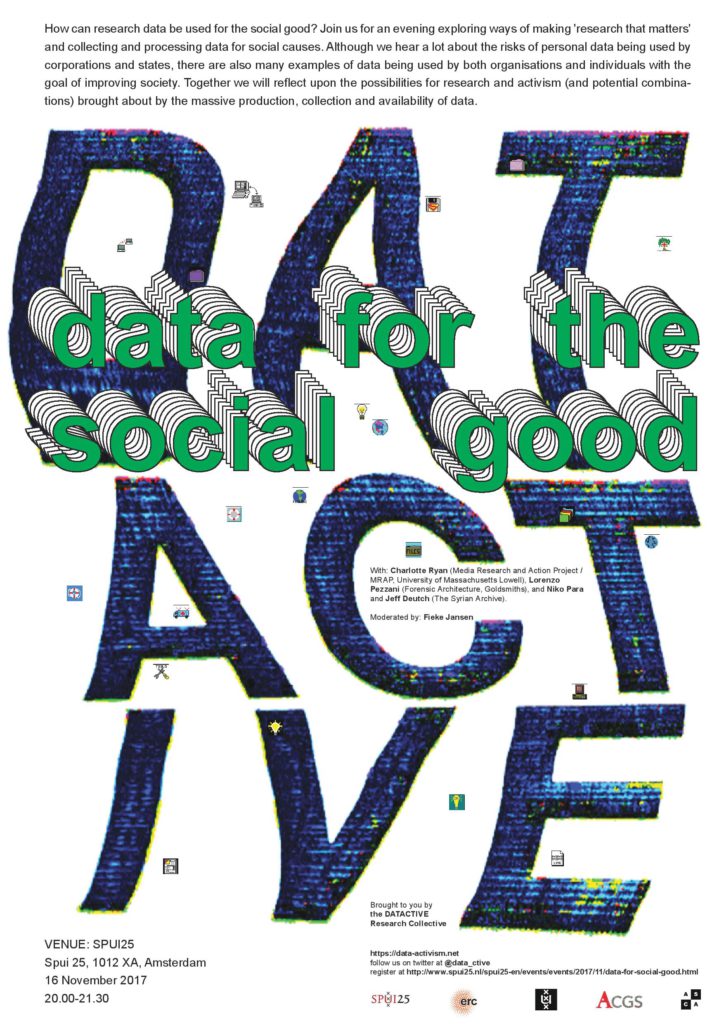
DAY 1: Data for the Social Good (SOLD OUT)
16 November 2017, 8pm-9.30pm, @ SPUI25, Spui 25, 1012 XA, Amsterdam
This event is fully booked, but tickets might become available just before the start. Also, a live-stream will be set up by Spui25 here at 8pm.
Join us for an evening about ‘research that matters’, exploring ways of collecting and processing data for social causes. Just as socioeconomic data about us are used by institutions to decide upon the allocation of budgets for public health, housing or urban planning, and behavioural data helps businesses to determine their location or set their prices, digital data are also mobilised by activists to legitimize their struggles against poverty, racism or injustice. Recently, as every aspect of our daily lives has turned into data susceptible of being quantified, processed and repurposed, it is not only the metrics created about us that are used as input for all kinds of decision-making, but those generated by us through the daily use of different types of technologies.
Although we hear a lot about the risks of (personal) data being used by corporations and states, there are also many examples of usage by organisations or individuals with the goal of improving society. From crowd-sourced maps about the ‘femicide’ epistemic in Latin America to the analysis of videos and photos to reconstruct drone attacks, data produced by people is mobilised for social good. The goal of this event is to reflect upon the possibilities for research and activism (and potential combinations) brought about by the massive production, collection and availability of data.
With the help of Charlotte Ryan (Media Research and Action Project/ MRAP, University of Massachusetts Lowell), Lorenzo Pezzani (Forensic Architecture, Goldsmiths), and Jeff Deutch and Niko Para (The Syrian Archive), the event will focus on discussing different dimensions of activist research. Fieke Jansen will be moderating the evening.
DAY 2: Data for the Social Good: A Focused Encounter
17 November 2017 9am-4pm, @E-Lab, Turfdraagsterpad 9 (room 0.16*), 1012 XT Amsterdam
* turn right after the entrance, room 0.16 is located at the end.
Should you want to participate, please drop an email to jeroen@data-activism.net. Seating is limited but we particularly welcome scholars interested in exploring the relationship between academia, action and policy.
DATACTIVE: Focused Encounter will be an exploration into ‘data activist research’ through a one-day workshop. The event will be the first in a series of seminars organized by DATACTIVE as an attempt to bridge theory and praxis, as well as to establish a network of activist-researchers and researching-activists working on themes of mutual interest around the politics of datafication.
DATACTIVE explores the responses to datafication and massive data collection, as they are implemented by citizens and organized civil society. As part of this program, we have adopted an ‘engaged’ approach to research by virtue of which we produce scientifically sound knowledge, while simultaneously paying attention to the impact this process might have on people and communities (see Milan, 2010). Furthermore, since we want to contribute to empower activists and citizens to think critically about datafication, empowerment and surveillance, we are currently exploring experimental research methods capable of bringing together activist communities and academia to develop joint research questions and/or projects. In this sense, on a more practical level, the goal of this first Focused Encounter is to start charting out a ‘data activist’ research agenda that takes into account this community building, mutual learning and knowledge-sharing mission. On a theoretical level the goal of the Focused Encounter is to discuss different aspects of inclusion and democracy, evidence and knowledge production, and the promises and perils of data activism and datafication more in general.
The event will consist of a morning program (9:15 – 12:30) featuring three speakers who will showcase ways of doing engaged research as well as the related challenges, followed by a moderated discussion. After lunch there is room for discussion and knowledge exchange in small moderated groups, for those who are interested (highly recommended), followed by about an hour of focused discussion and brainstorming. We will work together until approximately 16:00 and then have drinks.
Schedule
Morning:
9:15 -9:30 Welcome by Stefania Milan.
9:30 -10:00 Charlotte Ryan. “Building sustained research collaborations.”
10:00 – 10:30 Lorenzo Pezzani (Forensic Architecture). “Forensic Oceanography: Documenting the violence of the EU’s Maritime Frontier.”
10:30 – 10:45 COFFEE BREAK
10:45 – 11:15 Jeff Deutch and Niko Para (Syrian Archive). “Archiving for accountability: Collaboratively preserving, verifying and investigating open-source documentation of rights abuses in Syria.”
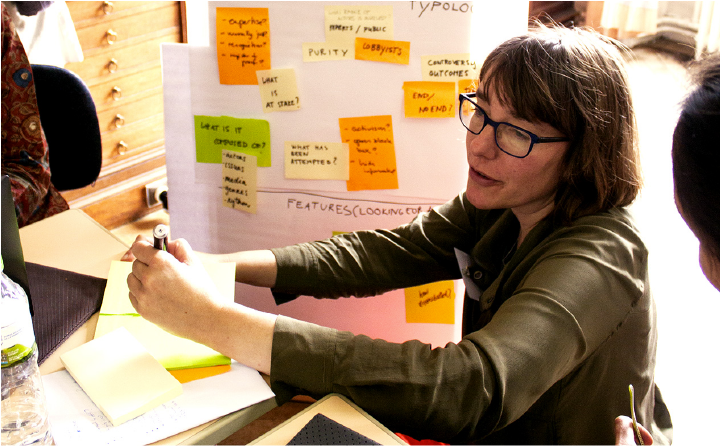
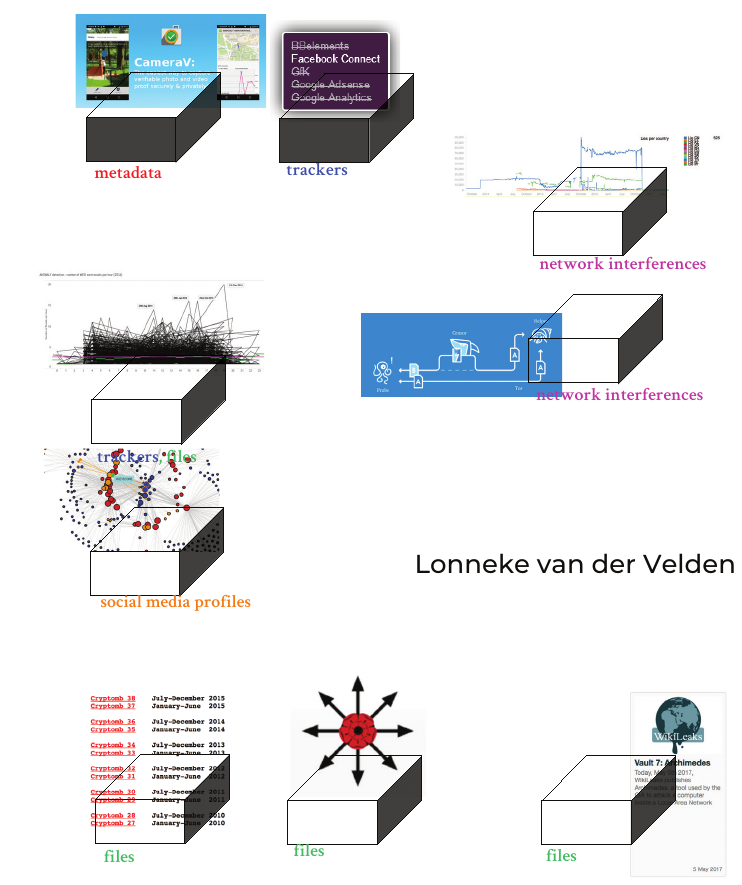
11:15 – 12:30 Discussion on ‘Data activist research’, moderated by Lonneke van der Velden.
Afternoon:
The afternoon session will provide space to reflect and look forward. What is needed, for us as a data-activist community, is to accelerate and expand our engaged and action-oriented research practices? Based on the diverse expert insights we gained during the morning session we will collectively start crafting an engaged research agenda for data activist research.
13:30 -14:00 Collective brainstorm. Moderator: Kersti Wissenbach.
14:00 – 16:00 Break- out sessions
15:30 – 16:00 Reporting back.
16:00 Closure
After 16:00 Drinks @Cafe de Jaren (Nieuwe Doelenstraat 20 – 22, 1012 CP / Amsterdam)
About the speakers
The speakers are invited to present their research projects, experiences and results, and to discuss with DATACTIVE members and attendees questions relating to research ethics, engaged research as well as data activism, its problems and outcomes.
Charlotte Ryan is an Associate Professor of Sociology at the University of Massachusetts, Lowell, and the co-founder (with Bill Gamson) of the Movement/Media Research and Action Project (a research group that aims to strengthen progressive social movements working toward social justice and inclusive and participatory democracy). Ryan worked also as an organizer in labor, community, health and anti-intervention movements, and has extensive experience with collaborative work between academia and activism. She is also a member of the DATACTIVE Ethics Board.
Lorenzo Pezzani is an architect and researcher. He is currently Lecturer at Goldsmiths, University of London, where he leads the MA studio in Forensic Architecture. His work deals with the spatial politics and visual cultures of migration, with a particular focus on the geography of the ocean. Since 2011, he has been working on Forensic Oceanography, a collaborative project that critically investigate the militarized border regime in the Mediterranean Sea, and has co-founded the WatchTheMed platform. Together with a wide network of NGOs, scientists, journalists, and activist groups, he has produced maps, videos and human right reports that attempt to document and challenge the ongoing death of migrants at sea.
Jeff Deutch & Niko Para are members of The Syrian Archive, a Syrian-led collective of human rights activists dedicated to preserving open-source visual documentation relating to human rights violations committed by all sides during the Syrian conflict. Through collecting, curating, verifying and investigating digital content, the Syrian Archive aims to preserve data as a digital memory, to establish a verified database of human rights violations for reporting and advocacy purposes, and to act as an evidence tool for legally implementing justice and accountability efforts as concept and practice in Syria. Jeff Deutch is a fellow at the Centre for Internet and Human Rights and a PhD candidate at the Humboldt-University in Berlin. He has developed workflows and methodologies for open-source investigations of human rights violations. Niko Para is The Syrian Archive’s lead technologist, where he develops the Sugarcube sequential data investigation pipeline for secure collection, preservation, transformation of user-generated content. He has worked with Tactical Technology Collective, Global Witness, as well as numerous smaller agricultural, artistic, and musical organisations and collectives. He unapologetically plays the banjo.
Fieke Jansen is an independent researcher. Until recently, she worked on the Politics of Data programme for Tactical Tech. Previous to that, she helped set up and manage the digital emergency programme for human rights defenders and activists at Hivos. She also co-authored the book Digital AlterNatives.



 In November 20-30 Stefania will be in Santiago de Chile for a number of talks. She will keynote at the 5th International Symposium of the



 Maylí Sepúlveda es directora general de Controla Tu Gobierno. Ha sido consultora de la William & Flora Hewlett Foundation, International Budget Partnership, Banco Mundial, Global Initiative for Fiscal Transparency y el PNUD.