Category: show on blog page

BigBang hackaton in London, March 17-18

This weekend the DATACTIVE team will be joining the IETF101 hackathon to work on quantitative mailing-list analysis software. The Internet Engineering Taskforce (IETF) is the oldest and most important Internet standard setting body. The discussions and decisions of the IETF have fundamentally shaped the Internet. All IETF mailing-lists and output documents are publicly available. They represent a true treasure for digital sociologist to understand how the Internet infrastructure and architecture developed over time. To facilitate this analysis DATACTIVE has been contributing to the development of BigBang, a Python-based automated quantitative mailinglists tool. Armed with almost 40 gigabyte worth of data in the form of plain text files, we are eager to boldly discover what no one has discovered before. By the way, we still have some (open) issues, feel free to contribute on Github 🙂

[blog] Internet Archive and Hacker Ethics: Answers to datafication from the hacktivist world

Guest author: Silvia Semenzin

This blogpost looks into the Internet Archive as a case-study to discuss hacktivism as a form of resistance to instances of control on the Internet and the use of data for political and commercial purposes. It argues hacktivism should not only be considered a social movement, but also an emerging culture informed by what may be defined as ‘hacker ethics’, after Pekka Himanen.

The Internet Archive is a free digital library founded in 1996 by Brewster Kahle, a computer engineer at MIT, who created a non-profit project which aims to collect cultural artefacts (books, images, movies, audio, etc.) and internet pages to promote human knowledge. Building a “global brain” can be challenging in the era of datafication and the Information Society, especially because huge amounts of information (and disinformation) are added on the internet continuously. Trying to create a modern version of the Bibliotheca Alexandrina, the Internet Archive’s goal is to make human knowledge accessible to everybody and preserve all kinds of documents. So far, the Internet Archive has digitalized more than 3 million of books, still scanning around 1000 books per day.

The Internet Archive in both strategies and business model seems to appeal to ‘hacker ethics’ as described by the Finnish philosopher Pekka Himanen through the hacker ethics of work, hacker ethics of money, and hacker ethics of the network:

1. For Himanen, ‘Hacker ethics of work’ describes passion in work, the freedom to organize one’s time, and creativity -which is the combination of the first two: for hackers, working with passion is the final purpose. This means that financial motivations are not of primary importance. Instead, they are just a result of work.
2. Benefits are measured in both passionate effort and social value, both features of the ‘hacker ethics of money’. This means that the work of a hacker must be recognized by the hacker community and that it must be accessible and open to everyone. This represents the vision of an open and horizontal model of knowledge, similar to the one at the Academy of Plato, which was based on a continuous and critical debate to reach scientific truths, even though many could argue that, in general, hacker culture is still not that open and horizontal (e.g. hostility to non-white male identities). However, projects such as Internet Archive seem to follow this model of shared knowledge for the sake of science.
3. Finally, the ‘hacker ethics of the network’ refers to the relationship between hackers and the Internet. On the one hand, from this relationship stems the value of the free activity, which indicates the act of defending total freedom of expression on the internet. On the other hand, hackers do also worry about involving everyone in the digital community and make the Network free and accessible to everybody (crypto parties are born as a result of this idea). This value is known as ‘social responsibility’.

Applied to the Internet Archive, it seems to draw on three strategies, in particular, that of participation and anonymity by default and non-profit business model. By doing so, the Internet Archive is defending the freedom of information, a fundamental right that needs protection in both the offline and the online world. To make sure that there is freedom of information, it is necessary to involve as many people as possible in the sharing of knowledge. Anyone can read and upload material to the website, thereby taking part in building a global digital library. Secondly, Freedom of information, freedom of expression and the right to anonymity are built in the Internet Archive by design and align with hacker ethics values. The Internet Archive does not track their user; they do not keep the Internet Protocol (IP) address of readers and make use of a secure web protocol (https). The website does not use data from users, not even for marketing: being a non-profit library, Internet Archive is funded on donations instead of advertising, or the collection/selling of personal data.

In extension, it could be argued that the Internet Archive with these anonymity and participatory practices often opposes larger datafication processes. The processes of datafication of society, recently observed in the rise of platforms and apps, implies that our financial habits, personal communication, movement, social network and political and religious orientation will translate into data. The availability of significant amounts of data raises questions concerning their usage by governments and corporations. Their access to Big Data might have a negative effect on both individuals and communities, by increasingly turning citizens into consumers, thereby sustaining a certain form of control. Fundamental rights such as freedom of speech, freedom of association or right to privacy seem growingly threatened by the collection and analysis of large data sets.

Guided by these values, hacktivists often criticize the use of technology and Big Data as it would go against their ethics, and try to spread hacker ethics using different a kind of action. Among the heterogeneity of hacktivist action, the Internet Archive can represent a good example of hacker ethics, as well as a powerful project born to defend freedom of knowledge and digital rights. These kinds of initiatives are relevant when researching for hacktivism and datafication because they illustrate how hacker ethics may be spreading the awareness concerning issues of datafication.

References

Himanen, P. (2002). Hacker Ethic and the Spirit of the Information Society. Prologue by LinusTorvalds. Destino

Hintz, A., Dencik, L., & Wahl-Jorgensen, K. (2017). Digital Citizenship and Surveillance| Digital Citizenship and Surveillance Society—Introduction. International Journal of Communication, 11, 9.

Internet Archive: Digital Library of Free Books, Movies, Music & Wayback Machine. (n.d.). Retrieved 22 February 2018, from https://archive.org/index.php

Milan, S. & Atton, C. (2015). Hacktivism as a radical media practice. Routledge companion to alternative and community media, 550-560.

Noah C.N. Hampson (2012), ‘Hacktivism: A New Breed of Protest in a Networked World’ 35 B.C. Int’l & Comp. L. Rev. 511, http://lawdigitalcommons.bc.edu/iclr/vol35/iss2/6 accessed 05/02/2018


About Silvia

Silvia Semenzin is a DATACTIVE research associate and PhD student in Sociology at the University of Milan. She is currently researching hacktivism and hacker ethics and is interested in the influence that digital technologies have on political action, public debate and citizens’ mobilization as instruments for democracy.

Big Data from the South: The beginning of a conversation we must have

by Stefania Milan and Emiliano Treré

On July 15, 2017 in Cartagena, Colombia, about fifty between academics and activists got together to imagine how ‘Big Data from the South’ would look like. Organized with little resources and much enthusiasm by the two of us* and preceding the annual IAMCR conference in Cartagena, the one-day event was designed to make the move ‘from media to mediations, from datafication to data activism’, as the title suggested. We thought that this beautiful gem of the Caribe, at the geographical margins of a country that has recently started to invent a peaceful future for itself, would be the most appropriate place to pioneer a much-needed conversation about a series of question that has kept both of us busy over the past few years: How would datafication look like seen… ‘upside down’? What questions would we ask? What concepts, theories, methods would we embrace or have to devise? What do we miss if we stick to the mainstream, Western perspective(s)? In this post, we resume the conversation we prompted in Cartagena—looking forward.

Datafication and its discontents: Beyond the West?
Datafication has dramatically altered the way we understand the world around us. Understanding the so-called ‘big data’ means to explore the profound consequences of the computational turn, its consequences on the mainstream epistemology, ontology and ethics, as well as the limitations, errors and biases that affect the gathering, interpretation and access to information on such a large scale. If scholars of various disciplines have started to critically explore the implications of datafication across the social, cultural and political domains, much of this critical scholarship has emerged along a Western axis ideally connecting Silicon Valley, Cambridge, MA and Northern Europe. We believe something is missing in this conversation.

We already know a lot, though. The emerging, composite field of critical data studies, at the intersection of social sciences and the humanities, calls our attention to the potential inequality, discrimination and exclusion harbored by the mechanisms of big data (Gangadharan 2012; Dalton, Taylor, & Thatcher 2016). It reminds us that big data is not merely a technological issue or the flywheel of knowledge, innovation and change, but a ‘mythology’ that we ought to interrogate and critically engage with (e.g., boyd & Crawford 2012; Mosco 2014; Tufekci 2014; van Dijck, 2014). It tells us that, although tinted with the narratives of positivism and modernization and widely praised for their revolutionary possibilities in terms of, e.g., citizen participation, big data are not without risks and threats, as opaque regimes of population management and control have taken central stage (see Andrejevic 2012; Turow 2012; Beer & Burrows 2013; Gillespie 2014; Elmer, Langlois and Redden 2015). The expansion of data mining practices by both corporations and states gives rise to critical questions about systematic surveillance and privacy invasion (Lyon, 2014; Zuboff 2016; Dencik, Hintz and Cable 2016). Critical questions arise also from the ways in which academia and businesses alike relate to big data and datafication: colleagues have questioned the ‘bigness’ of contemporary approaches to data (Kitchin and Laurialt 2014), and encouraged us to pay attention to bottom-up practices (Couldry & Powell 2014) and forms of everyday critical engagement with data (Kennedy and Hill 2017).

But how does datafication unfold in countries with fragile democracies, flimsy economies, impending poverty? Is our conceptual and methodological toolbox able to capture and to understand the dark developments and the amazing creativity emerging at the periphery of the empire? We call for the discontents of datafication to join forces to jointly address these concerns—and generate more critical questions.

From the South(s), moving beyond ‘data universalism’… and the universalism of social theory
We believe that we need to systemically and systematically engage in a dialogue with traditions, epistemologies and experiences that deconstruct the dominance of Western approaches to datafication that fail to recognize the plurality, the diversity, and the cultural richness of the South(s) (see Herrera, Sierra & Del Valle 2016). Like Anita Say Chan (2013), we, too, feel that too many critical approaches are still relying on a kind of ‘digital universalism’ that tends to assimilate the heterogeneity of diverse contexts and to gloss over differences and cultural specificities. We would like to contribute to the ongoing conversations about the urgency of a ‘Southern Theory’ that ‘questions universalism in the field of social theory’. We join Payal Arora in claiming that ‘we need concerted and sustained scholarship on the role and impact of big data on the Global South’ (2016: 1693)—and we go one step further, enlarging the picture to include all the Souths in the plural that inhabit our increasingly complex universe.

As Arora (2016) and Udupa (2015) reminded us, while the majority of the world’s population resides outside the West, we continue to frame key debates on democracy ad surveillance—and the associated demands for alternative models and practices—by means of Western concerns, contexts, user behavior patterns, and theories. While recognizing the key contributions of many of our amazing colleagues (and forgive us if for the sake of brevity we haven’t included you all), we feel that something is missing in the conversation, and that only a collective effort across disciplines, idioms, and research areas can help us to re-consider big data from the South. Our definition of the South is a flexible and expansive one, inspired to the writings of sociologist Boaventura De Sousa Santos (2007 and 2014) who was probably the first to write about the emergence and the urgency of epistemologies from the South against the ‘epistemicide’ of neoliberalism. Firstly, there is the geographical South, i.e. the people, activities, politics and technologies arising literally at the margins of the world as captured in the Mercator map. Secondly, and most importantly, our South is a place of (and a proxy for) resistance, subversion and creativity. We can find countless Souths also in the Global North, as long as people resist injustice and fight for better life conditions against the impending ‘data capitalism’.

Our reflections on ‘big data from the South’ fit within—and hope to feed—the broader process of epistemological re-positioning of the social sciences. We believe we cannot avoid measuring the sociotechnical dynamics of datafication against ‘the historical processes of dispossession, enslavement, appropriation and extraction […] central to the emergence of the modern world’ (Bhambra and de Sousa Santos 2017: 9), pending the risk of making the same mistakes all over again—and the same is to be said for our disciplinary toolbox. As Bhambra and de Sousa Santos acutely observed, ‘if the injustices of the past continue into the present and are in need of repair (and reparation), that reparative work must also be extended to the disciplinary structure that obscure as much as illuminate the path ahead’ (Ibid.).

What would a Southern theory of big data entail, then?

We take the challenge from Say Chan (2013), who reminded us that there are more and other ways than the mainstream to imagine the relation between technology and people. Here we share with you our growing list of the sine-qua-non conditions for thinking datafication from the South. The list is a work in progress, and comes with an explicit invitation to join us in this exercise.

  • Bring agency to the center of the observation of both bottom-up and top-down mechanisms and practices. Taking inspiration from Barbero (1987), we should focus on resistance and the heterogeneity of practices as they relate to datafication—not solely on data and datafication per se.
  • Decolonize our thinking, situating the post-Snowden dynamics of the data capitalism in the specificities of the South. While many elements will be the same, implementations, understandings and consequences might differ. What we already know should not be taken for granted but critically unraveled.
  • Pay attention to the ‘alternative’: alternative practices, alternative imaginaries, alternative epistemologies, alternative methodologies in relation to the adoption, use, and appropriation of big data. Prepare for the unexpected and the unexplored. To be sure: here alternatives are not necessarily subaltern or better, they are simply distinct.
  • Take infrastructure seriously, unpacking the complex flows (of relationships, data, power, money, and counting) they harbor, generate, shape and promote (thanks Anders Fagerjord for the inspiration to think in flows). Situate notions like the platform in the lived experience of distinct geographies.
  • Connect the critical epistemologies of emerging social worlds with the critical politics of social change (thanks Nick Couldry for sharing his thoughts on this matter in Cartagena—everyone watch out for his new book with Ulisses Mejias on ‘Data, Capitalism, and Decolonizing the Internet’).
  • Be mindful and critical of Western-centric concepts and methods. While they do offer a key point of departure, they cannot be taken by default as the (sole) point of arrival when approaching big data from the South.
  • At the same time, be critical of Southern understandings and practices as well, to avoid falling into the assumption that they are inherently different, alternative, or even better and purer forms of knowledge.
  • Be open to the dialogue, in whatever direction it takes us: North-South, South-South, South-North. In the face of much complexity, we can only advance together, entering in a conversation with different epistemologies and approaches.

That said, we would like to encourage our colleagues to embrace more explicitly a political economy perspective, which can help us to take a critical look at the multiple forms of domination that reproduce and perpetuate inequality, discrimination and injustice at all levels. We also advocate for historical approaches able to trace the current unfolding of datafication back to its roots in colonial practices, when applicable (see Arora 2016). We suggest engaging with feminist critiques and ideas around the decolonization of technology. Finally, we like to think of this type of inquiry as inherently ‘engaged’: while adopting the gold standards of solid scientific research, ‘engaged research’ might take sides and, most importantly, is designed to make a difference to the communities we come close to (Milan 2010). Such an approach goes hand in hand with the promotion of critical literacy, whereby even academics look for ways of making information accessible by means of translation into understandable and actionable material, in view of bringing more people to fight for their digital rights.

One example of approaching big data from the South
To make our call more concrete, we offer the example of our own work as one of the many possible ways of turning ‘upside down’ what we know about datafication. Emiliano has been studying the algorithmic manufacturing of consent and the hindering of online dissidence; his work outlines how creative and innovative forms of algorithmic resistance are being forged in Latin America and beyond (Treré 2016). Stefania and her team have been looking at how grassroots data activism (Milan & Gutierrez 2015; Milan 2017), new data epistemologies (Milan and van der Velden 2016) and practices of resistance to massive data collection emerge in the fringe of the ‘surveillance capitalism’ , including for example in the Amazon region (Gutierrez and Milan 2017). But we need to collectively—with you, that is—make a leap forward and rethink also theory, beyond case studies and contingent examples. We are not alone in this effort as many giants can lend us their shoulders. To name but one who inspired our event in Cartagena: almost thirty years ago, the Spanish-Colombian comunicologist Jesús Martín-Barbero urged us to move ‘from media to mediations’, that is, from functionalist media-centered analyses to the exploration of everyday practices of media appropriation through which social actors enact resistance to domination and hegemony (1987). The powerful move he triggered was inherently political: it meant refocusing our gaze from media institutions towards the people and their heterogeneous cultures, looking at how communication was shaped in bars, gyms, markets, squares, families, and the like. Following Barbero, our work has been oriented to making the move from datafication to data activism, examining the diverse ways through which citizens and the organized civil society in the South(s) engage in bottom-up data practices for social change and resist a datafication process that increases oppression and inequality.

Much more remains to be done, and many conversations to be had. Together with Anita Say Chan, we are launching ‘Big Data from the South’, a network of scholars and practitioners interested in bringing this multidisciplinary and multi-language dialogue forward. Join us!

Join the mailing list
Read the call for ‘Big Data from the South’ (Cartagena, 15 July 2017)
Check out the dedicated blog. Stay tuned: we have even commissioned a logo! We plan to start soon publishing guest posts on the topic, in any language people might want to write them. We are looking for your your ideas and provocations: to contribute please shoot an email to TrereE@cardiff.ac.uk and s.milan@uva.nl.

About the authors (and situating white privilege)
Interdisciplinary scholars constantly moving between the study of society and its tech imaginations and tactics, movement, change and contrast have been at the core of our scholarship and of our identity. Southern Europeans migrated North on account of the ethernal malaise of the Italian research system, we like to see ourselves as engaged scholars and to muddle the waters between disciplines and methods. Stefania is Associate Professor of New Media and Digital Cultures at the University of Amsterdam affiliated also with the University of Oslo, and the Principal Investigator of the DATACTIVE project. Emiliano is Lecturer in the School of Journalism, Media and Cultural Studies at Cardiff University where he is also a member of the Data Justice Lab, and a Research Fellow at the COSMOS Center for Social Movement Studies (Italy). Previously, he was an Associate Professor at the Autonomous University of Querétaro, Mexico. Both of us have conducted research and worked in various capacities in a number of Southern contexts. While we write from a privileged observation point, various Souths have crossed our professional and personal lives, instilling curiosity, imposing challenges and occasional suffering, and forcing us to ask ourselves critical questions. We don’t have many answers. Rather, we want this blog post to be the start of a conversation and of an open, collaborative network where different Souths can dialogue, learn and enrich each other.

*The event was made possible by the funding of DATACTIVE/European Research Council and by the generous engagement of Guillén Torres (DATACTIVE) and Fundación Karisma (Bogotá). We also wish to thank for the hospitality the local organizing committee of IAMCR (and Amparo Cadavid from UNIMINUTO in particular).

[blog] Hopes and Fears at SHA2017

Authors: Davide & Jeroen

A few weeks ago, a contingent of the DATACTIVE team attended SHA (Still Hacking Anyway), the periodic worldwide hacker camp hosted in the Netherlands. The great variety of people hanging around included IT pen-testers, system administrators, activists, developers, advocacy groups, journalists -and, of course, hackers. Around 3.300 attendants, 100 gigabit (!) of bandwidth, 320 talks, mixed with lights, music, artifacts of all kind -and a fair amount of drinks- contributed to characterize the gathering as a concrete embodiment of the hackers’ ethos of ‘work&play’.

We had the chance to attend dozens of talks and debates; to participate in the activity of the Technopolitics village TSJA; to interview dozens of participants; to give our own talk on mailing list analysis; to engage in chats, activities, and drinks with plenty of people.

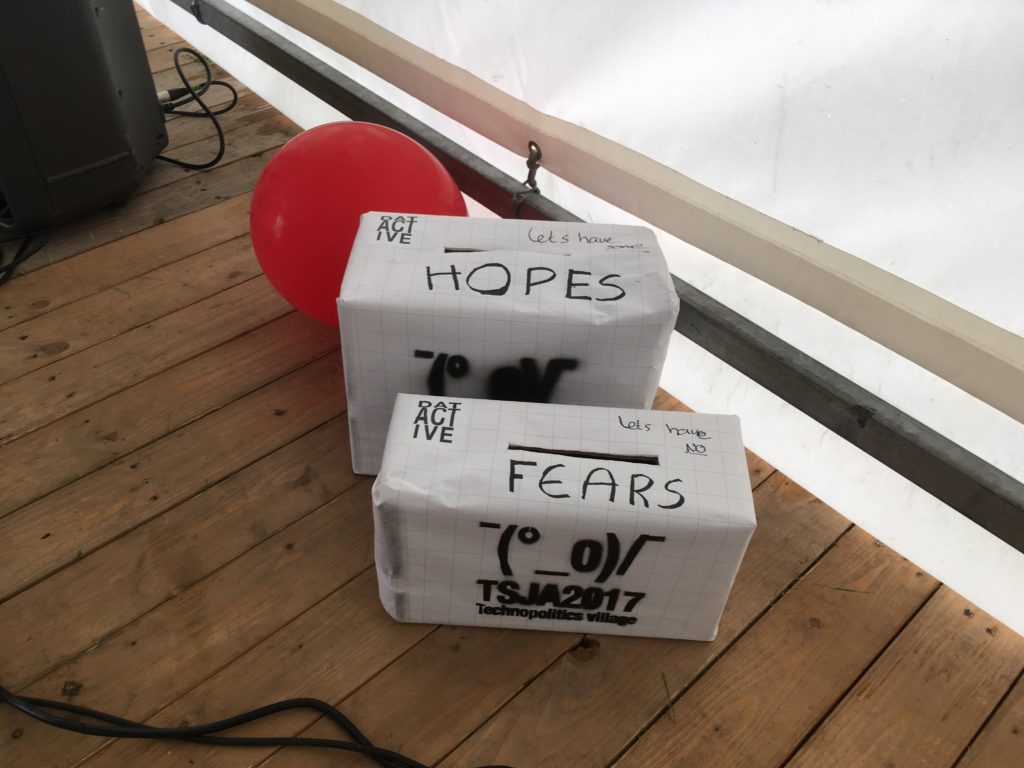
Eager to trigger discussion, we asked ourselves: with this great group of people, why not conduct a small informal survey in the evening hours, exploiting the generally relaxed atmosphere characterizing this moment of the day?

Assisted by a bottle of vodka (to lure into the discussion the more reluctant ;-), we walked around in order to harvest peoples’ “hopes and fears” related to the inexorable process of datafication. After Jonathan Gray, we understand datafication as “[a way] of seeing and engaging with the world by means of digital data” (2016). Its political relevance descends by the fact that “data can also actively participate in the shaping of the world around us” (ibid.). Activists, advocates, techies, hackers and interested citizens are more and more concerned both with the threats and the opportunities that the transformation of every aspect of reality into data brings along. What do people fear the most? What is (if any) their biggest hope?

It is interesting to notice that quite often people would at first have a puzzled reaction: ‘What do you exactly mean?’ and ‘isn’t there a neutral-answer option?’ were frequent instinctive responses. However, while not yet completely fleshed out for the purpose of a poll, the question worked well as a trigger for small discussion and, in many cases, people would then start to recognize quite some fears and hopes they bring, engaging in animated conversations with us.

The fears of SHA participants seem to circulate very much around the general topic of control, and that of prediction mechanisms in relation to algorithms. Pessimistic answers include the recognition that “[those] who control communication (infrastructure) control society”, denote a strict concern for “[people] predicting the wrong answer (or the wrong things)” and the fear “to be categorized” and a to experience a “lack of control over data collection”. The hopes, instead, largely insisted on how blockchain technologies, open data, and hacking might contribute to a more decentralized (and thus controllable-from-below) world.

It must be said that (quite unexpectedly), the hopes outnumbered the fears. To be fair, whereas blunt optimism doesn’t seem to find roots in this community, we have to register some hopeless reactions, as the one whose only hope is that we run out of metal on our planet (and whose fear is that the mining industry might outsource to Mars…).

Overall, the theme of (lack of) control over peoples’ own lives seems to be the red thread. Data (as Kranzberg’s law on technology reminds us) are not good nor bad in themselves -but neither neutral, since who, when, how, and for what purposes gain control over them determines their oppressive or liberating potential. In other words, ‘big data’ are political issues, and people at SHA are much aware of that.

To conclude, two methodological notes. The term ‘datafication’, despite sometimes obscure to the respondents and overly-general for the quite structured question, worked well as a floating signifier to trigger people into discussion about the topic. The vodka, instead, would have worked better with some orange juice next to it -lesson learned.


If you wanna look it up yourself, here is a transcript of both fears and hopes:

Fears on datafication:

  • who controls the communication (infrastructure) controls society
  • centralization will limit knowledge and sharing until control over the population is complete
    lack of control over data collection
  • fascism
  • even if algorithms are neutral, the data they work with are biased
  • to be categorized → filter bubble
  • predict the wrong answer (or the wrong things)
  • self-fulfilling prophecy as a service
  • advancement of face recognition techniques
  • people do not question algorithms
  • they start mining metals on Mars
  • genocide

Hopes on datafication:

  • we run out of metal atoms to share all the data
  • 42
  • blockchain as a technology of socialism
  • societies move in waves like everything in life. Future will require revolution
  • the democratization of mapping data
  • balancing power through open data
  • people learn to question algorithms like they do with politicians
  • new generations will be more aware and hack more
  • It will prove mankind is hopeless
  • helps with daily life
  • that the data is used to solve problems of society
  • it’s just a hype
  • they (doing it) notice they are themselves getting fucked by categorization and negative impact on their lives
  • decentralization through blockchain tech will give us the freedom to reclaim control over communication infrastructures


References

Gray, Jonathan (2016), “Datafication anddemocracy: Recalibrating digital information systems to address broader societal interests”, Juncture, Volume 23, ISSUE 3

[blog] Big Data and Civil Society: Researching the researchers

In March-May 2017, I had the opportunity to join the DATACTIVE project as a research trainee, at the Media Studies Department of the University of Amsterdam. I first met the DATACTIVE team during the 2015 Winter School of the Digital Method Initiative (also at the Media Studies Department, UvA). At the time, we worked on tracing social networks through leaked files, and I very much appreciated the methods they use, and the great care they put into privacy consideration when dealing with people’s data. For these reasons, when I got the opportunity to enroll in a research traineeship abroad as part of my PhD project, I decided to go back to Amsterdam.

My research activities within DATACTIVE focused primarily on monitoring and reviewing the scope of and methods used by other research lab dealing with big data and civil society. More specifically, the aim of this research was to try and understand in which way DATACTIVE can learn from the research projects in question. This task lies at the exact intersection of the DATACTIVE research goals and my own skills and interests. My background bridges across political communication and Big Data: I completed a master in Big Data Analytics & Social Mining at the University of Pisa only some weeks before traveling to Amsterdam.

I analyzed about 23 projects from seven research labs, exploring a multitude of interesting methodologies and theoretical frameworks. It was sometimes challenging for me to deal with the many different aims, methods, and point of views represented in these different projects, but I had the possibility to familiarize myself with tools and methods used in other research labs. In what follows, I provide an overview of the most interesting findings, however hard it might be to do justice to all of them!

What have I studied?

1. Thanks to the Share Lab projects (The Share Foundation located in Serbia) I learned about the importance of meta-data, and how detailed information about people can be retrieved just exploring fragments of data, like mail headers or browsing internet histories (Metadata Investigation: Inside Hacking Team, Browsing Histories: Metadata Explorations).

2. Another research from Share Lab showed how Facebook algorithms work to match people with ads (Human Data Banks and Algorithmic Labour), and how an electoral campaign can be manipulated and dominated on the web (Mapping and quantifying political information warfare).

3. Analyzing projects developed with the CorText platform (set up by LISIS a research project located at Université Paris-Est Marne-la-Vallée in Paris) showed how text can be elaborated upon in a free and easy way to perform a more complex analysis. It can do for instance semantic networks analysis in a bunch of scientific articles (Textdrill), topic extraction and clusterization from newspaper articles (Pulseweb), or geographical clusterization through text analysis (GeoClust).

4. Forensic Architecture (Goldsmiths, University of London) exemplifies how videos, photos, interviews and other kind of (social) data retrieved on the web, could be useful to reconstruct the “truth” in hard-to-reach war scenarios such as the Al-Jinah Mosque case (in which they performed an architectural analysis of a building destroyed in a US Airstrike in Syria on March 16th 2016), MSF Supported Hospital (in which researchers, asked by MSF, tried to understand which national air force, between Russian or Syrian, carried the airstrike), and Rafah: Black Friday in which Forensic collaborated with Amnesty International to reconstruct war operations in Gaza during 1-4 August 2014. It was emotionally challenging to read the reports while keeping an academic distance. This was the case, for instance, in the reconstruction of “the left to die boat” case, a vessel left to drift in the middle of the Mediterranean sea in which sixty-three migrants (seventy-two in total) lost their lives, or the report on what happens in the Saydnaya prison in Syria in which witnesses reported abuses and tortures. These are only some examples of what I encountered during my research.

But this was not a solitary research endeavor. Being involved in all the DATACTIVE discussions, meetings, conferences, and reading groups over the period of three months shed new light on qualitative research in context of “data activism”. For example, we discussed how to code activists’ interviews in terms of research aims and coding methods.

Thanks to the DATACTIVE experience and to the analysis of some projects (i.e. The Snowden Disclosures, Technical Standards, and the Making of Surveillance Infrastructures, Marginalisation, Activism and the Flip Sides of Digital Technologies), I better learned the importance to take care of personal data, and pay more attention to the multiple sides of technologies, which we often take as a black box. I have also reflected extensively on how digital technologies could be of help to a broad range of research activities, starting from simple tasks to perform complex “counter” analysis that allows understanding how the global financial system works (Corpnet, University of Amsterdam) or how a more equal and collaborative economy could be developed (Dimmons, Internet Interdisciplinary Institute, Open University of Catalonia). I am also convinced that all these research and outputs should be known and shared also beyond academia, not only among scholars, for their ability to speak to the world we live in.

I think that the experience and knowledge gained in this research traineeship will definitely add up to my PhD work: entering such a huge field of research has indeed broadened my own perspective on political communication and Big Data. Finally, I really appreciated being part of the DATACTIVE research team and being exposed to their collaborative way of working, and I really enjoyed the cultural and life experience in. I hope to come back.

See you soon.

about Antonio Martella

Antonio is a PhD student at the Political Science Department of the University of Pisa. His research project is focused on political leaders, populism, and social media. He graduated in Business communication and human resource policy and has a postgraduate master in “Big Data Analytics & Social Mining” by the University of Pisa along with the CNR of Pisa.

Featured image: Edward Snoweden WIRED magazine cover on news stand 8/2014 by Mike Mozart of TheToyChannel

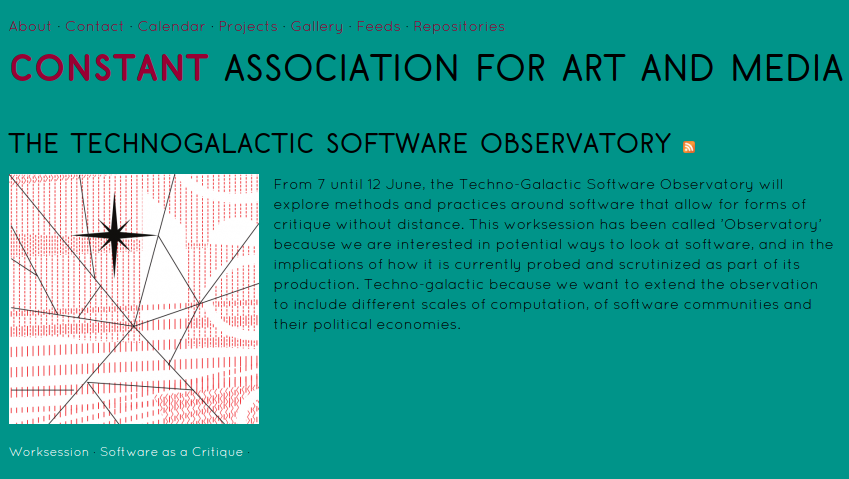
[blog] Techno-Galactic Software Observatory

Author: Lonneke van der Velden


Early June Becky and I participated in the Techno-Galactic Software Observatory, an event organised by Constant, a feminist art and technology collective in Brussels. It was a great event, in which theoretical insights from the philosophy of technology and software studies were combined with practical interventions which ended in an exhibition.

The event aimed to critically interrogate all kinds of assumptions about software and software knowledge. We discussed how software relates to time, spatializations, perspectives, and the hierarchies implied in ways of looking. The last day of the event was a ‘walk-in clinic’ in which visitors could get ‘software-critique as service’ at several ‘stations’.

The project I participated in was file-therapy. Departing from the Unix-philosophy that everything consists of a file (a program is a file, an instruction is a file, etc.), our desk would take people’s problems, understand them in their property of a file. Next, we would transform these files into other file types: visual data or music files.

We would not offer solutions. The idea was that our visitors, by being confronted with their new visualised or sonified file, could start developing a new relationship to this file. For example, one person would have a problem with her PhD-file: it was a big Word-file full of references and therefore difficult to handle. Working in it becomes a hassle. But listening to the transformed file is rather meditative. The other station in the room would criticise the reductionist ´file-formatted’ vision of the world, and in that way, we set up a dialogue about how computers format our lives.


hoij

A comparison of the various problematic files

The observatory was a great event and a learning experience at the same time. Please read other people’s experiences too 🙂


About constant

Constant is a non-profit, artist-run organisation based in Brussels since 1997 and active in the fields of art, media and technology.
Constant develops, investigates and experiments. Constant departs from, feminisms, copyleft, Free/Libre + Open Source Software. Constant loves collective digital artistic practices. Constant organises transdisciplinary worksessions. Constant creates installations, publications and exchanges. Constant collaborates with artists, activists, programmers, academics, designers. Constant is active archives, poetic algorithms, body and software, books with an attitude, cqrrelations, counter cartographies, situated publishing, e-traces, extitutional networks, interstitial work, libre graphics, performative protocols, relearning, discursive infrastructures, hackable devices.

[blog] A RightsCon2017 Post-Mortem: Hot in the digital rights agenda

On March 29-31, three brave members of the DATACTIVE team—Davide, Guillen and Stefania, respectively—descended on the lively city of Brussels to attend RightsCon 2017. The RightsCon Summit Series, organized by the US-based non-governmental organization Access Now, is a yearly event bringing together digital rights activists and practitioners with the tech industry. Brussels 2017 was RightsCon’s 4th edition—earlier editions took place in Silicon Valley (2014 and 2016) and Manila, the Philippines (2015). The rich program of RightsCon 2017 counted 21 conference tracks (!), touching upon a wide variety of subjects that mirrored the complex ecosystem of actors and agendas striving for an open and free internet.

Throughout three busy days of this 2017 edition, we had the chance to mingle with activists, researchers, journalists, the industry and law enforcement gathered to collectively think about the future of the internet. We organized our own panel on ‘Resisting Content Regulation in the Post-Truth Age’ in collaboration with Vidushi Marda from the Centre for Internet and Society in Bangalore, India. The panel opened the track ‘The truth is out there’: full house and lively conversation, bringing together the industry, journalism, academia, and multilateral organizations like OSCE. (What this space: a dedicated post will be online soon!). But we also had two other goals in mind. First, we wanted to take advantage of RightsCon’s ability to bring under one roof people from all over the world, with different backgrounds and distinct visions regarding the interplay between the digital and human rights, to make the best of collective learning and look for potential collaboration. Second, we intended to listen to and collect the voices from various projects and organizations currently working towards a free and open internet—in particular, of course, we wanted to swap thoughts with data activists! While we are still re-elaborating the outcome of these conversations, here we provide some reflections on what bubbles in the great minds participating that gathered this year in Brussels. What were the hot topics of RightsCon 2017?

#1 Fake News Fake News Fake News
Although the topic of fake news was dedicated a conference track of its own, the debate was not confined to those panels alone—rather, it permeated several other discussions, too. This is not surprising given the close connection between this fuzzy notion and other topics discussed at RightsCon, such as algorithms, freedom of expression, openness, and transparency. Interestingly, participants seemed to agree on one starting point: what constitutes ‘fake news’ is extremely difficult to determine, and the very same label should probably be abandoned since neither tech corporations nor governments should decide what constitutes ‘truth’ today. In this sense, although the problem of fake news could be tackled both by platforms themselves (for example, by implementing algorithmic curation) or by state institutions (for instance, by creating regulatory legal frameworks), either solution could easily turn into politically motivated censorship. Our own panel, for one, argued that many amongst politicians, experts and the general public are in fact advocating for the wrong fixes to the problem, e.g. content regulation on and by platforms.

However, we did not leave the conference without any suggestions to tackle such a pressing issue. On the contrary, some of the proposals were actually quite far-reaching. For example, it was suggested that although fake news is not entirely a new phenomenon, they have recently turned into a powerful money-making machine due to the fact that economic incentives promote ‘clicks’ and quantity over quality. How can we promote change in the ‘market’ of the Internet, if we are to prevent the spread of information that is specifically meant to deceive? A second productive approach aims at empowering the user and the citizen: ultimately the problem of false or manipulative information spreading on social media is one of digital literacy. Hence, long-term education, more than algorithmic fixes or regulation, is the key answer to the problem. In sum, the problem is socio-technical in nature (rather than solely ‘social’ or solely ‘technical’)—and thus requires a socio-technical response.

#2 Internet infrastructure between censoring and sensing technologies
The fundamental layer of the digital world we experience is the technological infrastructure of the internet. Two recurrent, somehow complementary themes, which appeared to be central to RightsCon 2017 are internet shutdowns and ubiquitous surveillance technologies. It is interesting to consider them together for two reasons. First, they both bring to the surface the importance of the lower layers of communication technology, in an era dominated by ‘apps’, ‘clouds’ and other intangible metaphors. Second, they represent complementary strategies of politicization of data flows: stopping the flow on the one hand, and somewhat multiplying the flow on the other.
In order to keep the internet free and open, one must first keep the internet running. This is an increasingly serious concern, given the often political use of internet shutdowns, ad hoc censorship and network manipulation, to prevent people getting their news or mobilizing to protest. As an example, some noticed a clear connection between the growth in internet shutdowns and the general increase of activism particularly in South East Asia. Consequently, some initiatives emerge in order to test, monitor and report internet shutdowns and censorship. The Open Observatory for Network Interference (OONI) is a spinoff of the Tor Project, which set the stage for “a global observation network for detecting censorship, surveillance and traffic manipulation on the internet”. Another brilliant project along these lines is TurkeyBlocks, which monitors “wide-scale internet slowdown and shutdown incidents using a combination of digital forensic techniques”, with a focus on the delicate Turkish situation.

Next to censoring, another much-debated theme is that of today’s omnipresence of sensing technologies. Alongside the many promises of simplifying life and empowering people, the so-called Internet of Things (IoT) is bringing surveillance technology literally in every corner of our daily life. While activists (and sometimes governments and companies, too) advocate for “privacy-by-design”, the IoT is objectively promoting “surveillance-by-design”. Moreover, especially with the advent of smaller companies in the market, these technologies present not only a higher number of vulnerabilities, but also kinds of vulnerabilities that can hardly be patched, thus representing a permanent threat to individual and group privacy. Consequently, one should not only focus on whether or not this technology is currently used by government to spy on citizens; the urgent need to regulate the market of surveillance products comes from their potential uses, as it is impossible to anticipate their trajectory from country to country, from government to government, and from present to future uses.

#3 Digital Rights in the Global South
Nowhere else in the world is the number of internet users growing more than in the Global South. Unfortunately, this positive trend is usually not adequately accompanied by the creation or reinforcement of the necessary legal frameworks to protect digital rights. Many activists at RightsCon 2017 shared the problems they face when defending their privacy, resisting surveillance and generally struggling to exercise their rights in the Global South. On a positive note, however, the creativity abounds. In Brussels, activists shared the strategies they use to make their voices heard by both states and corporations. A cluster of Latin American organizations emerged, where groups and individuals are pushing for a regional strategy for the defense of digital rights since they have identified that not only the challenges they face are similar, but also that the tools available to overcome them can be mobilized at the transnational level. Among the problems highlighted by the attendees to RightsCon was the perception within governments in the Global South that digital rights are a matter for developed countries, which results in a generalized lack of political will to engage with civil society actors to develop adequate policies. In addition to that, there seems to be a strong historical and cultural connection between the exercise of basic rights and personal data collection policies implemented by institutions. Telling examples are Argentina, where a longstanding tradition of identification has produced countless databases with personal information, whose management is unclear and far from transparent, and Venezuela, where citizens need to surrender their biometric information in order to access basic services like food distribution. Among the strategies showcased by activists to address these issues, strategic litigation in national and international courts was presented as one of the most efficient tools to force governments and corporations alike to respect internet users’ rights. Therefore, a few organizations in South America, led by the Fundación Datos Protegidos, are calling for the creation of a regional network for strategic litigation related to digital rights, with the goal of triggering a process of knowledge transfer among peers in different countries.

All in all, RightsCon 2017 was an enriching experience for the DATACTIVE team—and it was mostly due to all the people we got to meet and to the excellent organization (thanks, Access Now!). We would like to acknowledge everyone who dedicated some of his/her precious time to talk to us: you know who you are, See you at RightsCon 2018, in Toronto, Canada!

[blog] Communication and Activism – a research visit to the Center of Social Movement Studies

By Kersti R. Wissenbach, March 2017

This week I returned to the beautiful city of Florence to spend several months with the Centre on Social Movement Studies (COSMOS) located at the Institute of Humanities and Social Science at Scuola Normale Superiore. It is my second visit to the institute and whilst Tuscany is always worth a visit, I did not (just) return for the great weather. Spending time at COSMOS proved to be a very enriching experience given the stimulating environment of like-minded social scientists and particularly a great group of researchers working on the intersection of social movement studies and media sciences –as I do.

As a communication and political science scholar with a background in critical development studies, I am working on the intersection of social movements, democracy, and communication. I am particularly interested in the role of communication in relation to power. During my stay at COSMOS I will advance a part of my theoretical work and finalize an article aiming to (re)introduce the concept of communication, as distinct from media or technology, to the field of social movement studies. I am a huge communication advocate when it comes to social and political change processes, no matter how much attention is given to the potentials of data and new technologies. I will briefly explain why.

There is much blurriness when it comes to the terminology around communication, media, and technology. In the fields of social movement studies and Development Communication much reference is made to media and oftentimes we do not clearly distinct between the terms or we find authors speaking of the use of communication where in fact referring to media as institution or technological infrastructure. Lumping together everything under the media term, however, risks disproportional techno or data deterministic attention whilst underestimating dynamics between activists that might be crucial for how (seemingly) technological interventions play out.

Why is that problematic? Communication is essentially a social practice, based on human interaction and as such relations between people. Where we have human relations and societal interactions we have power dynamics. Those power dynamics ultimately shape activist as much as governance spaces.

My doctoral research deals with what I call civic tech activism -activist groups making use of the abundance of data and new technologies to open up civil society space for direct engagement in formal governance processes and to directly hold government institutions to account. An example would be the community around the freedom of information request tool Alaveteli, which supports citizens willing to exert power over under-performing institutions in currently twenty-five countries. At its core stands a belief in the potential of ICTs and data to support citizens in the exercise of their democratic agency. There has been much attention on the potential of data and technology for governance in recent years, usually looking at platforms and tools that enable governments to open up information or that enable citizens to claim information from governments. Little attention, however, is usually given to power dynamics that emerge and persist within activist communities and thus ultimately shape who is actively engaged in building and practicing mechanisms to hold governments to account or to voice demands to government institutions. So community dynamics – relations, interactions, hierarchies- ultimately affect whose voices are heard, how accessible and accessible to whom respective tools are built, etc.

In consequence, we could say that social practices and relations within activist communities shape social practices and engagement mechanisms between civil society and government institutions. This is why I will deep-dive into communication approaches, mainly those rooted in non-western scholarship, over the coming months. My intention is to provide a conceptual framework that supports a communication driven analysis to social movement dynamics within the governance activism field.

Stay tuned for more!

[blog] The politics of network graphs

Author: Jeroen de Vos, humanities scholar, entrepreneur and research assistant at DATACTIVE.

Schermafdruk van 2017-03-22 10-40-49

How do the graphs above differ? With their different colors, layouts and visual densities, they seem to each adhere to their own unique network. However, as an image they consist of the same kind of materiality: a network plotted in nodes and edges, dots and their connections, actors and their ties. What if I would say they actually present exactly the same network? That would challenge our notion of a network as one uniformly tangible, portrayable, showable and renderable object. This short blogpost will introduce ‘collaborative reading’ as a method to question the affordances these graphs have in a research setting -it reflects DATACTIVE’s quest for more mixed- and interdisciplinary research methods.

Collaborative readings

It builds on a larger research effort to map the Dutch entrepreneurial ecosystem using mixed methods, which combined an analysis of the Twitter-data of Dutch startup entrepreneurs with exploratory semi-structured interviews. In such interviews, I would introduce one of the graphs above to any of the Dutch entrepreneurs in question, together with a descriptive explanation of the method and logic of its production. This would look something like: [Every node [dot] represents a Twitter user account / If one user mentions another, this creates an edge [link] between the two nodes / The more mentions, the stronger the traction between the nodes / The node size represents a number of times the user is mentioned / The colours express statistical communities]. I would leave the floor open to see how the interviewees reacted, and in a follow-up question invite them to interpret the graph for me. Obviously, the process of triangulating the product of social network analyses by providing it to the subject of research is as old as early anthropological attempts to annotate kinship structures through early categorization practices (ie. Anthropologist Lewis Henry Morgan, 1818–1881). However, just giving back a networked representation as a form of consent or reciprocity is different from an actively collaborative reading the graph in question. Internalizing the validation of your methods through the practice of collaborative readings can serve multiple purposes.

Complications

This technique, that is clearly resonating with other naive interview techniques (DeWalt & DeWalt, 2010), helped to flesh out the role of the graph as an actor intervening in the space between the interviewee, the researcher, the Twitter accounts in question, and the colorful dots that represent their contested place in a field of other actors.

  1. The first complication of using these network graphs was the fact that as a researcher, one often has little explanation for the statistical correlations that are continuously rendered in various network plots. Since these networked correlations are not self-evident, every methodological step taken to work towards a single readable visual network can be challenging. The researcher often has little understanding of the underlying mechanism that could either support or discourage a particular way of plotting. This problem coincides with the discussion between social- and data scientists on the question whether data-correlations are self-explanatory, or that we still need a man-made hypothesis to allow structural knowledge gathering (boyd & Crawford, 2012; Burrows & Savage, 2014).
  2. A second consequence of working with these visuals as a means to represent the ecosystem was the constant struggle over readability. With the sheer size and ‘messiness’ of network representations, the collaborative reading consisted of much panning in zooming. It shows the inherent constraints of forcing a (3d) network to be visualized on a small rectangular screen, and other researchers experimented with other ways to plot a network graph, as a poster, a large map on the floor in which actors can be enacted. Nevertheless, the mere size and inclusivity of larger network representations inevitably force to constantly switch, in which the overview will typically be as insightful as the detail.
  3. Lastly, with its graphical inclusivity, many respondents read the networks as some form of entirety. Rather than providing a self-contained overview, the Dutch entrepreneurial ecosystem is produced through a series of very specific sociotechnical criteria. This is the result of many people sending tweets in a particular context, often with an (imagined) audience in mind – data which is re-appropriated for mapping purposes. The subsequential visual representations clearly demarcate one set of actors which evokes an understanding of the entrepreneurial ecosystem which might be somewhat superficial. The graphs float in a void like the contours of a nation-state map. They thereby surpass the idea that any peripheral node is again center of other social networks inherent part of any network analysis.

What ecosystem

Which brings me to my last point, regarding the contribution to entrepreneurial ecosystem studies. The study of ecosystems arose from the socioeconomic economic cluster analyses. From early comparative research comparing the proliferation of (mostly US-based) economic clusters in the 1980s (Saxenian, 1996), the effort to map and understand the entrepreneurial ecosystem infused with the promise to reproduce success (Hospers, Desrochers, & Sautet, 2009; Moore, 1996). This lead to many scholars and experts in the field contributing to case-studies and ideal types (Feld, 2012; Isenberg, 2011). However, the notion of an economic cluster as an ecosystem might be criticized. Drawing on the biological metaphor of ‘a heterogeneous set of interdependent living and nonliving actors’, the ecosystem metaphor is used to denote an inherently closed system in which everything coexists into some form of natural equilibrium. It presupposes the same kind of delimitations that is one of the pitfalls of the network graphs above: in their serenity, they invite to interpret an all inclusive and finalized representation. Instead, this post is meant to invite to think beyond the delimited ecosystem analyses, to be able to create a more flexible framework which can better bare notions of messy, unfinalized and impartial perspectives. What would such a representation look like?

For more information:

See the research website or the full thesis, or simply drop a line using jeroen@data-activism.net

This research project has originally been established with the help of Dealroom and in a collaboration with Digital Methods Initiative [UvA].


References

boyd, danah, & Crawford, K. (2012). CRITICAL QUESTIONS FOR BIG DATA: Provocations for a cultural, technological, and scholarly phenomenon. Information, Communication & Society, 15(5), 662–679. https://doi.org/10.1080/1369118X.2012.678878

Burrows, R., & Savage, M. (2014). After the crisis? Big Data and the methodological challenges of empirical sociology. Big Data & Society, 1(1). https://doi.org/10.1177/2053951714540280

DeWalt, K. M., & DeWalt, B. R. (2010). Participant observation: A guide for fieldworkers. Rowman Altamira.

Feld, B. (2012). Startup communities: Building an entrepreneurial ecosystem in your city. John Wiley & Sons.

Hospers, G.-J., Desrochers, P., & Sautet, F. (2009). The next Silicon Valley? On the relationship between geographical clustering and public policy. International Entrepreneurship and Management Journal, 5(3), 285–299.

Isenberg, D. (2011). The entrepreneurship ecosystem strategy as a new paradigm for economic policy: Principles for cultivating entrepreneurship. Institute of International European Affairs, Dublin, Ireland.

Moore, J. F. (1996). The death of competition: leadership and strategy in the age of business ecosystems. HarperCollins Publishers.

Saxenian, A. (1996). Inside-out: regional networks and industrial adaptation in Silicon Valley and Route 128. Cityscape, 41–60.


[blog] Taking a look at institutional resistance to citizen empowerment

By Guillén Torres

(Image copyright: Bob Mankoff)

To celebrate the 50th anniversary of the Freedom of Information Act (FOIA) in July, 2016, ProPublica, a U.S. nonprofit newsroom, published a long essay titled Delayed, Denied, Dismissed: Failures on the FOIA Front, in which several journalists detailed their frustrating experiences when requesting government data from U.S. institutions. In the comments section of ProPublica’s website, a reader captured the general feeling of the article as follows:

“To summarize: byzantine internal processes governed by antiquated laws operate with insufficient resources and no sense of urgency or accountability, and are shepherded by sometimes incompetent or dishonest public servants to produce documents that often have self-serving redactions or outright denials (sic)”.

This grim picture of the U.S. Government’s openness -with recent concerns related not only to Trump, but also Obama– is not an isolated case, unfortunately. Around the world, other governments have been accused by journalists and activists of discursively pushing openness forward, despite effectively making the use of government data difficult. For example, the Mexican government takes pride in having one of the most advanced transparency legislations, yet is currently discussing a new General Archives Law that will leave in the discretional and unaccountable hands of the Ministry of Interior the decision of what information should be preserved, and hence what data exists to be accessed. Moreover, the federal government is still struggling to make a buggy National Transparency Platform work, almost a year after it was presented as the main tool to guarantee Mexican citizens’ right to information. In the opposite side of the world, India’s recent public consultation to draft its License for Open Data use ended with a blatant disregard of the advice given by citizens, producing a regulation that does not offer any warranty against errors or omissions in the data held by the government, and transfers the liability for misuse to the citizens (instead of the data controller).

These examples point to the existence of a reactive process to citizen empowerment, in which some governments have found institutional ways to resist civil society’s access to data, hindering its ability to influence political processes. The research I will be conducting within the DATACTIVE project aims to locate empirically and frame theoretically this institutional reaction to citizen empowerment, to describe how it influences the configuration of the power relation between the State and citizens, and more broadly, how it affects the practice of data activism. To do so, I will start with a question originating in my own experience as an activist in Mexico: what if institutional resistance to public use of data is a political strategy, instead of the result of non-political flaws in the regulation related to Government Data?

By not taking for granted the State’s compromise to openness, I will explore whether the sociomaterial practices related to the production, dissemination and use of Government Data might make possible not only the empowerment of citizens, but also the State’s monopoly over some political issues which, according to the ideals of modern democracy, should be subject of collective discussion. The point of departure will be the work of proactive data activists who, while looking to mobilise Government Data to strengthen their attempts to influence public policy or oversee governmental action, have struggled to get the information they seek. In a second stage, I will look at how institutional actors deploy their resistance strategies, tracing the regulatory and material components involved in the process. Finally, I will develop a similar analysis over the strategies used by activists to counter institutional resistance. In the process, I hope to contribute to the study of the role played by data in configuring the power relation between citizens and the State in the age of Open Government, as well as helping to identify (and ideally produce) formal and informal mechanisms that activists can implement to keep rogue institutions under citizen control.

I am always interested in hearing about instances where public institutions do not follow through on their claims of making data effectively open and accessible to interested activists. If you have any examples or experiences, please drop me a line: guillen@data-activism.net